Immersive Room Cost in the UK: Budget Ranges and What Drives Them
Immersive Room Cost in the UK: Budget Ranges and What Drives Them
Immersive room cost in the UK runs from about £5,000 for a single interactive floor or wall to £260,000 or more for a four-wall 360 degree suite. Most fitted rooms in schools and hospitals land between £10,000 and £50,000. The number of surfaces you light up, and the content you put on them, decides where yours falls.
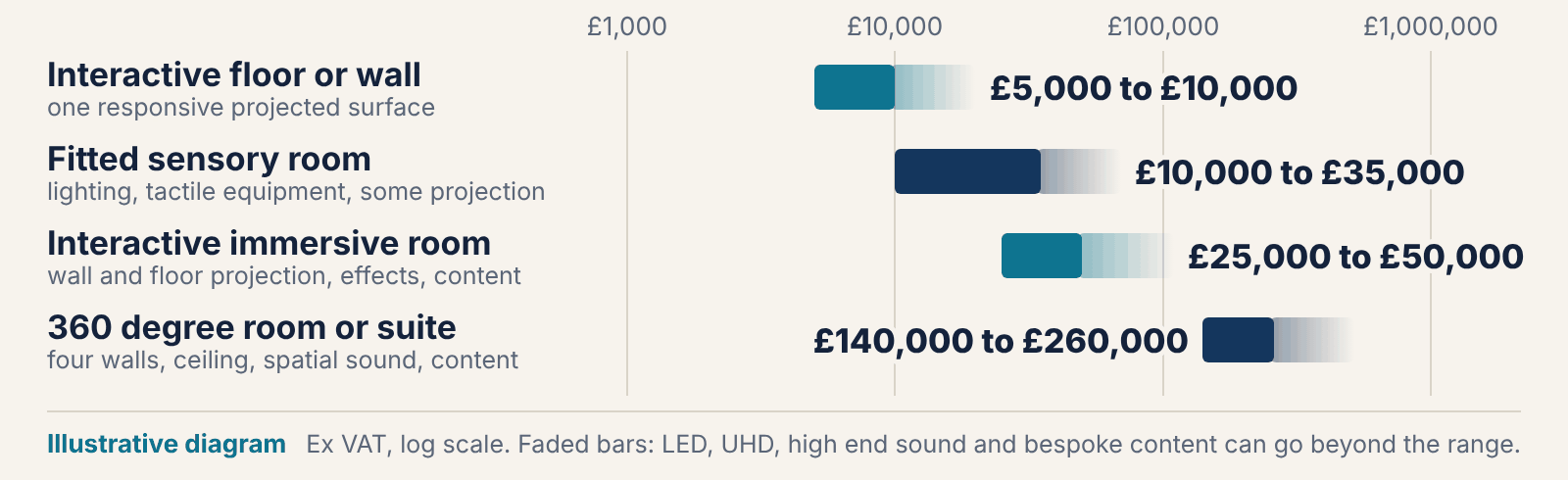
These are the ranges we’d plan around at the start of a project. They’re informed by published UK contract awards, grant announcements and supplier price lists from 2022 to 2025, and they suit projection based rooms with standard content. Choose LED surfaces, UHD, high end sound or bespoke content and a room can go well past the top of its range.
Immersive room cost in the UK by type of room
Most projects fall into one of four types. The edges overlap, because a large sensory room and a small interactive room can cost about the same.
| Type of room | What you get | Planning range | Goes beyond when |
|---|---|---|---|
| Interactive floor or wall | One responsive projected surface in a room you already have | £5,000 to £10,000 | The area is large or the content is bespoke |
| Fitted sensory room | Lighting, tactile equipment, sound and some projection for calm and play | £10,000 to £35,000 | The fit-out is extensive or the equipment is specialist |
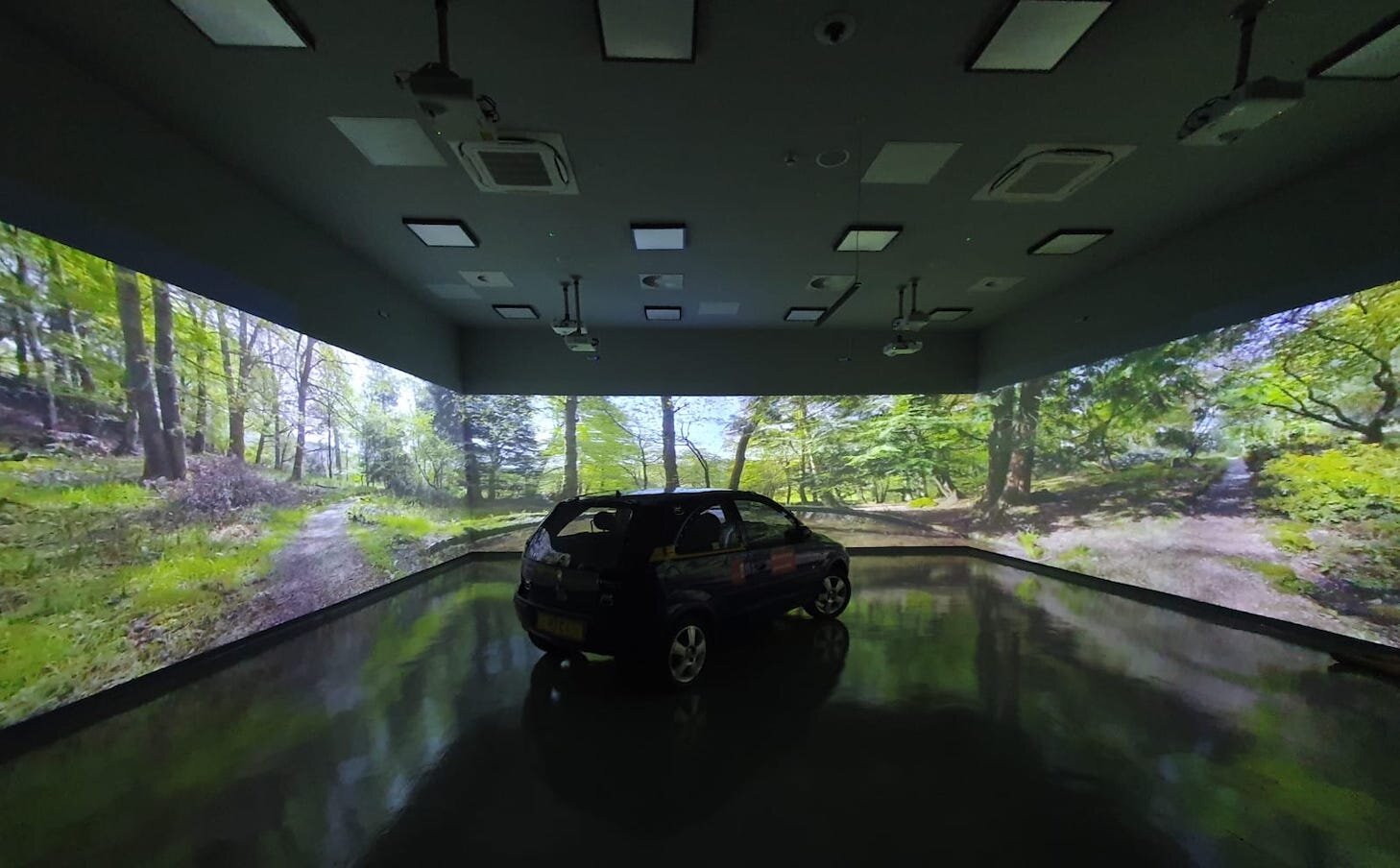
| Interactive immersive room | Wall and floor projection, motion tracking, sound, effects and a content library | £25,000 to £50,000 | A third wall, higher resolution or richer effects are added |
| 360 degree room or suite | Four walls and a ceiling, blended projection, spatial sound, content and training | £140,000 to £260,000 | LED surfaces, UHD or bespoke content are specified |
The top of each range is where you start paying for the extras covered below: extra surfaces, richer sound and effects, and content made to measure.
Rooms between about £50,000 and £140,000 do exist, but far fewer are published and the spread is wide. We’d want to survey the space before putting a figure on one.
We assume each range covers equipment, installation, commissioning, basic content and training, and excludes VAT. Building work, bespoke content and long support contracts come on top. Some of the evidence is public, such as a Welsh health board’s announcement of a wall and floor room in a children’s emergency department and a university’s tender notice for an immersive suite. Single jobs make poor yardsticks, because scope and VAT differ too much between them.
Why immersive room cost climbs as you add surfaces
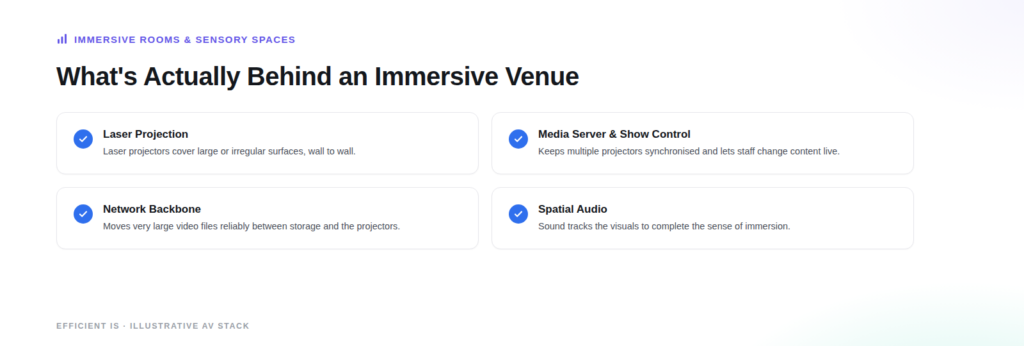
The biggest single driver is how much of the room you light up. A floor needs a projector and a sensor. Add a wall and you need more projection, alignment with the floor and content cut to fit both. By the time you reach four walls and a ceiling, you’re blending the edges of many projected images so they read as one, driving them from a media server, and keeping them aligned as the building settles and the lamps age.
Each surface usually brings another projector, more processing and more time on site, and the content has to be made to fit it.
Interactivity is a separate step. Motion and touch sensing needs sensors calibrated to each surface, plus software that reacts to them. A reactive floor feels obvious to a child and takes careful calibration to build.
Our view: if the budget is tight, do two surfaces well. Four thin ones rarely feel immersive.
How the display choice changes immersive room cost
Most rooms in the ranges above use projection, and the display is the first place immersive room cost can jump. Projection is the cheapest way to cover a large area, but it needs controlled light for the image to hold up. LED surfaces stay bright in daylight and people can stand close to them. They cost more per square metre, and the price climbs as the pixel pitch gets finer. Our post on LCD versus LED cost explains why.
Resolution adds its own bill. A UHD image has four times the pixels of Full HD, so the media server, the signal path and the content all have four times as much to handle. Use LED or UHD across a whole room and you’ve left the ranges above behind.
A middle path is projection for the large surfaces and LED or a high resolution display for one close-up surface, such as a touch wall. Ask for both to be priced and see what the difference does to immersive room cost.
Sound and effects are where budgets stretch
Audio is easy to under-budget, and it can add more to immersive room cost than people expect. A calm sensory room needs quiet, even sound from a few well placed speakers. A 360 degree room where sound moves around the audience needs many more speakers, a processor that places sound in space and acoustic treatment so the room doesn’t blur it. High end spatial audio is one of the quickest ways to push a room past the top of its range.
Lighting and scent or wind effects follow the same logic. Each is more equipment, more cable and more programming. All of it should run from one control point so staff can start a session without calling a technician, and every effect has to be programmed and tested before the room opens.
Decide which effects earn their place with your users. In SEN and care settings, controllable lighting and quiet, predictable sound often matter more than spectacle.
The room itself adds to immersive room cost
The kit goes into a room, and the room has to be ready for it. Projection needs controlled light, so blackout and lighting control come first. Floor projection needs a surface that’s hard wearing and light enough in colour to take an image. Projectors give off heat and their fans make noise, so cooling and acoustic treatment matter, especially in quiet rooms. All of it needs power and data where the equipment sits, and ceiling mounts that can carry the weight.
Layout is also a safety question, since doors and walkways must stay clear. Our post on immersive room safety covers flashing content and how people get in and out.
Some quotes include room preparation and some assume someone else will do it. Ask which, because it can be the difference between a quote that looks cheap and one that’s complete. Building work is often its own budget line with its own contractor, so get it priced early.
What it costs after the room opens
The day the room opens is the start of the spending. Content comes first. A ready-made library gets you running quickly, while bespoke scenes cost more to make and more to change. Ask who owns the content, who can add to it and whether there’s a licence fee each year.
Software needs updating. Projector lamps or lasers age, filters clog and floor sensors drift out of calibration. Someone has to clean the lenses, replace parts and answer the phone when a session is about to start.
Nobody can give you one honest annual figure, because it depends on how many projectors the room has, the content licence and the level of support you choose. We’d plan on a five year view and ask every bidder to price it. Our support and maintenance service covers installed AV, and the same four questions apply to anyone who’ll look after your room: who replaces a failed projector, how fast, who updates the content and what a call-out costs.
How to set an immersive room budget
Before you ask for prices, decide what immersive room cost means for your project: the one-off figure or the total over five years. Then start with who’ll use the room and what you want them to get from it, and pick the type of room from the table. Measure the space, note the ceiling height and the windows, and find out what power and data are already there.
Decide which extras can wait, and whether your budget includes VAT, because our ranges don’t. Most systems can add a surface or an effect later if the design allows for it, so ask for that.
Ask for an itemised quote over five years, with each cost on its own line.
Look into funding early. Schools and hospitals have paid for rooms through public grants, charity match funding and local authority money. For specific users, see our guides to immersive rooms for SEN schools and for dementia care.
How Efficient IS prices an immersive room
Efficient IS is a Glasgow AV and IT integrator. We design, procure, install and support the whole room, and we’re independent of any single manufacturer, so a proposal follows your brief. That lets us compare projection and LED on the same room and show what the extra money buys.
Eligible public bodies can buy through the Scotland Excel audio visual framework, where we’re an approved supplier. Our certifications include ISO 9001, ISO 27001, ISO 14001 and Cyber Essentials, which public sector buyers often ask for. Our immersive rooms page shows what we build.
Because we install and support what we design, we set support out as its own line from the start, and each option gets a separate price so you can see what a choice costs. If a cheaper option won’t meet your brief, we’ll say so.
Start with the basics: the room, who will use it and your budget. From those we can say which type of room you’re in and what the quote should include.
FAQ
How much does an immersive room cost in the UK?
From about £5,000 for a single interactive floor or wall. A fitted sensory or interactive room usually lands between £10,000 and £50,000, and a four-wall 360 degree suite runs from about £140,000 to £260,000 or more. The number of surfaces and the display choice account for most of the difference.
How much does a sensory room cost?
Expect £10,000 to £35,000 for a fitted sensory room with lighting, tactile equipment and some projection. A basic corner can come in under that, and a large custom room with padding can pass it. Building work is often separate.
Why does a 360 degree room cost so much more?
Four walls and a ceiling mean many more projectors, more blending and calibration, a media server and content made for every surface. Rooms at that scale also tend to include training and support, so immersive room cost ends up several times that of a wall and floor room.
Does LED cost more than projection for an immersive room?
Yes, per square metre. LED earns its price where the room can’t be darkened, where people stand close to the surface or where you need extremely bright images.
What does an immersive room cost to run?
There’s no honest single figure, because it depends on the number of projectors, the content licence and your support level. Plan for content licences, lamp or laser replacement, calibration and a support contract, and ask each bidder for a five year total.
How do I compare two immersive room quotes?
Get both bidders to price the same room over the same five years, with equipment and installation on separate lines from content, training and support. Check who pays for room preparation, and how each quote treats VAT. Our ranges exclude it.
Pricing up an immersive room?
Send us the room, who’ll use it and your budget band, and we’ll tell you which type you’re in and what the quote should include.