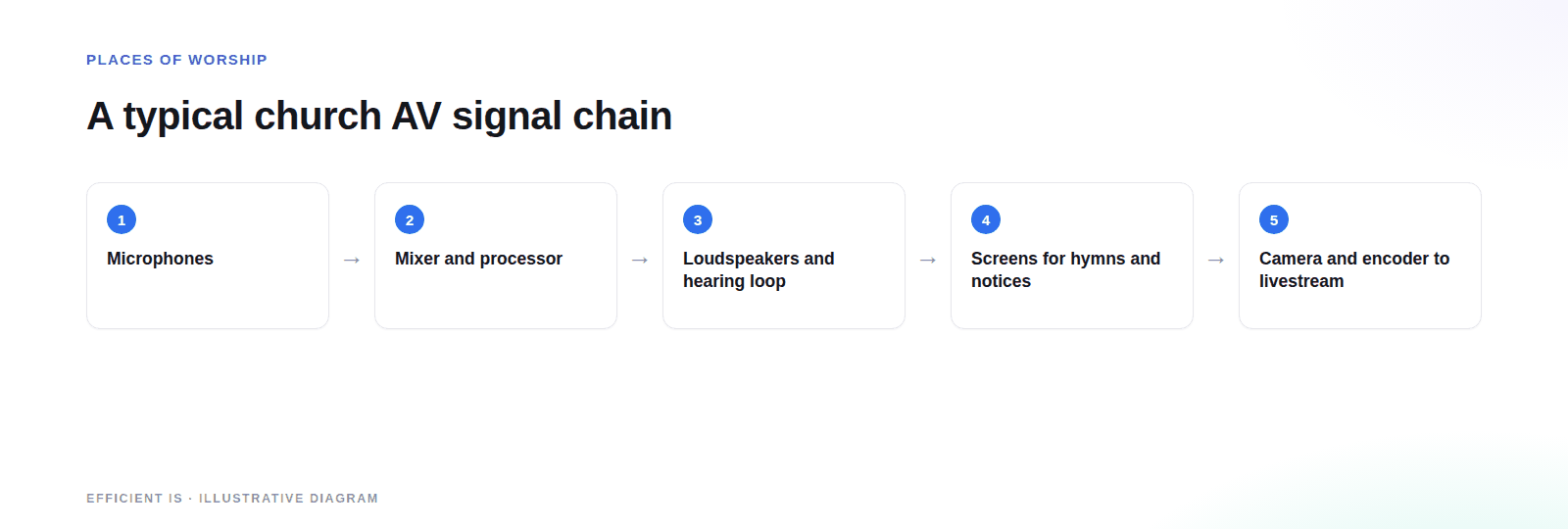
Church AV covers sound reinforcement for buildings with a long echo, hearing loops, screens for hymns and notices, and livestreaming of services. Efficient IS specifies and installs it across the UK for churches, chapels and other places of worship. We keep it discreet in historic buildings, and simple enough for volunteers to run on a Sunday.
Speech and music that is clear from every pew, a hearing loop, and screens for hymns, readings and notices placed so they’re visible without dominating the building.
The hall is used by the congregation on Sunday and the community all week. A simple room that works for a toddler group, a funeral tea and a committee meeting, based on our meeting room AV approach.
A camera or two, clean audio and a way to send services out live for people who can’t attend. Our event, venue and streaming AV work covers the same ground.
Stone, glass and high ceilings do bad things to speech. The answer is rarely a bigger amplifier.
In a long-reverb space, sound bounces around and smears, so turning it up makes speech worse. The better answer is loudspeakers aimed at the congregation and kept off the walls, positioned close to listeners, with delay where the room is deep. We survey the room before we choose speakers.
Sunday’s operator may be a teenager, a retired engineer or whoever turned up. We set up presets for the services you run, such as a normal service, a wedding or a funeral, behind a clearly labelled touch panel. Where possible the microphones are mixed automatically, so nobody’s riding faders.
Many places of worship fund AV from donations and grants, in stages. We design the infrastructure once, including cable routes and rack space, so phase one can be sound and a loop, phase two screens and phase three streaming, without ripping anything out. Our design consultancy can produce a phased plan to support a funding application.
Slim column speakers can be finished to match the stonework, cables can follow existing routes and fixings can be minimal and reversible. We raise permissions with you at the start, because whoever manages your building’s consents needs to be involved before we order a single speaker.
An induction loop sends the sound straight to a hearing aid set to its telecoil, cutting out the room. The current standard for loop performance is BS EN IEC 60118-4:2015+A1:2018, Induction-loop systems for hearing aid purposes. System performance requirements, covering field strength, frequency response and noise. A loop should be measured against it when it’s installed, rather than switched on and assumed to work.
The Equality Act 2010 puts a duty on service providers to make reasonable adjustments for disabled people, including providing auxiliary aids; see section 20 of the Act. Whether it applies to your activities, and what’s reasonable, is a question for your own adviser, but a loop is the adjustment most congregations look at first.
Camera positions matter more than camera quality. We aim to frame the minister, the lectern and the music group, and keep the congregation out of shot unless people have been told and are comfortable with it.
Check your music licences cover streaming before the first broadcast. A clear sign at the door and a seating area out of shot is basic courtesy.
A small chapel and a large reverberant church need very different speaker coverage.
Cable routes, fixings and finishes that protect the fabric take more time and sometimes more specialist hardware.
Loop cost depends on the area covered, and metal in the floor can complicate things.
A large screen or projector seen from the back of the nave needs to be sized for distance and ambient light.
One fixed camera and audio feed is a modest project. Several cameras with remote control and a mixer is a larger one.
Staging the work spreads the cost, and a care plan keeps things working after the volunteers who installed the first system move on.
Prefer to talk it through? Call 0845 095 3600 or email av@efficient-is.co.uk. We’ll give you a straight answer, not a sales script.
A survey of the building, a conversation with whoever runs the sound on Sunday, and phased budget options.
Procured through our manufacturer and distributor relationships, or your framework of choice.
Delivered by our engineers in Scotland, or a vetted local partner, anywhere in the UK, with work planned around services, weddings and funerals. Every system is tested before we call it done.
Plain-English guides, hands-on training for your volunteers and optional care plans for when someone moves away.
Usually reverberation. Hard surfaces and high ceilings keep sound bouncing around long enough to blur the words, and turning up the volume makes it worse. Normally the fix is better loudspeaker placement and processing, and a survey will tell you which.
There’s no blanket rule, but the Equality Act 2010 puts a duty on service providers to make reasonable adjustments for disabled people, including auxiliary aids, and a loop is the usual first thought for people who use hearing aids. Whether the duty applies to you, and what’s reasonable, depends on your activities, so take advice. We can specify and supply a loop and test it against BS EN IEC 60118-4.
Generally, with care. We use reversible fixings and existing cable routes where possible, finish speakers to blend in and raise permissions with you at the start. Build time for consents into your plan.
Yes. A fixed camera, clean audio from the mixer and an encoder is often enough, and it can be extended later. We’ll also cover framing, privacy and licensing so the first broadcast doesn’t cause problems.
That’s the design aim. Presets for each type of service, clear labels, automatic microphone mixing and a one page guide mean someone new can run a normal service after a short handover.
You can. We design the cabling and rack space once and add elements as funds arrive, typically sound and a loop first, then screens, then streaming.
It can. The government’s statutory guidance lists places of worship among premises in scope where 200 or more people, including staff and volunteers, can reasonably be expected at once from time to time. Places of worship stay in the standard tier however large they are. The main duties haven’t commenced yet. Our Martyn’s Law readiness page covers the communication side.
Tell us the building, how you use it and who runs the sound, and we’ll tell you what’s realistic.








Find our work useful? Add us as a preferred source on Google.