
Outdoor Advertising & Building Displays: Advertising that works outdoors, not just in a showroom demo.
Direct sunlight, rain, wind loading and years of unattended operation are a completely different design problem to an indoor screen. Building-mounted LED, freestanding totems and large-format outdoor displays, specified for the site they’re actually going on.
Built for the room, not the showroom
Building & facade LED
Large-format LED mounted to a building exterior, brand presence and advertising revenue, visible from the street or a main road.
Freestanding totems
Forecourt, retail park and campus totems, directional, brand and promotional content that doesn’t depend on a building wall being available.
Large-format window & storefront
Bigger and brighter than a standard shop window screen, built for high footfall retail parks, flagship stores and transport hubs.
Why brightness, pixel pitch and the video processor matter more outdoors than anywhere else
An outdoor display has to win against direct sunlight, run unattended for years in the weather, and stay legible from a moving car, none of which an indoor screen ever has to deal with. Getting these choices right up front is the difference between a display that still looks sharp in year three and one that’s already been written off.
Brightness & sunlight readability
A typical indoor commercial display runs at 400 to 700 nits. Direct sunlight needs several times that, outdoor LED is usually specified from 4,000 nits upward, with an automatic ambient light sensor to dim it back down at night rather than dazzling passers-by. Getting the brightness spec right the first time is one of the basics we build into every Outdoor Advertising & Building Displays project, rather than a figure picked off a generic data sheet.
Get this wrong and the symptom isn’t subtle: the display simply washes out and becomes unreadable every time the sun’s on it, which for a street- or road-facing site can be most of the working day.
Weatherproofing & unattended operation
An IP65-rated (or better) sealed cabinet, proper drainage, a wide operating temperature range and conformal-coated electronics are what let an outdoor display run for years without a service visit, this isn’t an indoor panel in a weatherproof box, it’s built differently from the ground up.
Structural and wind-load calculations matter just as much for a building-mounted display as the display itself, we factor this in at design stage, not as an afterthought once the panels have already been chosen.
Pixel pitch and viewing distance
Pixel pitch, the distance between LED clusters, in millimetres, decides how close an audience can stand before the image stops looking sharp. As a rule of thumb, minimum comfortable viewing distance in metres is roughly the pixel pitch in millimetres, so the right pitch depends entirely on how far away most of your audience actually is.
A facade display read from across a street or a main road can use a coarser, more cost-effective 6 to 10mm pitch; a forecourt totem viewed from a car park at closer range typically wants something finer, in the 3 to 5mm range, to stay crisp.
Why the video processor is doing the real work
The video processor driving the display is what actually makes it useful day to day, scheduling and rotating content without a laptop plugged in on-site, keeping a multi-panel facade display in sync so it reads as one image rather than a grid, and providing input redundancy so one fault doesn’t blank the whole display during a paid advertising slot.
This is also what makes remote content management possible, updating what’s showing on a totem or facade display from anywhere, rather than sending someone out with a USB stick every time a campaign changes.
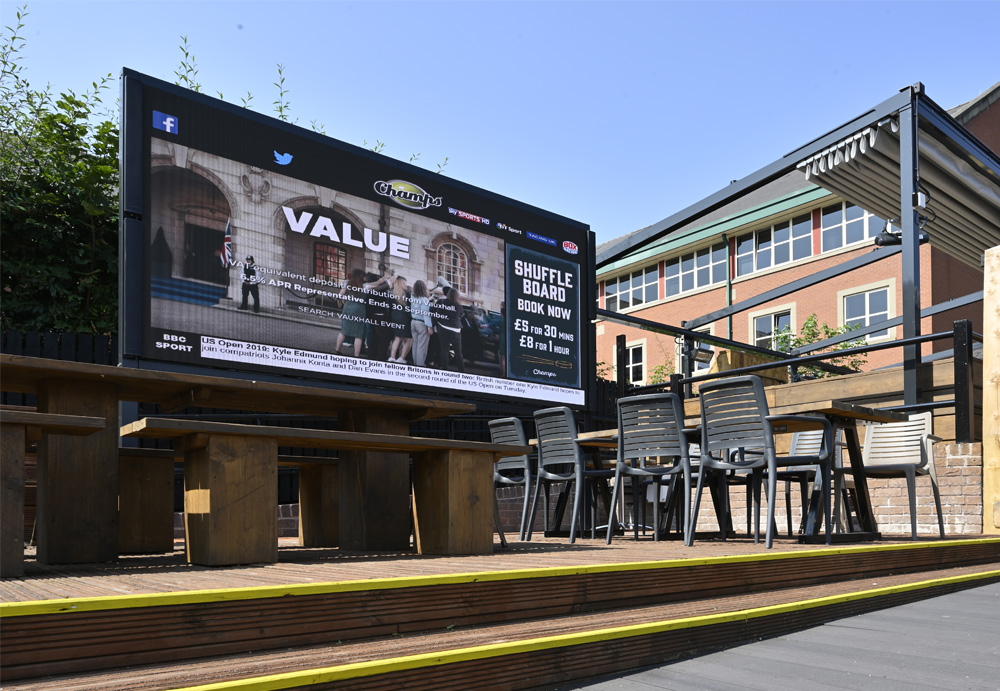
What an outdoor display actually changes
Beyond “it looks impressive from the street”, the practical reasons a building or forecourt display earns its budget.
Engagement
A bright, moving facade display or forecourt totem catches attention that static print or a lit sign simply can’t, and holds it long enough for a message, offer or piece of wayfinding to actually land with drivers and passers-by.
Innovation & advertising revenue
Building-mounted LED can generate its own advertising revenue as a media site in its own right, not just serve as brand signage, turning what was previously a blank wall or forecourt into a genuine commercial asset. That revenue angle is increasingly why organisations come to us for Outdoor Advertising & Building Displays in the first place, not just for the visibility.
Cost & environmental efficiency
One remotely-managed content platform replaces the print-produce-install-replace cycle of static banners and posters, no wasted print stock every time a message changes, and no site visit needed to swap it. Modern outdoor LED is also considerably more power-efficient per m² of bright, legible surface than the previous generation of illuminated signage it typically replaces.
What outdoor advertising & building displays costs
Indicative ranges, supplied and installed. Every project is scoped individually, this is a starting point for budgeting, not a quote.
| Configuration | Typical use | From |
|---|---|---|
| Outdoor DV-LED, building-mounted (per m²) | Facade or wall-mounted advertising display | From £2,100 +VAT |
| Freestanding outdoor totem | Forecourt, retail park, campus | Quoted individually |
| Large-format outdoor window display | Flagship retail, transport hubs | Quoted individually |
| Structural & weatherproofing survey | Any outdoor installation | From £450 +VAT |
Public sector and education purchase orders accepted.
Prefer to talk it through? Call 0845 095 3600 or email av@efficient-is.co.uk: we’ll give you a straight answer, not a sales script.
Design, supply, install, support, one team throughout
Design
Site survey and requirements gathering, technology recommendation and budget options.
Supply
Procured through our manufacturer and distributor relationships, or your framework of choice.
Install & commission
Delivered by our engineers in Scotland, or a vetted local partner, anywhere in the UK, every system tested and calibrated before we call it done.
Handover, training & support
Formal handover and documentation, hands-on training for your team, and optional ongoing care plans.
Built and tested off-site, live the same day
A City Centre Outdoor Kiosk, From Warehouse to Live in One Day
A freestanding outdoor LED kiosk in Dundee city centre, built and fully tested in our own warehouse, craned into position on site, and running live content the same day, no return visit needed to finish the job.
Read the case studyAssembling and proving the enclosure, LED module and network connection off-site first turns a city centre install into a single lift-and-connect operation, rather than a multi-day build in a busy public space.
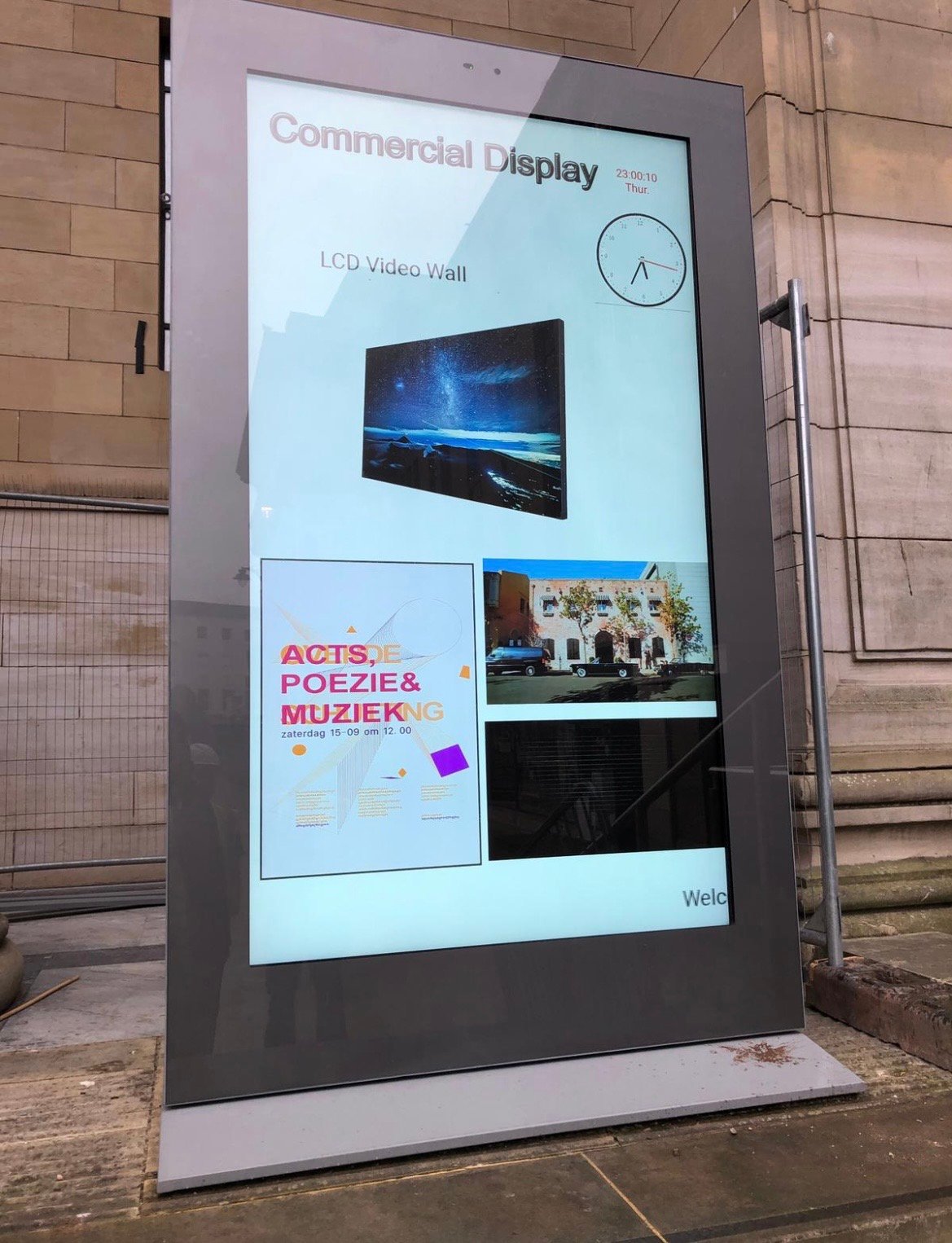
Lanark Memorial Hall: Outdoor Screens the Venue Manages Itself
Multiple outdoor LED screens across one site, confirmed legible from full daylight through dusk to complete darkness, all run from a content management system and server rack the venue controls itself.
Read the case studyA single CMS, backed by an on-site server rack, scheduling and managing content across every screen on the network, so the venue updates listings itself rather than raising a support ticket for every routine change.
Outdoor Advertising & Building Displays: Answered Plainly
What’s actually different about an outdoor screen versus an indoor one?
Brightness, first, an outdoor display needs to stay legible in direct sunlight, typically several times brighter than an indoor screen. Then weatherproofing (IP-rated housings, drainage, operating temperature range), structural loading (wind is a real engineering factor on a building-mounted display), and serviceability, since you can’t just walk up and swap a panel the way you can indoors.
Do we need planning permission?
Often yes, particularly for building-mounted advertising displays and larger totems, this varies by local authority and whether the display is classed as advertising under planning law. We’ll flag this early in the design process rather than let it surprise you after a system’s been specified.
How does a totem compare to a building-mounted display?
A totem doesn’t depend on having a suitable building wall or facade available, and can be positioned exactly where footfall or sightlines are best, a forecourt entrance, a retail park approach road. Building-mounted LED usually covers more area for the same footprint and can double as a genuine architectural feature, not just a screen bolted to a wall.
Can this connect to the same content system as our indoor signage?
Yes, where it makes sense, outdoor displays run on the same content management platform as indoor digital signage, so one team can manage messaging across an entire estate rather than treating outdoor as a separate system.
Have a project in mind?
Tell us the room and the outcome you need, we’ll tell you what’s realistic.









Find our work useful? Add us as a preferred source on Google.