
Immersive Experiences: What UK Museums and Venues Are Actually Building
Frameless in London and the touring Van Gogh immersive shows get the headlines, but the AV behind them is the same technology, scaled up, that is now reaching smaller museums and galleries across the UK.
Visitor appetite for immersive experiences is a real, measurable trend rather than a marketing phrase. The Association of Leading Visitor Attractions reported UK visitor numbers at the country’s most popular attractions rose again in 2025, with the Natural History Museum the most visited attraction in the UK, and attendance generally continuing a steady climb back toward pre pandemic levels. Against that backdrop, immersive projection has moved from a one off novelty to a genuine category of its own, covered consistently by attractions trade press as one of the defining trends shaping the sector heading into 2026.
The permanent installation: Frameless, London
Frameless at Marble Arch is the clearest UK example of a permanent, purpose built immersive venue: four galleries of floor to ceiling, wall to wall projection showing more than a hundred digitised artworks, widely reported as the UK’s largest permanent immersive art installation. It demonstrates what a venue looks like when immersive projection is the entire proposition rather than an add on to an existing collection, and it has become a reference point for the whole sector.
The touring format: immersive Van Gogh shows
A different, more accessible model is the touring immersive exhibition, with Van Gogh branded immersive projection shows appearing in multiple UK cities including London and York. These use the same underlying projection mapping technology as a permanent venue, but in a format that can move between cities, which matters for any venue thinking about return on a smaller capital budget than a dedicated building allows.
The integrated gallery: museums adding digital layers
The third model, and probably the most relevant for most UK museums and galleries, is adding immersive or digital elements inside an existing collection rather than building a dedicated space. The National Gallery launched new digital experiences for its two hundredth anniversary, including a dedicated digital project built with a specialist studio. The British Museum has introduced immersive digital exhibits under its own Journey branding. The National Science and Media Museum in Bradford refreshed its Sound and Vision galleries with new interactive displays. Each of these treats immersive and interactive technology as one more tool inside an established visitor experience, which is a realistic model for most venues that do not have Frameless sized capital budgets.
The technology underneath
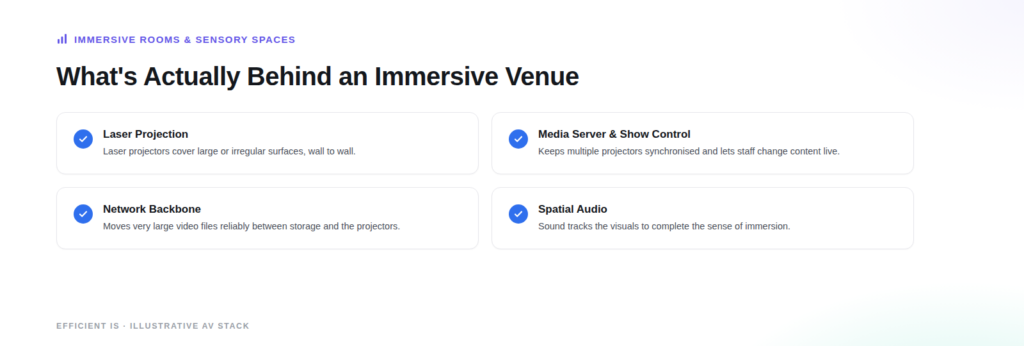
Whichever model a venue chooses, the AV backbone is broadly consistent: laser projectors capable of covering large, often irregular surfaces, a media server and show control system that keeps multiple projectors synchronised and lets staff change or schedule content, and a network backbone that can move very large video files reliably between storage and the projectors. Panasonic and Christie both supply laser projection technology used in UK immersive venues, Barco is active in projection mapping specifically, and UK based specialists including Igloo Vision build modular immersive rooms that smaller venues can install without a Frameless scale construction project. Because none of this technology is proprietary to one supplier, a brand agnostic integrator can genuinely match the specification to the venue’s budget and building, rather than starting from one manufacturer’s product range.
What this means for a smaller venue
None of this requires Frameless sized ambition to be worth doing. A single wall, a corner of an existing gallery, or a touring style show rented for a season are all genuine, lower cost ways into the same category, and all use the same underlying technology as the largest installations, just at a smaller scale.
See our Immersive Rooms and Sensory Spaces page, or read our plain English guide to what an immersive room actually is if you are starting from scratch.
FAQ
Do we need a dedicated building to do an immersive exhibition?
No. A permanent venue like Frameless is one model, but a touring exhibition format, or adding immersive and interactive elements inside your existing galleries, both use the same underlying technology at a much smaller scale and cost.
Is visitor interest in immersive experiences actually growing, or is this a fading trend?
The data points toward genuine, ongoing growth rather than a fad. The Association of Leading Visitor Attractions reported rising visitor numbers at the UK’s most popular attractions again in 2025, and immersive experiences have been a consistent feature of attractions industry trend coverage for several years running, not a single season spike.
What is the actual technology behind a show like Frameless or the Van Gogh exhibitions?
Laser projectors covering large or irregular surfaces, a media server and show control system keeping everything synchronised, and a network capable of moving very large video files reliably. It is the same category of technology whether the venue is a purpose built permanent space or a single gallery wall.
Can an existing museum add immersive elements without replacing its current collection displays?
Yes, and this is what most UK museums are actually doing. The National Gallery, the British Museum and the National Science and Media Museum have all added digital or immersive elements inside their existing galleries rather than building a separate dedicated space.
Have a venue or visitor experience project in mind?
Tell us what you’re trying to fix and we’ll tell you honestly what’s realistic.