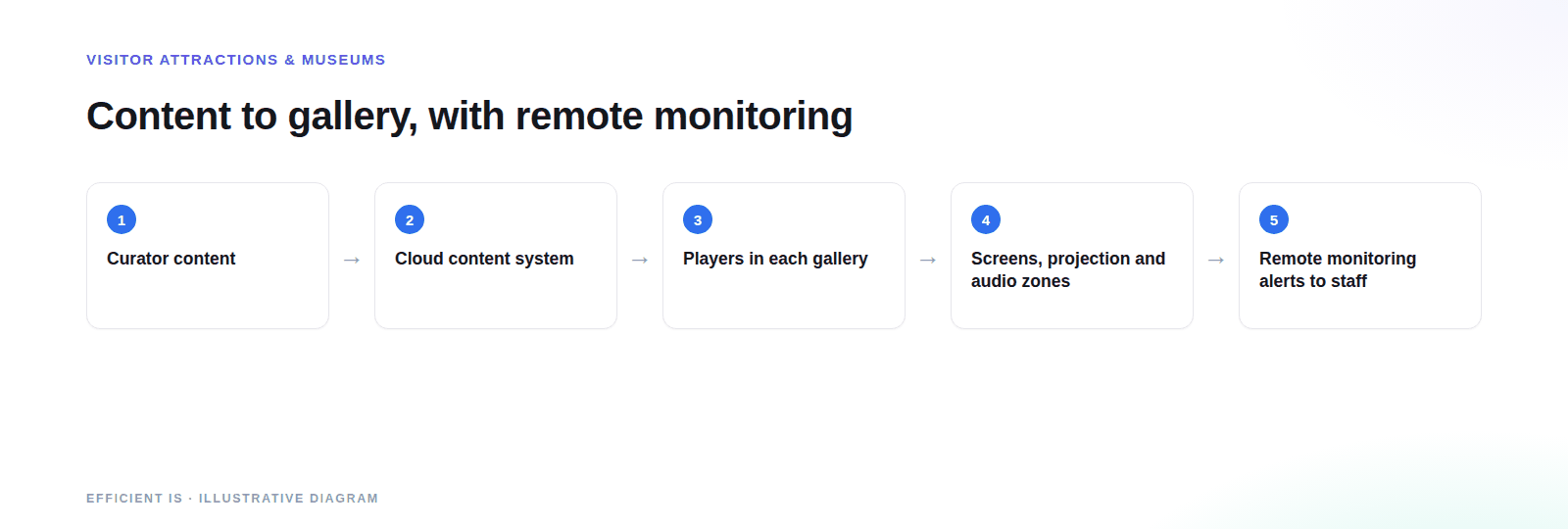
AV for visitor attractions and museums means interpretive screens, immersive projection, audio zones, wayfinding, queue messaging and the screens in shops and cafes. Efficient IS designs and installs it across the UK for councils, trusts and independent venues. Most have no AV person on site, so we set systems up to run themselves and be managed remotely.
Screens and audio in galleries that tell the story, with sound kept inside the zone it belongs to so one exhibit doesn’t drown out the next. Content comes from a central system that curators can update.
Edge-blended projection onto walls and floor, interactive flooring and lighting, controlled from a tablet. See immersive rooms and sensory spaces, which attractions use to put visitors somewhere they couldn’t otherwise go.
Entrance and lobby screens that show opening times, today’s events, timed entry and queue information, so front-of-house staff stop answering the same few questions all day.
Menu boards and promotional screens in the shop and cafe, on the same platform as the galleries where it makes sense. Our retail and restaurant screens cover that side.
Most of these venues have a modest AV budget and nobody on site whose job is AV, but plenty of visitors. The design has to allow for that.
Screens and players should switch on by themselves in the morning and come back after a power cut. A dead screen in a gallery looks worse than a blank wall, so we plan for failure with schedules, auto-recovery, spares and remote monitoring, and we want to hear about a fault before a visitor does.
One system managing every screen across the building, or across several sites, so content changes and health checks don’t need someone on a ladder.
Captions on video content, readable text sizes, sensible mounting heights and assistive listening where there’s spoken audio. Far cheaper at design stage than as a retrofit.
Many attractions belong to councils or charitable trusts, so there are grant conditions and procurement rules to follow. We work with public sector frameworks and know how local government buyers need a specification written.
Where an attraction has a talk, a theatre space or a film with narration, an induction loop lets hearing aid users with a telecoil hear the sound directly. An installed loop should be measured against BS EN IEC 60118-4:2015+A1:2018, Induction-loop systems for hearing aid purposes. System performance requirements, which sets out field strength, frequency response and noise limits.
Service providers, which includes many attractions, have a duty under section 20 of the Equality Act 2010 to make reasonable adjustments for disabled people, which includes considering auxiliary aids. Loops and captions are two of the most common ways of doing that. What counts as reasonable depends on your building and your visitors.
A real immersive room is projection, interactive flooring, lighting and sound built as one system and controlled live, and a projector in a dark room doesn’t qualify. Calibration matters as much as the hardware: a scene that is misaligned or colour-mismatched across surfaces breaks the illusion straight away.
The same kit can run calm sensory sessions as well as spectacle, because the intensity can be dialled up, down or off for each session.
What moves a quote most.
A few interpretive screens and a full wall and floor immersive room are different orders of cost.
Thick walls, limited cable routes and fragile surfaces mean slower, more careful installation.
Directional speakers and tight zones cost more than room-filling sound, and visitors notice the difference.
Screens need something to show. Content creation, licensing and updates are a real cost, so decide early who provides them.
Monitoring and agreed response times matter most once the installers have gone and the screens have been running for a couple of years.
Grant funded projects often come in stages. We can design the infrastructure once and add rooms as money arrives.
Prefer to talk it through? Call 0845 095 3600 or email av@efficient-is.co.uk. We’ll give you a straight answer, not a sales script.
Site survey, a conversation with front-of-house and curatorial staff, requirements gathering and budget options.
Procured through our manufacturer and distributor relationships, or your framework of choice.
Delivered by our engineers in Scotland, or a vetted local partner, anywhere in the UK. Equipment is staged and tested first, so time spent in your galleries is short.
Documentation, training for the team that will actually run it, and optional care plans with remote monitoring, so we find faults before visitors do.
A freestanding outdoor LED kiosk in Dundee city centre, built and fully tested in our own warehouse, craned into position on site, and running live content the same day, with no return visit needed to finish the job.
Read the case studyThe same build and test first approach suits outdoor information points at attractions, where closing a public space for days isn’t an option.
Most need interpretive screens or projection in the galleries, audio that stays inside its zone, entrance and wayfinding screens, and a content system the team can update. Larger sites add immersive spaces, talks and theatre rooms with assistive listening, and screens for the shop and cafe.
Usually yes, with a careful approach. We use minimal and reversible fixings where we can, plan cable routes that avoid damaging fabric, and work with whoever manages your building’s permissions early in the design. We survey before we promise anything.
Build it in from the start: captions on video, readable text, a hearing loop or other assistive listening in spoken audio spaces, and sensible mounting heights. A loop should be tested against BS EN IEC 60118-4 when it’s installed, and we can specify and supply loop systems.
That’s what cloud-based content management is for. You can schedule and monitor screens by site or department from one dashboard, and remote monitoring flags a failed player or screen before visitors notice. Our care plans cover the hardware side.
It can. The government’s statutory guidance lists museums and galleries among publicly accessible premises, with the duties depending on how many people, including staff, can reasonably be expected at once. 200 or more triggers the duty and 800 or more adds further requirements. The main duties haven’t commenced yet. See our Martyn’s Law readiness page for the communication side.
Where it suits, yes. One content platform can manage every screen, with permissions so the cafe manager edits the menu and curators edit the galleries.
Tell us the building, the visitors and who looks after it, and we’ll tell you what’s realistic.









Find our work useful? Add us as a preferred source on Google.