A simulation suite needs cameras, microphones and recording that let trainers run a scenario, watch it from another room and replay the key moments afterwards. Efficient IS specifies and installs that AV for NHS boards, universities and emergency services training teams across the UK.
Clinical skills and simulation centres where teams rehearse emergencies, handovers and communication under pressure. See our NHS and healthcare work.
Simulated wards, consulting rooms and theatres used by large cohorts on a tight timetable, where recordings are marked, reviewed and sometimes assessed. See universities.
Command exercises, assessment rooms and scenario spaces where behaviour and decisions are reviewed afterwards. See fire and rescue and police and justice.
The test is simple. Can an instructor run a scenario, flag the moments that matter and replay them in the debrief without going near a laptop? Everything below serves that.
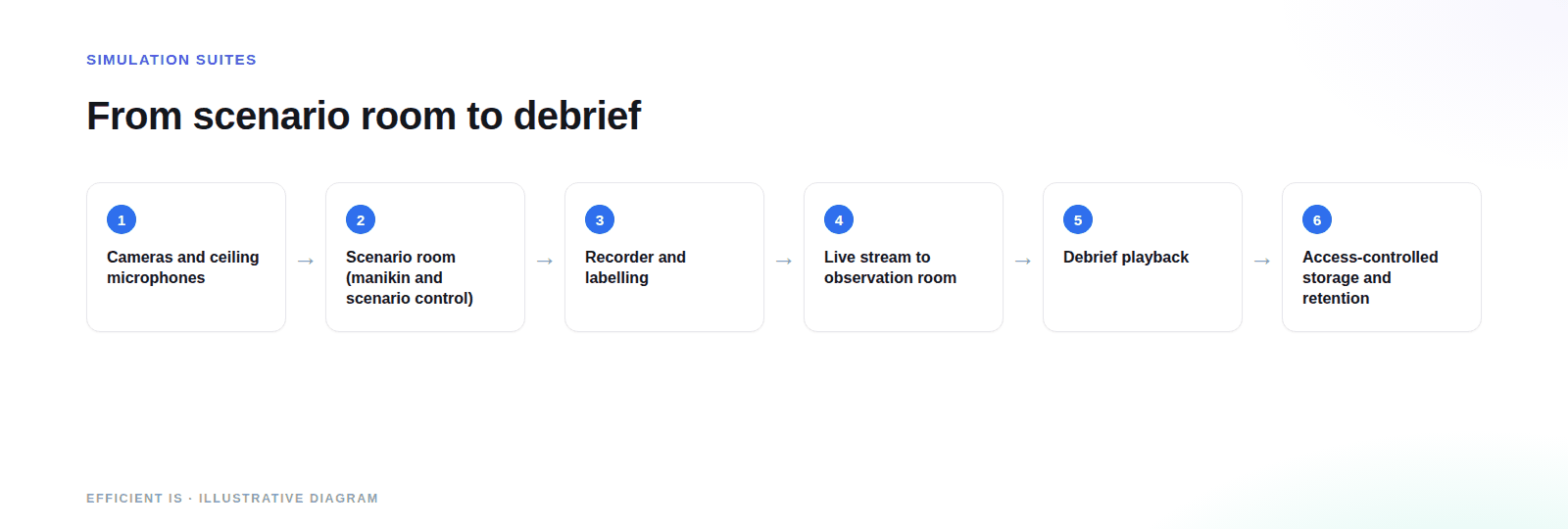
Usually a wide view of the room plus one or more close angles on the patient or the point of action. Fixed or pan-tilt-zoom cameras can be ceiling mounted, out of the way of the scenario and out of reach of enthusiastic learners.
Learners move, turn away and talk over each other, so a single table microphone won’t do. Beamforming ceiling microphones cover the whole floor and keep speech intelligible, which is what makes a recording worth replaying.
Observers watch live in a control or observation room, or a larger group watches remotely. Debrief rooms need a display, good audio and a simple way to jump to a flagged moment, so the discussion stays on the learning.
One-touch start and stop, clear labelling of who, which room and which scenario, and playback that synchronises every angle with the audio. Markers added during the session save a lot of scrubbing later.
A scenario can be streamed to a nearby room, another building or a remote assessor. We design the network path and the encoding so the stream doesn’t stall during a busy session, and so the people watching see and hear what the people in the room do.
The same approach underpins the national remote-assessor streaming at the SFRS Incident Command Centre, covered below. For a single small room with observers next door, a full streaming set-up is overkill.
The manikin and its scenario control software usually come from a specialist simulation supplier, and your educators will have a view on which. We specify and integrate with them: agreeing where the control computer sits, what needs to appear in the recording and how the network and audio are arranged around it.
Integration depth varies by product, so we confirm what’s possible with your chosen system during design, not on install day.
A recording of a scenario is personal data: it contains faces, voices and, often, performance judgements. UK GDPR applies, and the Information Commissioner’s Office (ICO) is the regulator.
Learners and staff should know before they walk in that sessions are recorded, for what purpose and who will see them. Notices at the door and in the course paperwork belong in the design from day one.
Access should follow role: the instructor, the assessor, perhaps the learner. We set up user permissions and storage so recordings aren’t sitting on a shared drive that anyone in the department can open.
The ICO’s guidance on storage limitation says you shouldn’t keep personal data longer than you need it. We build in retention settings and deletion so your policy can actually be applied.
We’re not your data protection officer and this isn’t legal advice. We work with your IT, information governance and DPO teams so the technical design matches the decisions they make, including whether recordings live on your own servers or in a cloud service.
A recording nobody can understand is a recording nobody replays. Poor microphone coverage is the commonest complaint we hear about existing suites.
If starting a session takes a technician, it won’t happen on a busy teaching day. One-touch control, with the AV tied to the room’s booking or scenario, is what gets the room used.
Recordings with no labelling, no search and no retention rules turn into a storage problem and a data protection one. Naming and metadata are cheap to design in and expensive to retrofit.
The number of simulation rooms and the cameras and microphones in each.
How many observers, where they sit and whether anyone watches remotely.
On-premises or cloud, how much footage you keep and for how long.
Cabling, network capacity and how closely the AV works with scenario control.
Sessions with educators, ICT and information governance before we specify anything, so the design follows your teaching workflow.
Camera and microphone layouts, network and storage design, and a specification you can build from or put out to tender.
Delivered by our engineers in Scotland, or a vetted local partner, anywhere in the UK. Every angle and microphone is tested with a mock scenario before handover.
Hands-on training for instructors and ongoing support and maintenance for a room that has to work on teaching days.
The national Incident Command Centre was rebuilt around the assessor’s workflow: consistent audio across every assessment pod, automated camera tracking, one-touch recording and national remote-assessor streaming.
Read the case studyIt isn’t a clinical simulation suite, but the AV problem is the same: beamforming ceiling microphones, dual-lens PTZ cameras and hardware-based recording in every pod, the Incident Command Room and the Plenary observation space.
Prefer to talk it through? Call 0845 095 3600 or email av@efficient-is.co.uk. We’ll give you a straight answer, not a sales script.
At the least, cameras covering the scenario area, ceiling microphones that pick up everyone, a way to record and label sessions and a display with decent audio for the debrief. Bigger suites add an observation room, live streaming and a link to the scenario control system.
We specify and integrate with the systems your educators already use. How deep that goes depends on the product, so we check what’s possible with your supplier during design and tell you plainly where it stops.
Yes, they do. Footage and audio of identifiable people is personal data, and the ICO expects you to keep it only as long as necessary. Your DPO decides purpose, notices and retention; we design the system so those decisions can be applied.
They can. Streaming over your network lets observers or remote assessors see and hear the session as it happens. We check network capacity at design stage, because that’s where live streams usually struggle.
Usually. Ceiling-mounted cameras and microphones suit existing rooms well, and a survey will show whether the cabling and network need work. We’d rather find that out before quoting than after.
We do both, and fire and police training teams too. Universities usually want many identical rooms running to a timetable, so dependability and simple control matter most.
Tell us the rooms, the cohort size and who reviews the recordings. We’ll tell you what’s realistic.






Find our work useful? Add us as a preferred source on Google.