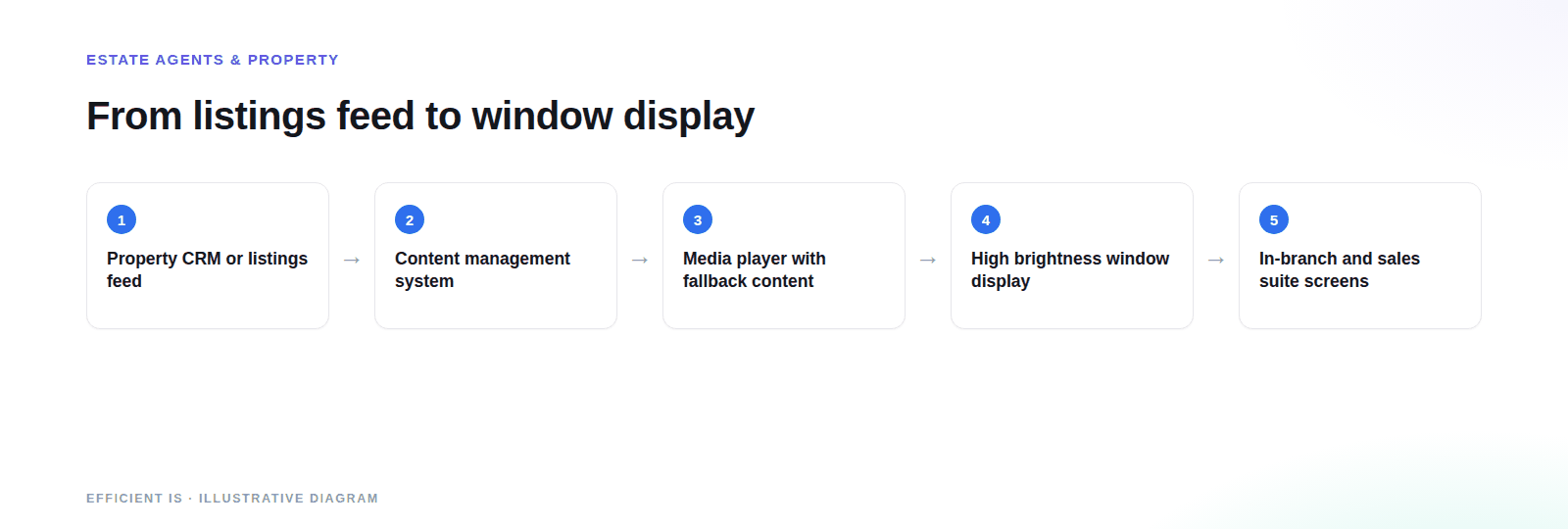
Window display screens for estate agents show your listings in full daylight, day and night, so nobody has to print new cards every week. Efficient IS supplies and installs high brightness window displays, in-branch screens and sales suite displays for agents, lettings teams and developers across the UK. Your own staff update the content from a browser.
Listings seen from the pavement and from passing traffic, with the brightness to beat daylight and glare. This is the screen that sells while the office is closed. Our window screens are configured for the shopfront.
Listings, valuations and team information on screens that negotiators and visitors can see, on the same signage platform as the window.
Plot availability, floor plans and developer messaging on screens, updated as properties are reserved or sold, so nothing gets reprinted.
Large format or video wall displays showing the development and its location, with room for sales staff to talk through plots.
A shop window is one of the harshest places to put a screen. It faces the sun, sits behind glass and has to look good from the street all day.
A standard indoor television washes out in a bright window. Window displays use high brightness panels, several times brighter than normal indoor screens, with an ambient light sensor that dials them down at dusk so they don’t dazzle. Matte or anti-glare finishes and sensible positioning cut reflections from the street. For large, street-facing displays on the building itself, see outdoor advertising.
Sunlight through glass heats a screen cabinet quickly. Displays need a suitable operating temperature range and room to breathe, and we check ventilation and mounting before we recommend a panel, because heat is what shortens a window screen’s life.
Your team should be able to add a property, change a price or mark something sold in minutes, from a browser. Templates keep the layout consistent, scheduling handles different content at different times, and head office can control several branches from one place.
Where the window is deep or visible from two directions, double sided displays are an option, as are tall layouts that suit property cards. We choose by how people approach the branch, and we can specify and supply double sided formats on request.
Re-keying listings into a screen every week is a job nobody keeps up with. We can integrate with common property feeds, so listings, prices and photos flow from the system you already use into the display automatically, and content can still be edited by hand for promotions and branch news.
Automatic feeds need a few decisions up front: how often the screen refreshes, what happens when a listing is withdrawn, and what shows if the feed fails. We set a fallback so the window never goes blank or shows a stale price.
Developer suites are a different brief from a branch window. The audience is already inside, so the screens carry more detail: site plans, plot availability, fly-throughs and location maps, often on a large video wall or an interactive touch display. We can specify and supply touch displays where the brief needs them.
A marketing suite also tends to be temporary. We plan installs so equipment can be reused or relocated when the development completes.
What moves a quote most.
Single screen, double sided unit or a multi-panel window all price differently, as does a tall or wide layout.
Higher brightness panels and protective or ventilated housings cost more than indoor screens, and a south-facing window is no place to economise.
Connecting to your CRM or listings feed takes setup and testing, and it saves staff time every week.
Rolling out across several branches with central control is cheaper per branch than treating each one separately.
Shopfront access, cable routes through glazing and working outside trading hours all affect the programme.
Templates and training are one-off, while care plans and remote monitoring are an ongoing cost that keeps the window live.
Prefer to talk it through? Call 0845 095 3600 or email av@efficient-is.co.uk. We’ll give you a straight answer, not a sales script.
Site survey of the window and branch, a look at your listings system, requirements gathering and budget options. We check sun direction and reflections before recommending a panel.
Procured through our manufacturer and distributor relationships, or your framework of choice.
Delivered by our engineers in Scotland, or a vetted local partner, anywhere in the UK, with installs arranged around trading hours and every display tested in daylight and after dark.
Training for the people who’ll update the screens, and optional care plans with remote monitoring for multi-branch estates.
Far brighter than an indoor television. A south-facing window in summer needs a high brightness panel with an ambient light sensor, and the exact figure depends on how much sun hits the glass. We survey before specifying.
We can integrate with common property feeds, so listings, prices and images update on the screen without anyone re-keying them. We confirm the feed format with your software supplier during design, and set a fallback for when a feed fails.
Yes. A browser-based content system with templates lets a negotiator add a property, change a price or mark a sale in minutes. We train your team on handover and head office can manage several branches centrally.
Where the window or unit can be seen from two sides, yes, double sided options are available. Whether it makes sense depends on the window depth and how people approach the branch, and we’ll give you an honest view after the survey.
Only if it’s specified for it. Window displays need panels with a suitable operating temperature, ventilation and brightness, and a sensible position behind the glass. An indoor screen in a bright window won’t last, and we’d tell you so before quoting it.
Typically a large screen or video wall for the development story, with plot availability and floor plans on a second display, and a way to update it as units sell. It depends on the room and the audience, so we scope it with you.
It depends on the display and on your council, so ask your local planning authority before you buy. In England the Planning Portal says most illuminated signs need advertisement consent, while some adverts are not regulated or have deemed consent. Scotland and Wales have their own rules. We can give you the size and brightness details they will ask for.
Tell us the window, the branches and how your listings are managed today, and we’ll tell you what’s realistic.












Find our work useful? Add us as a preferred source on Google.