
Lecture Theatre Refurbishment: Room Standards, Summer Deadlines and Accessible Recordings
Three or four standard room types, a summer date that holds and captions you can defend will get most lecture theatre refurbishments over the line.
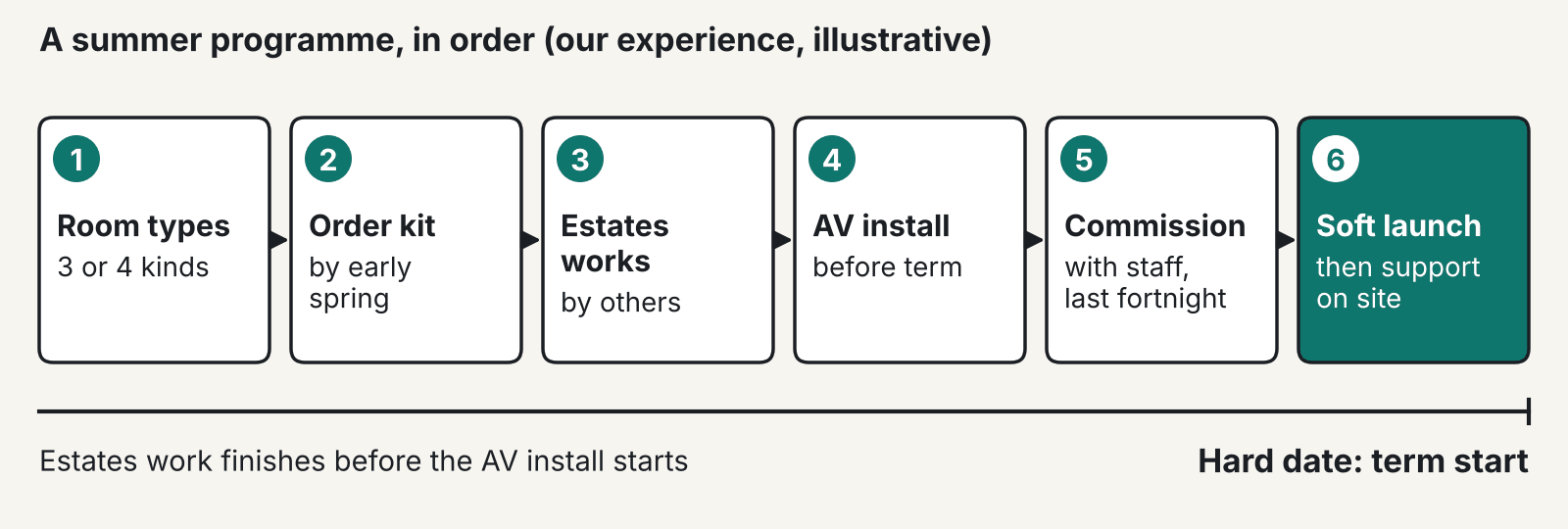
Lecture theatre refurbishment goes smoothly when you standardise the room types and work back from a hard term-start date. In our experience, three or four room types, one control interface and one capture set-up cover most estates. Plan accessibility in from day one: the rules on recordings come from the Public Sector Bodies Accessibility Regulations 2018.
Standard room kits for lecture theatre refurbishment
Define three or four room types and build every refurbishment from them. A typical split is small seminar, medium teaching room, large theatre and specialist space. Every room of a given type gets identical control, capture, cabling, microphones and labels. Support gets cheaper and staff training gets shorter. That’s a design choice and no regulation asks for it.
Universities do publish this kind of guidance. UCL has a spaces and audio visual guidelines page, last updated in September 2018 according to its own footer. The UK Higher Education Learning Space Toolkit is a SCHOMS, AUDE and UCISA collaboration aimed at AV, IT and estates teams. The FLEXspace page describing it says it covers managing learning space projects, working with professional advisors, types of space and evaluating spaces. It doesn’t give a year, so check the current version before you rely on it.
In our view, bespoke one-off rooms are a bad trade. They look good on opening day, then every fault becomes a special case that only one technician understands. We’d rather have four boring room types than forty clever ones.
Planning the summer window
A summer lecture theatre refurbishment is a race against a date that won’t move. This section is our own practical experience and it isn’t sourced. Lead times for displays, projectors, microphones and encoders can be long, so we’d order by early spring and get the dates in writing. Physical works have to finish by a fixed date before term, and everything after that is testing. Any slip in the works comes straight out of your testing time, because term start won’t move.
Estates dependencies come first in a lecture theatre refurbishment. Access, asbestos surveys, power and data containment, and ceiling and acoustic works all need to be done by others before AV starts. Our guide to AV and M&E coordination covers who does what and when.
Leave the final fortnight for commissioning and testing with the staff who will use the rooms, then run a soft launch week before the main term starts. Budget for a support presence in the first weeks of term, because that’s when the unexpected faults show up. Keep spare equipment on site.
What the accessibility regulations mean for recordings
The regulations came into force for public sector bodies on 23 September 2018, according to GOV.UK. Exempt content includes pre-recorded audio and video published before 23 September 2020, and live audio and video. The standard to meet is WCAG 2.2 AA on GOV.UK’s current guidance. Bodies must publish an accessibility statement that lists any exempt content or any claim of disproportionate burden, and GOV.UK says lack of time or knowledge isn’t an acceptable excuse.
Recordings made in a refurbished room now fall inside the rules, so put the captioning workflow in the project plan.
The GOV.UK page doesn’t name universities and colleges, and it advises taking legal advice if you’re unsure. Jisc’s captioning guide is written for tertiary education, addresses colleges and universities directly and says the body as a whole is responsible, which includes every department. So Jisc treats universities and colleges as covered. Whether your own institution is, only your own legal advice can settle.
Captions: what counts as compliant
Accurate captions are compliant, and Jisc says so plainly. Pre-recorded audio and video published from 23 September 2020 must meet the regulations, and captions can be added up to 14 days after publication. Unchecked captions that contain mistakes don’t meet the requirement. W3C says automatic captions aren’t enough unless they’re fully accurate, and that they usually need significant editing. Jisc gives no accuracy percentage, so we won’t invent one.
Live captioning is a separate question. WCAG 2.2 AA asks for live video to be captioned, but Jisc says the UK regulations omitted that requirement. Teams and Zoom both offer live captions, which Jisc notes can contain errors. For room design, the practical point is that captioning is a workflow. Decide who checks the captions before the first lecture is recorded, and budget their time.
In our experience, this is where things drop between the AV team and the learning technology team, so write down who owns it. Use the 14 days as a checking window. Have the owner review the first recordings from each refurbished room in the first week of term.
Hearing loops and audio coverage
Put the loop and the audio coverage into the lecture theatre refurbishment design from the start, and keep them off the snag list. Under the Equality Act, section 20(5) asks for reasonable steps to provide an auxiliary aid, section 20(11) says that includes an auxiliary service, and section 29(7)(a) applies the duty to service providers. A loop should be commissioned against BS EN IEC 60118-4:2015+A1:2018, which is the current edition we found in October 2026. Our hearing loop installation post has the detail, and it isn’t legal advice.
The loop at our SFRS Cambuslang auditorium covers the whole auditorium, which is the aim in any big room.
For speech coverage, ask the integrator to measure against AVIXA A102.01. Its scope is the uniformity of a sound system’s early arriving energy across the listener areas, with a procedure to measure and classify it. We haven’t quoted an edition year or a tolerance, because sources differ. Ask for the measured result and the edition used.
Privacy and support once term starts
Recording by default with no notice is a pitfall we see often. For colleges teaching under-18s, Jisc’s guide for further education recommends a privacy notice covering what data is collected, why, the lawful basis, who sees it and how long it’s kept. It also recommends a DPIA when you record learners under 18, says everyone should know a recording is happening and suggests offering a recording-free zone. Our lecture capture guide covers microphones, cameras and storage in depth.
Support is the other half of a lecture theatre refurbishment. Pick a management platform that reports display hours, mic mute and room status to the helpdesk, and decide who gets the alert at 08:50 on a Monday. For hybrid sessions, return audio from the remote class back into the room is the commonest failure, so test it. Decide too who watches the remote students while the lecturer teaches.
See our Lecture Theatres and Lecture Capture page and our work for universities.
FAQ
How long does a lecture theatre refurbishment take?
The AV install itself is short next to the lead time on equipment. Displays, projectors, microphones and encoders can take a long time to arrive, so we’d order by early spring for a summer finish. Ask suppliers for current lead times in writing.
Do recorded lectures need captions?
Under the 2018 regulations, pre-recorded audio and video published from 23 September 2020 must meet the standard, and Jisc says captions can be added up to 14 days after publication. Whether your institution is covered is a legal question. Jisc treats universities and colleges as covered.
Are automatic captions enough?
Only if they’re accurate. Jisc says unchecked captions that contain mistakes don’t meet the requirement, and W3C says automatic captions usually need significant editing. Live captions in Teams and Zoom can contain errors too.
Do live lectures need captions under UK regulations?
WCAG 2.2 AA asks for live video to be captioned, but Jisc says the UK regulations omitted that requirement. Check your own institution’s policy and any student support plans before you decide.
How many room types should a lecture theatre refurbishment use?
Three or four is a sound start: small seminar, medium teaching, large theatre and specialist. That’s our practice and no regulation asks for it. Add a fifth type only when a room’s use really differs.
Does a refurbished lecture theatre need a hearing loop?
That depends on your own legal position, which we can’t judge for you. Section 20(5) of the Equality Act asks for reasonable steps to provide an auxiliary aid, and a loop is one common answer. Our hearing loop post sets out the wording we checked.
Planning a lecture theatre refurbishment for next summer?
Tell us how many rooms, what types and when term starts, and we’ll give you a straight answer.