Lecture capture fails on audio far more often than it fails on video
Most complaints about recorded lectures aren’t about picture quality, they’re about not being able to hear the question a student asked from the back row.
Audio is the priority, not the camera
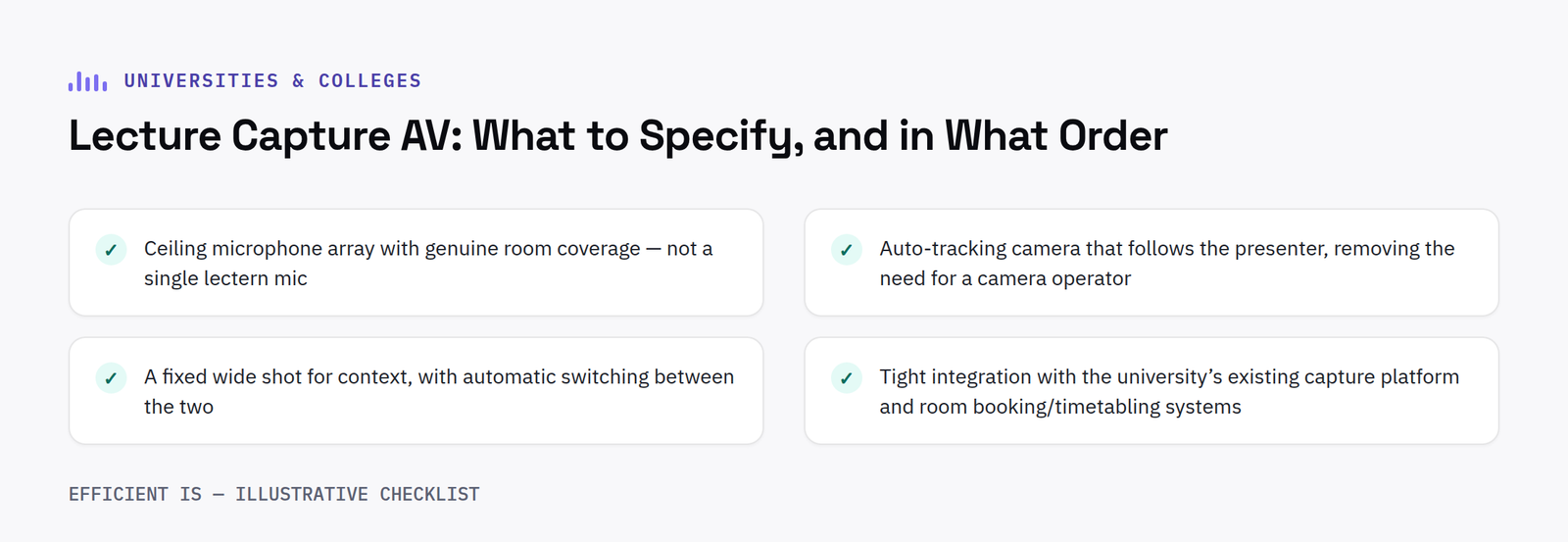
A lecture theatre’s biggest audio challenge isn’t the lecturer, it’s capturing audience questions and discussion from a room that might hold 200 people. Ceiling microphone arrays with genuine room coverage, not a single lectern mic, are what actually determine whether a recording is usable afterwards, particularly for students revising from the capture rather than attending live.
Camera framing that doesn’t need a technician
Auto-tracking cameras that follow a presenter around the front of the theatre remove the need for a dedicated camera operator on every session, genuinely important given how many lectures run without any AV support staff present. Combine this with a fixed wide shot of the room for context, and most lecture capture platforms can auto-switch between the two.
Integration over isolation
Lecture capture shouldn’t be a bolt-on system nobody uses because it requires a separate login or workflow. Specifying AV that integrates with the university’s existing lecture capture platform (Panopto and Echo360 both being common in UK higher education) and existing room booking/timetabling systems is what actually gets a system used consistently, rather than switched on for the first fortnight of term and ignored after.
FAQ
Does lecture theatre AV need to integrate with our existing lecture capture platform?
Yes, this should be confirmed and specified at the design stage rather than assumed, since compatibility varies by platform and room configuration.
What matters more for lecture capture, camera or microphone?
Microphone coverage, in most cases, poor audio makes a recording unusable far more often than imperfect camera framing does.
Storage and access considerations often missed at spec stage
Lecture capture generates a significant volume of video content over a full academic year, and storage requirements are frequently underestimated at the specification stage. Working out roughly how many hours of content will be recorded, how long it needs to be retained, and whether storage sits on the university’s own infrastructure or a cloud platform, are questions worth answering before a system is chosen rather than discovered as a problem once storage starts running out mid-term.
Access permissions deserve equal attention. Students generally need straightforward access to recordings for their own modules, while staff need the ability to review, edit or restrict access to specific recordings, a lecture containing sensitive discussion, for example, without that becoming an administrative burden for the AV or IT team managing the platform day to day. Getting this structured correctly from the outset avoids a steady stream of ad hoc access requests once the system is in regular use.
Analytics, showing which recordings are actually being watched and for how long, are worth asking about too: this data genuinely helps academic teams understand which content students find useful, rather than assuming every recorded lecture is equally valuable simply because it exists.
Reliability during the recording itself matters more than any other single factor, since a failed recording cannot be redone once the lecture has finished. Automated alerts flagging a failed or incomplete recording immediately, rather than a lecturer or student discovering it missing days later, should be treated as a baseline requirement rather than a nice to have addition.
Have a project in mind?
Tell us what you’re trying to fix and we’ll tell you honestly what’s realistic.