What building services engineers need to know about AV cabling standards
How AV cabling differs from standard data cabling, and why building services engineers need the right cable schedule and containment at first fix.
AV cabling is not the same design problem as general office data cabling. Rooms with displays, video conferencing or AV-over-IP distribution typically need more cable drops per space, longer runs to racks and displays, and containment sized for a different fill profile than a standard desk-and-data layout. Getting the category cabling, containment allowance and rack provision right at first fix, rather than retrofitting it once ceilings and walls are closed, is the single biggest factor in whether an AV installation goes in cleanly or turns into an expensive, disruptive second pass.
How AV cabling differs from a standard data cabling layout
A typical office data cabling brief is fairly predictable: a couple of outlets per desk, a run back to the nearest comms room, done to a known category standard. AV cabling doesn’t follow that pattern, and it’s worth being specific about why.
Cable counts per room are often higher. A meeting room with a display, a conferencing camera, ceiling or table microphones, a control panel and a table-based connectivity plate can easily need six or more individual runs where a standard office desk needs one or two. A council chamber, lecture theatre or large meeting space multiplies that again, cameras, gain-shifted microphones, programme audio and control all typically run back to the rack as separate, structured cable paths rather than sharing a single data drop.
HDMI and AV-over-IP have their own distance and containment implications. Native HDMI runs are distance-limited in a way general data cabling isn’t, which is why most fixed AV installations either use HDMI-over-twisted-pair extenders (running over category cable rather than HDMI cable itself) or move to AV-over-IP distribution across the structured network. Either approach changes what the containment needs to carry: more category cable runs than a naïve “one cable per screen” assumption would suggest, and, where AV-over-IP is used at scale, enough switch capacity and cable pathway to carry AV traffic without contending with the rest of the building’s data.
Runs to displays and racks tend to be longer and less forgiving. Displays and video walls often sit a meaningful distance from the nearest comms room, and unlike a desk that can be shifted slightly if a data point is wrong, a fixed display position is fixed. That makes accurate first-fix positioning more consequential for AV runs than for general office cabling.
AV containment is often best run separately from general data containment, particularly where cable counts are high or where a room is likely to be re-cabled or re-purposed at some point without touching the rest of the building’s data infrastructure. That’s a coordination point worth raising early with the AV designer rather than assuming general data containment has capacity to spare.
Why getting this right at first fix matters
The cost of an AV cabling shortfall is not evenly distributed across a project. Specify a container one size too small, or miss a run that turns out to be needed once room layouts are finalised, and the fix after ceilings, walls and floors have closed is materially more disruptive and expensive than it would have been at first fix, new containment routes chased into finished surfaces, ceiling tiles back off, a room that was ready for handover back in a snagging cycle.
This is the same argument that applies to M&E coordination generally, just with AV as the discipline most likely to arrive last, after containment sizing and first-fix positions are already fixed. Our post on AV and M&E coordination, getting containment, power and data right first time covers the wider coordination problem; the cabling standard is one specific part of getting it right.
What “AV-ready” structured cabling actually means in a spec
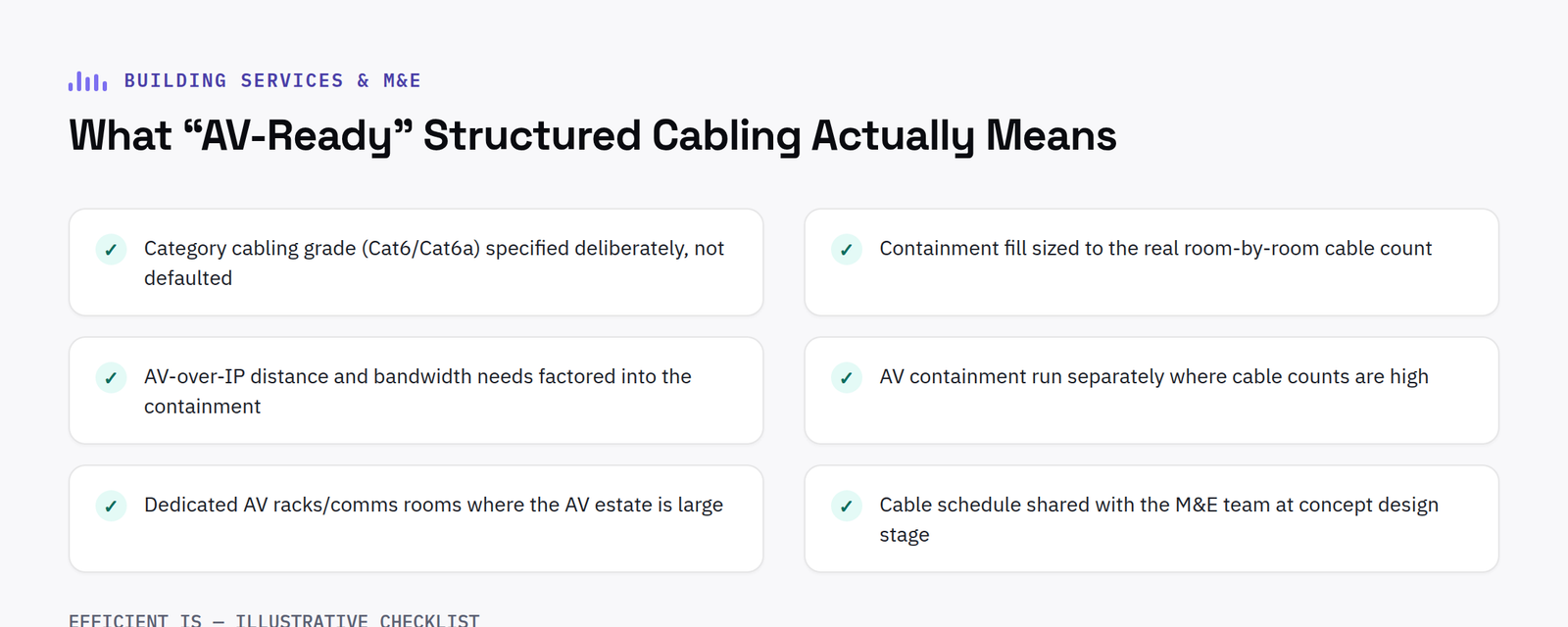
“AV-ready” isn’t a single product or a checkbox, it’s a small set of decisions that need to be made deliberately rather than defaulted to whatever the general data cabling spec already says.
Category cabling grade. Cat6 and Cat6a both have a place, but they’re not interchangeable once you’re pushing AV-over-IP traffic, PoE-powered endpoints, or longer runs at higher bandwidth. If you’re weighing which to specify for a given project, our guide to Cat6 vs Cat6a sets out the practical differences without repeating them here.
Containment fill. Containment sized for the data cabling count alone, with no allowance for the AV runs sharing the route or for future re-cabling, is a common source of retrofit pain. AV-ready containment carries a realistic fill allowance based on the actual room-by-room cable count the AV designer has produced, not an estimate.
Dedicated AV comms rooms or racks where scale demands it. A single meeting room’s AV cabling can usually share the building’s general comms infrastructure without issue. A building with a significant AV estate, multiple large spaces, a council chamber, a lecture capture setup, often justifies a dedicated AV rack or comms room, with its own power, cooling and cable entry, kept separate from general IT infrastructure.
Structured cabling specified this way sits inside our structured cabling and network design services, produced to a standard that’s built to coordinate with the rest of the M&E design rather than sit apart from it.
The practical coordination point for building services engineers: cable schedules early enough to use
The single most useful thing an AV designer can hand a building services engineer is a room-by-room cable schedule and containment route, early enough to fold into the wider M&E first-fix drawings, not added late once those drawings are largely fixed. That schedule should state, for each room, how many cable runs are needed, what category or type each one is, where they originate and terminate, and any containment sizing implications that fall out of the total count.
Handed over at concept or detailed design stage, that schedule is one more input into the containment sizing you’re already doing, no different in principle to accounting for power or mechanical services, just specific to AV. Handed over after containment is fixed, it becomes a list of problems instead. Asking for it early, and asking the AV designer to work to the same drawing and revision process as the rest of the design team, is what keeps AV cabling from becoming the thing that holds up a programme.
FAQ
Is AV cabling just Cat6 or Cat6a like everything else on the data network?
Often yes, in terms of the cable itself, but the count of runs per room, the containment allowance needed to carry them, and whether they should run on shared or dedicated containment differ from a standard office data layout. The category grade is one part of the spec, not the whole of it.
How many cable runs does a typical AV-equipped meeting room need?
It varies with the room, but a room with a display, a conferencing camera, microphones and a control panel commonly needs several separate runs where a standard desk needs one or two. Larger spaces such as council chambers or lecture theatres need more again. A cable schedule from the AV designer, produced against the actual room design, is more reliable than a general rule of thumb.
At what design stage should we ask the AV designer for a cable schedule?
As early as possible, ideally at concept design, alongside the rest of the M&E first-fix planning, so containment can be sized against the real AV cable count rather than an estimate added later.
Efficient IS specifies structured cabling, containment and data infrastructure for AV to a standard that coordinates with the wider M&E design, working directly with building services engineers and M&E consultants from concept design through to tender pack. Read more on our building services & M&E consultants sector page, or get in touch to talk through what a project needs.
Sizing containment and cabling for an AV-heavy project?
Get in touch and we'll help you get the schedule right early.