Cat6 or Cat6a, the cabling decision you only get to make once
Structured cabling goes in once and disappears behind walls and ceilings for the next 15 to 20 years. Getting this one decision right matters more than almost anything else in an office fit-out.
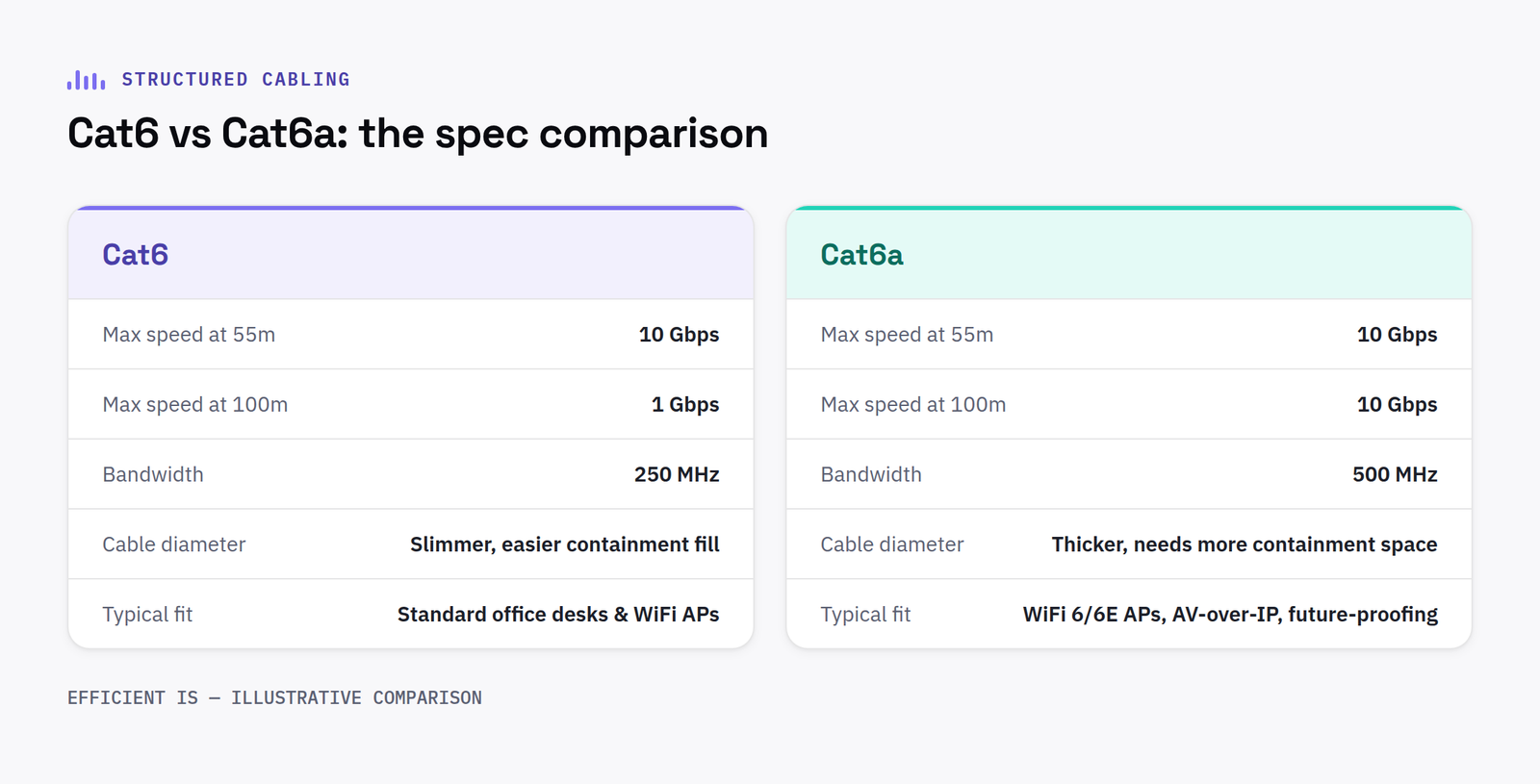
Cat6 vs Cat6a: the technical difference, without the jargon
Both are twisted-pair copper cabling standards. Cat6 supports 10 Gigabit Ethernet, but only reliably over short runs, typically up to 55 metres, often less with nearby electrical interference. Cat6a is engineered to deliver the full 10 Gbps over the entire 100-metre channel length permitted by structured cabling standards, with meaningfully better shielding against interference between cables running in the same bundle.
Where the extra cost actually pays off
Cat6a costs roughly 30% more than Cat6 in materials. That premium is easy to justify for three specific reasons: any cable run over 55 metres where full 10 Gbps matters, any deployment with heavy Power over Ethernet use, WiFi access points and IP cameras being the two most common, where Cat6a handles the power load with less heat build-up in dense bundles, and any office that wants the cabling to still be adequate in ten years, not just adequate today.
What most UK offices are actually installing in 2026
Cat6a has become the baseline specification for new office structured cabling projects in the UK. Cat6 remains a reasonable, defensible choice specifically for budget-constrained projects with predominantly short cable runs, not simply the cheaper default by habit.
FAQ
Is Cat6a backward compatible with existing Cat6 or Cat5e switches?
Yes, Cat6a uses standard RJ45 connectors and works with existing switches, routers and patch panels, simply running at whatever speed the connected equipment supports.
How long does structured cabling last once installed?
A properly installed system typically has a useful life of 15 to 20 years, which is exactly why the standard chosen at installation is worth getting right rather than treating as a minor spec decision.
What to specify if you are not sure yet
For a business genuinely unsure whether Cat6a is worth the extra cost, a practical middle ground is to install Cat6a cabling throughout but terminate and test it to run at whatever speed the current network equipment actually needs. This costs a little more than installing Cat6 outright, but far less than a full re-cable later, and means the cabling itself, the part that is genuinely disruptive and expensive to replace once walls and ceilings are closed up, is already future-proofed even if the switches and equipment connected to it are upgraded gradually over time.
Where budget is the primary constraint and cable runs are consistently short, Cat6 remains a legitimate choice rather than a compromise, provided it is specified deliberately rather than defaulted to purely on habit or because a supplier quoted it without being asked about the alternative.
Whichever standard is chosen, insist on individual test certificates for every run rather than a general statement that testing was carried out. This is the only real evidence, years later, of what was actually installed and whether it still meets the standard it was specified to.
Labelling at both ends of every cable run, consistent and matched to whatever documentation is handed over at completion, is a small detail that makes a real difference to how quickly a fault gets traced years later, regardless of which cabling standard was chosen at installation.
Have a project in mind?
Tell us what you’re trying to fix and we’ll tell you honestly what’s realistic.