Martyn’s Law and Your Front Door: What Building Access Has to Do with the Terrorism (Protection of Premises) Act
Martyn’s Law doesn’t mention building access control by name, but the law’s whole premise is about reducing harm at the point where the public comes in, which makes your front door one of the first things worth looking at, not an afterthought once the paperwork’s done.
What Martyn’s Law actually requires
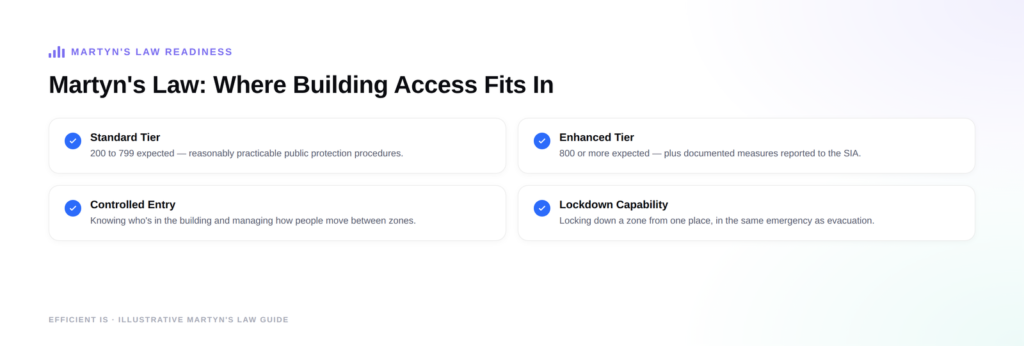
Martyn’s Law is the common name for the Terrorism (Protection of Premises) Act 2025, which received Royal Assent in April 2025. The government has said it intends an implementation period of at least 24 months before the duty becomes enforceable, so compliance is currently voluntary, with enforcement realistically expected from around spring 2027. It applies in two tiers based on the number of people reasonably expected on the premises at once: Standard Tier covers premises expecting 200 to 799 people and requires “reasonably practicable” public protection procedures; Enhanced Tier applies at 800 or more and adds a requirement to reduce the premises’ own vulnerability to an attack, documented and reported to the Security Industry Authority, who regulate compliance under the Act.
Where access control fits in
The law requires public protection procedures “reasonably expected to reduce the risk of physical harm” if an attack occurred. Evacuation, invacuation, lockdown and communication come up most often in guidance, invacuation meaning moving people to safety within the building rather than out of it, and we’ve covered the communication side in detail on our own Martyn’s Law Communication Readiness page. But knowing who’s actually in the building, controlling how people move between zones, and being able to lock a specific area down quickly are access control jobs as much as they’re communication ones. A door that only unlocks with a fob, and a system that can lock a zone from one place in an emergency, is a physical procedure in exactly the same sense that evacuation signage is.
What “reasonably practicable” means for a front door
The Act explicitly scales expectations to the premises’ size and resources, a 250-capacity venue isn’t expected to run the same measures as an 800-plus Enhanced Tier site. For most Standard Tier premises, that likely means sensible basics: controlled entry points rather than every door standing open to the public, a reasonable way of knowing roughly who’s inside at a given time, and a lockdown capability covering at least the main public areas. It doesn’t mean a fully biometric, airport-style access-controlled building for a 300-capacity venue.
What to do before enforcement starts
With implementation running to at least spring 2027, premises expecting 200 or more people have a genuine window to assess their current access arrangements against the duty, rather than scrambling once it’s actually enforceable. That means working out which tier realistically applies based on expected capacity, not maximum theoretical capacity; auditing existing entrances and access control for whether they’d actually support a lockdown or controlled evacuation if needed; and aligning that with your existing fire strategy, the subject of our guide to BS 7273-4: rather than treating fire safety and security as two unrelated projects.
See our Building Access Systems page for how we scope door entry, access control and visitor management together, or Martyn’s Law Communication Readiness for the screens, speakers and network side of the same duty.
FAQ
Does Martyn’s Law require us to install specific access control equipment?
No, the Act doesn’t name specific technology or products, it requires “reasonably practicable” procedures proportionate to your premises. For many Standard Tier premises that’s about reviewing how entrances and existing systems would support a lockdown or controlled evacuation, not buying a prescribed access control system.
What’s the difference between Standard and Enhanced Tier?
Standard Tier applies to premises expecting between 200 and 799 people at a time and requires reasonably practicable public protection procedures. Enhanced Tier applies at 800 or more and adds a requirement to reduce the premises’ vulnerability to an attack, with documentation reported to the Security Industry Authority. Both are based on realistic expected capacity, not maximum theoretical capacity.
When does Martyn’s Law actually come into force?
The Act received Royal Assent in April 2025, and the government has said it intends an implementation period of at least 24 months before the duty becomes enforceable, meaning compliance is currently voluntary, with enforcement realistically expected from around spring 2027. Checking now gives you time to fix gaps before that point rather than after.
How does this relate to Efficient IS’s Martyn’s Law Communication Readiness work?
Communication readiness, whether your screens, speakers and network can actually deliver a lockdown or evacuation message, is one half of the picture. This covers the other half: whether your entrances and access control can physically support that same procedure. See our Martyn’s Law Communication Readiness page for the communication side specifically.
Working out what Martyn’s Law means for your premises?
Tell us your expected capacity and we’ll tell you honestly what tier applies and what’s worth doing now.