
Is Your Door Access Control Actually Compliant with Fire Regulations? A Plain-English Guide to BS 7273-4
Fire door access control isn’t automatically a compliance problem just because a magnetic lock sits on an escape door. The problem is when nobody’s checked it against BS 7273-4, which is the standard that decides whether an access-controlled door will actually let people out in a fire.
What BS 7273-4 actually covers
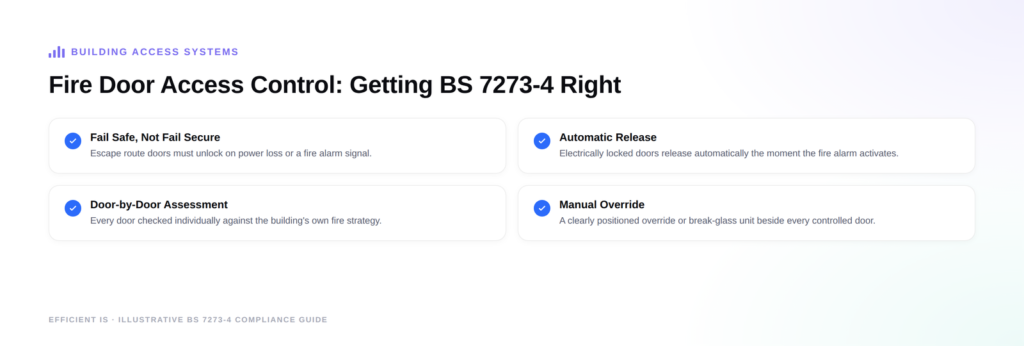
BS 7273-4 governs how electrically powered door locks interface with a building’s fire detection and alarm system, requiring automatic unlock when the fire alarm activates, fail-safe release if the system loses power, and an appropriate manual override. It doesn’t replace mechanical escape hardware like lever handle exit devices for staff areas or panic bars for public areas, it only comes into play where electronic control of an escape route is genuinely needed on top of that hardware, not instead of it.
Fail-safe vs fail-secure, the distinction that actually matters
A fail-safe lock unlocks if it loses power or receives a signal from the fire alarm, the correct behaviour for any door on a designated escape route. A fail-secure lock does the opposite: it stays locked if power is lost, which is appropriate where keeping something locked matters more than escape, like a server room or a comms cupboard, but should never be fitted to a door on a means of escape. Mixing the two up, putting a fail-secure lock on an escape route door because it happened to be the one in stock, is the single most common fire-door access-control mistake we see.
Who’s actually responsible
The building owner or “responsible person” under fire safety legislation defines the escape routes and fire strategy for the building. The installer or designer then has to competently assess each door individually against that strategy, rather than simply following a spec sheet the client handed over, and can’t introduce a double-action escape requirement, needing two separate actions, like a keypad and then a handle, to get out, on a door meant to allow single-action escape. Responsibility for getting this right genuinely sits with both sides, not just the person who commissioned the work.
Common mistakes we see
Retrofitting a mag-lock onto an existing fire door without checking it against the building’s fire strategy. Access control installed after the fire risk assessment was last reviewed, so nobody re-checks the door against it. Override or break-glass units positioned somewhere non-obvious, behind a noticeboard or above head height, rather than immediately beside the door they release. And in multi-let buildings specifically, access control added to a shared escape stair without coordinating with each individual tenant’s own fire strategy, so the building owner’s system and the tenants’ assumptions about that stair don’t actually match.
We check every door against your fire strategy as a standard part of designing a building access system, not as an optional extra, the same principle we apply on the CCTV side, where compliance is designed in from day one rather than bolted on afterwards.
FAQ
Does every access-controlled door need to comply with BS 7273-4?
Only doors where an electrically powered lock controls an escape route, a card reader on an internal office door that isn’t a designated fire exit doesn’t fall under it in the same way, though it’s still worth checking against your fire strategy as good practice. Any door on a means of escape fitted with an electric lock is where this genuinely applies.
What does “fail safe” mean in practice?
It means the lock releases, rather than stays locked, if it loses power or receives a signal from the fire alarm system, so a power cut or a fire never leaves someone unable to get out. The opposite, “fail secure”, is appropriate for doors where keeping something locked matters more than escape, like a server room, but should never be fitted to a designated escape route.
Who’s liable if an access-controlled fire door isn’t compliant?
Responsibility generally sits with the premises’ “responsible person” under fire safety legislation, though an installer who fits a non-compliant system without flagging the issue isn’t off the hook either, competent assessment of each door is expected from whoever’s designing and installing it, not only the person who commissioned the work. We check this against your fire strategy as a standard part of design, not an optional extra.
Can we add access control to an existing fire door without reassessing the whole building?
You need to reassess that specific door against the existing fire strategy, not the whole building, but skipping even that single-door check is the most common way access control ends up non-compliant. It’s a quick check as part of a properly scoped installation, not a reason to avoid doing the work at all.
Retrofitting access control onto an existing building?
We’ll check it against your fire strategy before anything’s fitted, not after.












Find our work useful? Add us as a preferred source on Google.