Does Martyn’s Law apply to your premises? Here’s the actual test.
Martyn’s Law uses a single, fairly mechanical test: how many people might reasonably be expected to be in your building at the same time. Get that number right and you know exactly which duties apply.
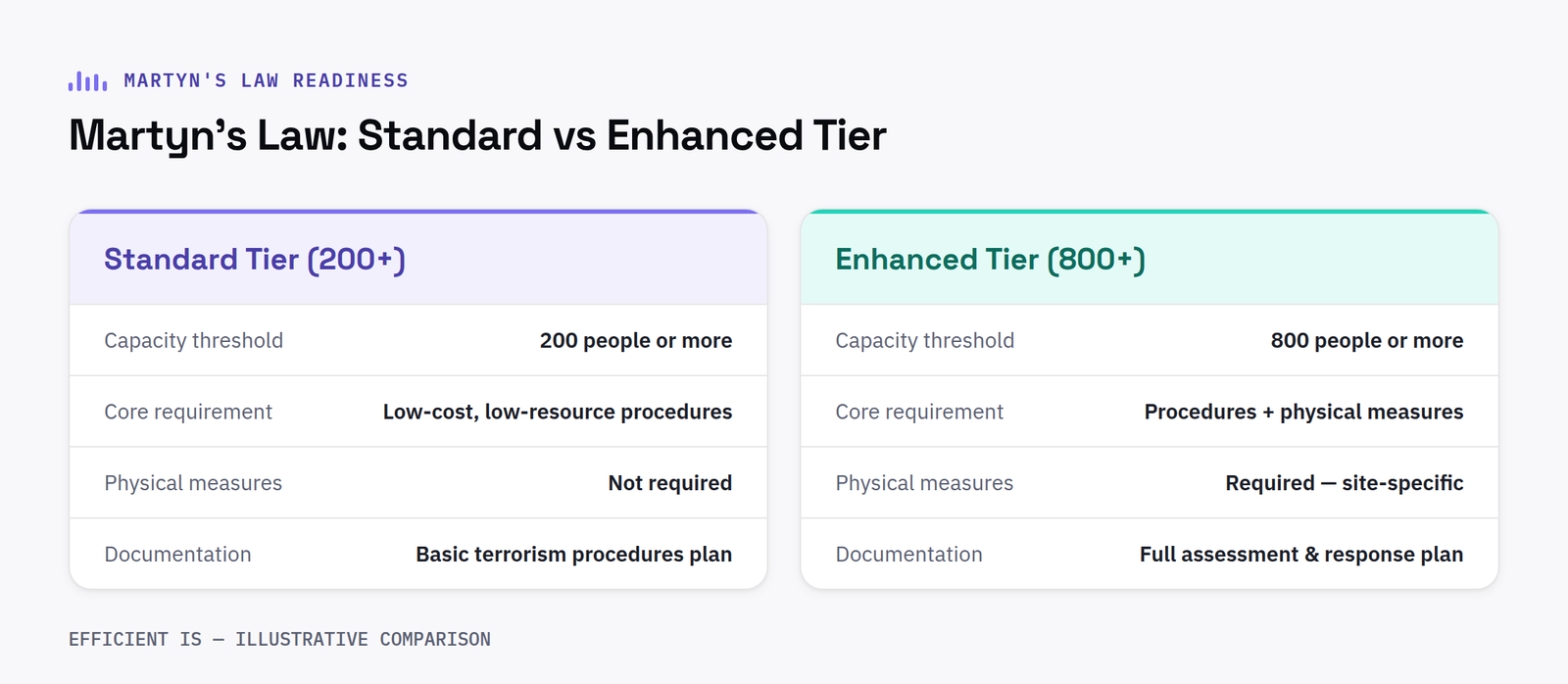
The two tiers
Standard Duty applies where 200 to 799 individuals may reasonably be expected to be present at the same time. It requires the four core procedures, evacuation, invacuation, lockdown and communication, but no specific physical equipment. It’s about having a workable plan and staff who know it, not about buying anything.
Enhanced Duty applies at 800 or more. It adds further public protection measures, requires a named senior individual accountable for compliance, and a formal compliance document provided to the SIA. Below 200, premises are outside the scope of the Act entirely.
How to count
The figure includes everyone who might reasonably be present at the same time, staff, contractors and volunteers, not just visitors or customers. A shop with a 750-person customer capacity and 60 staff on a busy shift is at 810, Enhanced Duty, not Standard.
Assess against your realistic peak, not an average day. If your premises occasionally hosts a higher-attendance event, a school fair, a store’s Christmas trading period, that peak can bring you into scope even if a normal Tuesday wouldn’t.
The one significant exception
Education settings, schools, colleges and similar, stay in the Standard Duty tier regardless of how many people are on site, as long as they’re above the 200 threshold. A large secondary school doesn’t move into Enhanced Duty purely on numbers the way a shopping centre or arena would.
Who this actually covers in practice
In practice: shops, restaurants and bars above 200 capacity, schools and colleges, council and public buildings, leisure and cultural venues, healthcare sites, and places of worship large enough to meet the threshold (many won’t). If you’re the person who’d get asked “what happens if we have to lock this building down at 2pm on a Tuesday” and you don’t have a confident answer, it’s worth checking where you sit.
FAQ
What’s the capacity threshold for Martyn’s Law?
200 individuals, including staff, reasonably expected to be present at the same time. Below that, premises are outside the Act’s scope. 200 to 799 is Standard Duty; 800 or more is Enhanced Duty.
Do staff count towards the numbers?
Yes. The test counts everyone who might reasonably be present at once, staff, contractors and volunteers, not just customers or visitors.
Are schools always Enhanced Duty if they’re large?
No. Education settings remain in the Standard Duty tier regardless of capacity, provided they’re above the 200 threshold, they don’t move to Enhanced Duty on numbers alone the way other premises types do.
What happens if numbers sit close to a threshold
Premises with attendance figures close to 200 or 800 are worth reviewing more carefully than those clearly above or below either line. A small change, an extended opening hours trial, a seasonal event, an extra function room brought into regular use, can shift a premises from outside scope into Standard Duty, or from Standard into Enhanced Duty. Reassessing capacity whenever a premises’ use changes meaningfully, rather than treating the original assessment as fixed permanently, avoids being caught out by a duty that quietly started applying without anyone noticing.
Have a project in mind?
Tell us what you’re trying to fix and we’ll tell you honestly what’s realistic.