Bringing Offices Alive: What LED Video Walls Actually Do for a Workplace
An LED video wall in reception does more than fill an empty surface, it is one of the few single investments that changes how a visitor, a candidate and your own staff feel about the building in the first thirty seconds.
Getting people back into the office has become a genuine workplace priority, not just a management preference, and the physical office itself is part of how that argument gets made. CBRE’s own commentary on the hybrid workplace argues plainly that the office is more important than ever precisely because it has to earn its place against the convenience of working from home, and JLL’s annual fit out costs guide tracks exactly the kind of investment companies are now making in their space as a result. A reception or breakout area with a genuinely good video wall is a small but visible part of that argument.
Where video walls actually earn their place
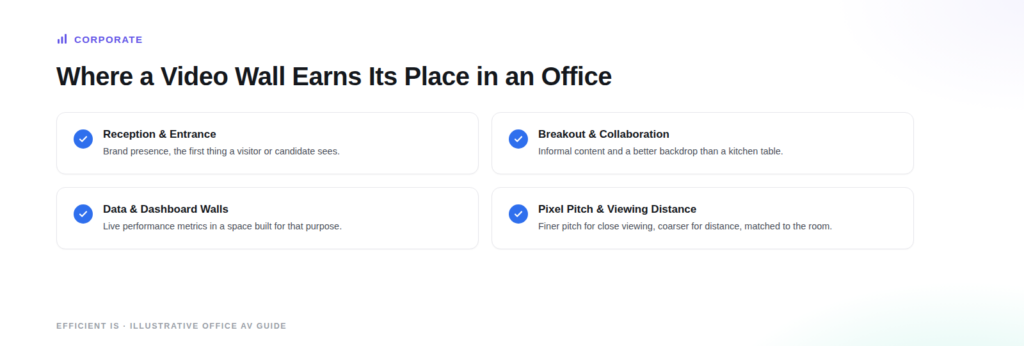
Three locations consistently make sense for a direct view LED wall in an office. Reception and entrance areas use a wall for brand presence and a first impression, often the single most visible piece of technology in the building. Breakout and collaboration spaces use a wall for informal content, team dashboards, or simply a better backdrop for the kind of space staff are being asked to choose over their kitchen table. Larger organisations also use a dedicated data or dashboard wall, showing live performance metrics or operational data, usually in a space built specifically for that purpose rather than a general social area.
The technology and who makes it
Direct view LED has become the default choice for anywhere a wall needs to look genuinely good up close, rather than an LCD video wall with visible bezels between panels. Samsung, LG, Absen, Unilumin and Planar all supply LED wall technology actively used in UK corporate installations, each with strengths in particular pixel pitches and panel formats, which is exactly why staying brand agnostic through procurement matters: the right panel for a reception wall viewed from three metres away is not the right panel for a boardroom wall viewed from one metre away.
What this means for a fit out budget
LED wall cost is driven mainly by physical size and pixel pitch, the distance between individual LEDs, since a finer pitch needed for close viewing costs more per square metre than a coarser pitch suited to a wall people only see from a distance. This is exactly the kind of line item JLL’s fit out guide tracks as part of the wider category of technology and finishes spend in a modern office project, and it is worth scoping early in a fit out rather than as a late addition, since cabling, structural fixing and content management all need to be planned into the build rather than retrofitted afterward.
See our Video Walls page for real pricing context, or our Office Refurbishment and Fit-Out page if this is part of a wider project.
FAQ
Where in an office does a video wall actually make sense?
Reception and entrance areas for brand presence, breakout and collaboration spaces for informal content and a better backdrop, and dedicated data or dashboard walls for live operational metrics in larger organisations. Each of these is a specific job the wall is doing, which is the difference between a worthwhile investment and decoration.
What drives the cost of an LED video wall?
Mainly the physical size and the pixel pitch, meaning the distance between individual LEDs. A finer pitch needed for close up viewing, such as a reception desk, costs more per square metre than a coarser pitch suited to a wall people view from further away, such as above a lobby seating area.
Is this something to plan into a wider office fit out, or can it be added afterward?
It is much better planned in from the start. Cabling, structural fixing and content management all need to be built into the project rather than retrofitted, and fit out guides from firms like JLL already treat this kind of technology spend as a standard line item in a modern office project.
Does it matter which manufacturer we use?
It matters less which single brand and more that the panel is matched to the room. Samsung, LG, Absen, Unilumin and Planar are all genuinely used in UK corporate installations, each suited to slightly different pixel pitches and viewing distances, which is why a brand agnostic specification process is worth insisting on.
Thinking about your reception or breakout space?
Tell us what you’re trying to fix and we’ll tell you honestly what’s realistic.