Door Entry, Access Control and Visitor Management: What’s the Actual Difference?
“Door entry”, “access control” and “visitor management” get used almost interchangeably in conversation, right up until someone asks which one actually stops a former employee getting back into the building. Access control and visitor management in particular get treated as one thing, and most buildings beyond a single-door office end up needing some combination of all three rather than just one.
What door entry actually means
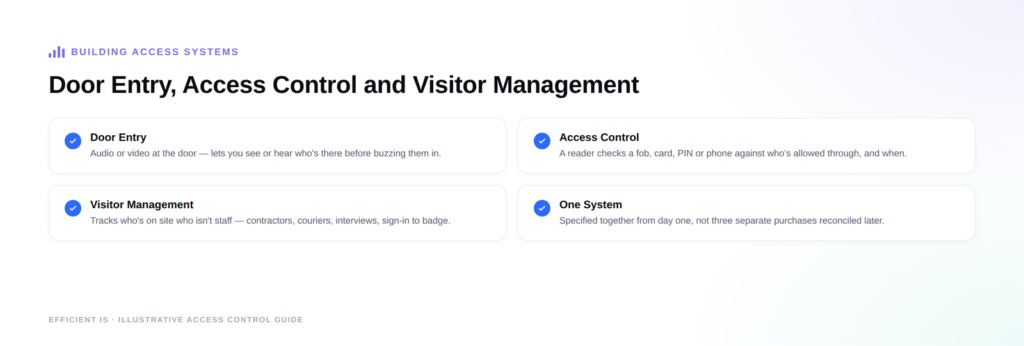
Door entry, sometimes called entry phone or intercom, is the simplest of the three. It lets whoever’s inside see or speak to whoever’s at the door before deciding whether to let them in, and it’s the standard setup on shared entrances in multi-let residential and managed buildings, where a single front door serves several separate occupiers. It doesn’t know who’s coming in, only that someone is, and whether the person being buzzed has decided to let them through.
What access control adds
Access control replaces that conversation with a credential, a fob, card, PIN or phone, and a reader that checks it against a list of who’s allowed through that specific door, at that specific time. Where door entry asks “should I let this person in,” access control already knows the answer and just checks the card. That’s what gives you an audit trail of who went through which door and when, permissions that can differ by door and by time (cleaners allowed in at 6am, not at midnight), and the ability to revoke one person’s access instantly without re-keying a lock. A reader like the UniFi Access Ultra reads a card, fob, PIN or phone and sits on the same network as the rest of the building’s IT, rather than needing its own standalone wiring closet and software.
What visitor management covers
Visitor management sits above both of those: tracking who’s on the premises who isn’t on the regular access list, contractors, couriers, interviewees, job applicants. Historically this has meant a paper book at reception, which has two real problems. It’s not a great look under UK GDPR if every visitor can read the entries above theirs, names, companies and visit reasons of complete strangers, left open for anyone waiting at the desk. And it tells you nothing useful in an emergency: if the fire alarm goes off, nobody actually knows who’s in the building at that moment. A proper setup, kiosk or app-based sign-in, printed or digital visitor badges, a real-time list of who’s on site, solves both problems at once.
Do you need all three?
Genuinely depends on the building. A five-person office with one door probably needs a decent access control reader and nothing else. A multi-let building with a shared entrance and several tenants is likely to need all three, door entry for the shared front door, access control for who gets into which suite, and visitor management so each tenant actually knows who’s visiting them specifically, not just that someone buzzed in. Public-facing premises, retail, hospitality, usually need visitor management and access control more than door entry, since the public walks straight in rather than waiting to be let through. The honest answer is that we design around what’s actually in the building, rather than selling a fixed bundle regardless of size.
See our Building Access Systems page for typical costs and how we scope a project, or our CCTV page for the camera side of building security.
FAQ
Can one system do all three jobs?
Often, yes, modern platforms like UniFi Access can run door entry, access control and a basic visitor log from the same app and the same network, rather than three separate pieces of kit from three different suppliers. It’s not universal though, and a larger or more complex building may still need purpose-built visitor management software alongside it.
What’s the minimum a small office actually needs?
A single access control reader on the front door covers most five-to-twenty-person offices. It replaces the keyed lock, gives you an audit trail, and lets you revoke a leaver’s access immediately rather than re-keying the door. Door entry and formal visitor management tend to matter more once you’ve got a shared entrance or regular visitors you don’t already know.
Is a paper visitor sign-in book actually against the law?
Not inherently, but an open book that every visitor can read, seeing the names, companies and visit reasons of everyone before them, is the kind of thing the ICO would flag as part of a complaint, since it exposes other people’s personal data without their knowledge or consent. A kiosk or app-based system where each entry is only visible to authorised staff avoids the problem entirely.
How much does a basic access control reader cost installed?
From around £450 +VAT per door, supplied and installed, for a straightforward single-door reader, though it depends on cabling, mounting and how many doors you’re doing at once. See our Building Access Systems page for a fuller cost breakdown.
Not sure which of the three you actually need?
Tell us about the building and we’ll tell you honestly what’s worth having.