Commissioning AV alongside BMS and M&E: a coordination checklist
Why AV commissioning should run alongside BMS and M&E rather than after it, and what needs confirming before AV commissioning can genuinely start on site.
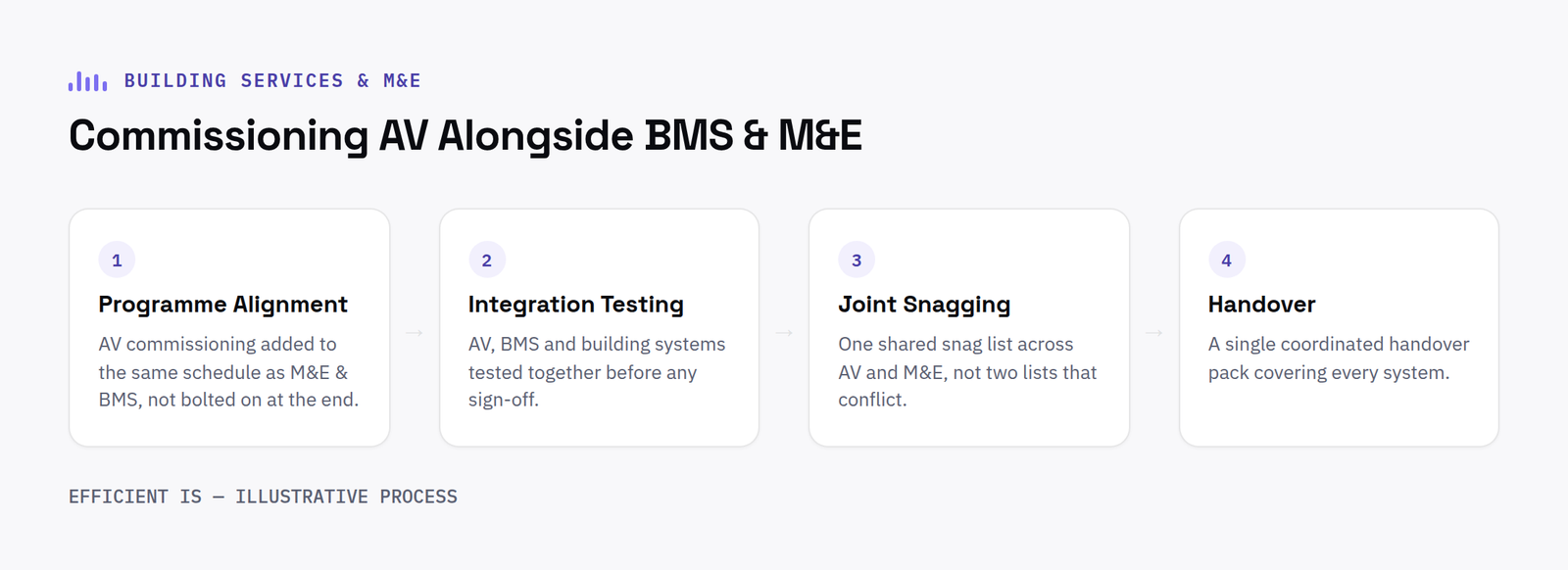
AV commissioning should be sequenced into the same programme as M&E and BMS commissioning, not scheduled as a final task once everything else is signed off. Treating it as a bolt-on means AV faults get discovered after the wider programme has closed, and dependencies on power, network and containment go untested until it is too late to fix them cheaply. Good practice is to commission AV against the same milestones as the rest of the building’s systems, with joint witnessing wherever AV shares infrastructure with network or BMS.
Why AV commissioning ends up as an afterthought
On most projects, AV is procured and installed by a specialist contractor who sits outside the core M&E team, with scope defined late relative to power, data and BMS. That has a knock-on effect on commissioning: the M&E and BMS programme gets built first, around the systems everyone treats as critical path, power distribution, ventilation, life safety, controls, and AV commissioning gets added to the end almost as a formality, on the assumption it can happen whenever the room is “basically ready”.
The problem is that AV is rarely self-contained. A video wall, a room booking panel, a conferencing codec or a digital signage player all depend on power that has been tested and stable, a network that is live and correctly VLANed, and containment that is actually complete rather than substantially complete. If any of those are still being finished when the AV commissioning engineer arrives, the visit either gets wasted or turns into partial commissioning with a snag list that has to be revisited, usually after the main commissioning team has already demobilised.
The other recurring issue is sign-off. Where AV sits outside the main commissioning programme, its test results and snagging live in a separate document, checked separately, on a separate timeline. Nobody owns the interface between AV and the systems it depends on, so a network configuration fault gets logged as an AV fault, and time is lost working out which contractor actually needs to attend. We cover the same coordination problems, from the other direction, in our post on AV/M&E coordination for containment, power and data: commissioning is where poor coordination earlier in the programme shows up.
What good coordination looks like when commissioning AV alongside BMS
Good AV commissioning coordination starts with a shared programme, not a shared spreadsheet after the fact: AV commissioning dates inside the same commissioning schedule as BMS and M&E, sequenced against the systems AV depends on, rather than tacked onto the end as a separate line.
Where AV interacts directly with another system, testing should be witnessed jointly rather than commissioned in isolation and assumed to work. AV running over the building’s structured network is the clearest example: if AV traffic sits on specific VLANs or routes through specific switching, that should be tested with both the AV engineer and the network commissioning engineer present, so a fault is diagnosed once by the right people rather than bounced between two contractors guessing at each other’s configuration. The same applies to AV integrated with room booking or BMS, occupancy sensing feeding room booking displays, or AV power sequencing tied into building controls. Our post on structured cabling standards for building services engineers covers the physical layer this depends on.
Coordination also means a single commissioning record: AV test results, snagging and sign-off feeding into the same commissioning file as the rest of the programme, rather than sitting as a standalone AV document reconciled separately at handover.
What needs to be confirmed before AV commissioning can genuinely start
Before an AV commissioning visit is scheduled, a small number of things need to be true, and it is worth someone actually confirming them rather than assuming they are done because the programme says so. Power to the room needs to be live and tested, not just connected, an unstable or untested supply produces faults that look like equipment problems but are actually electrical ones. The network needs to be live and correctly configured for the AV equipment specifically, meaning the ports and VLANs AV depends on have been set up and tested, not just that the network is operational in general. Containment relevant to AV, first fix cabling, second fix connections, cable management at screen and lectern positions, needs to be complete, because commissioning that starts before containment is finished tends to surface problems that are actually containment problems, logged incorrectly against AV. And the room’s fit-out needs to be substantially finished: ceiling tiles in, furniture in position, and any building work that could disturb a screen mount, ceiling speaker or wall plate either finished or sequenced to happen after AV. None of this needs to be perfect, but it needs to be genuinely at the stage the programme claims, because commissioning against systems that aren’t actually ready produces false snagging that has to be worked through again on a second visit.
This is usually easier to get right if it is built into the programme from the design and tender stage rather than retrofitted once installation is underway, our design consultation and tender management service is aimed at exactly that point in a project, before commissioning sequencing becomes a problem to solve rather than a plan to follow.
Who should be in the room for AV commissioning sign-off
AV commissioning sign-off works best with the same discipline as the rest of the commissioning programme: the people who can actually resolve an issue on the spot should be present, not brought in afterwards to explain a fault already logged incorrectly. That typically means the AV commissioning engineer, a representative able to speak to the network configuration if AV runs over the building network, and someone from the main contractor or client side who can confirm room readiness and authorise final fit-out adjustments. Where AV is integrated with BMS or room booking, whoever is commissioning that system should be available too, at least for the tests where the two interact. Involving the right people at sign-off, rather than after it, is what actually closes out the snagging list instead of extending it.
FAQ
Should AV commissioning happen before or after the room is fully finished?
It should start once the room is substantially finished, power live and tested, network live and configured, containment complete, rather than waiting for absolute completion or starting while those things are still in progress. Starting too early produces false snagging; leaving it until everything else is fully signed off tends to push AV commissioning outside the main programme entirely.
Why does AV commissioning depend on network commissioning specifically?
Most modern AV equipment, from video conferencing codecs to digital signage players, runs over the building’s IP network rather than dedicated AV cabling. If the network isn’t live and correctly configured for the ports and VLANs AV needs, AV commissioning either can’t proceed or produces faults that are actually network configuration issues rather than AV ones.
Who is responsible for AV commissioning on a project with a separate M&E contractor?
This should be agreed and documented at design or tender stage, not left to be worked out during commissioning. Where AV is a distinct package, the AV contractor typically owns AV-specific commissioning, but sign-off on shared interfaces, like AV over the network or AV integrated with BMS, needs joint witnessing with whoever owns that adjacent system.
If you’re planning the commissioning phase of a project with an AV element, it’s worth looking at how AV commissioning is sequenced against the rest of the programme before it becomes a problem on site. See our building services and M&E sector page for how we work with consultants and project managers on this, or go straight to our commissioning and programming page for how we handle AV commissioning itself. To talk through a specific project, get in touch and we’ll get back to you.
Sequencing commissioning on a project with AV?
Get in touch and we'll help you build AV into the programme properly.