Hearing Loop Installation and the Equality Act: What an Installer Should Hand Over
The Equality Act never mentions a hearing loop. It asks for reasonable adjustments, and a loop is one common answer. Here’s what the Act says and what a good hearing loop installation includes.
Hearing loop installation isn’t something the Equality Act 2010 spells out. Section 20 asks for reasonable steps to provide an auxiliary aid where a disabled person would otherwise be at a substantial disadvantage, and a loop is one common way to do that. What counts as reasonable depends on your building and your service.
This post is not legal advice. It sets out the statute wording we checked, the standard an installer should commission against, and what a good job looks like. We last checked the sources in October 2026.
What the Equality Act says about hearing loop installation
Section 20 sets out a duty made up of three requirements. The third is the one that matters here. Where a disabled person would, but for an auxiliary aid, be put at a substantial disadvantage, section 20(5) requires you to take such steps as it is reasonable to have to take to provide that aid. Section 20(11) adds that an auxiliary aid includes an auxiliary service.
Section 29 applies the duty to service providers, and section 29(7)(a) says so directly. Schedule 2 then says that for services, the reference to a disabled person in section 20(3), (4) or (5) is to disabled persons generally. In effect, you can’t wait for a named complaint before you think about it. That’s our reading, not the statute’s own phrase.
Paragraph 2(7) of the same schedule says a service provider needn’t take a step that would fundamentally alter the nature of the service or the nature of its trade or profession. The Act applies across Great Britain. It never uses the words “induction loop”, and no section prescribes a hearing loop. “Reasonable” gets judged case by case, so a village hall and a large auditorium will land in different places.
The Equality and Human Rights Commission publishes a statutory Code of Practice on services. A 2026 edition is now on GOV.UK, so check you’re reading the current one before you quote it to anyone.
Who a hearing loop helps, and where it falls short
A hearing loop installation helps people whose hearing aids or implants have a telecoil, and only those people. RNID says over 18 million adults in the UK are deaf, have hearing loss or tinnitus, and that figure includes tinnitus. It also estimates 2.4 million adults have hearing loss that makes most conversational speech hard to follow. Not all of them will have a telecoil, and not all of them will know how to switch it on.
The ABTT’s 2013 guide to hearing assistance in UK auditoria gives a fair summary of the trade-offs. Loops are comparatively easy to install, relatively low in cost and can be discreet. The downsides are electrical and magnetic noise, especially from lighting control equipment, audio quality that isn’t always good, and large or variable seating that is hard to cover. Infrared systems avoid the magnetic noise. They need line of sight, receivers, chargers and someone to manage them.
Bluetooth Auracast is the newer option. The Bluetooth SIG says loops and telecoils have long been the standard for assistive listening in public spaces, and that Auracast broadcast audio can send sound from PA systems and TVs straight to hearing aids, with supporting products now coming onto the market. We’d treat it as emerging and complementary. We aren’t giving dates, because we haven’t seen any we trust.
What BS EN IEC 60118-4 covers
The current designation we found is BS EN IEC 60118-4:2015+A1:2018, and BSI lists it as current, published 30 April 2018. We checked in October 2026 and found no newer edition. Its title is Electroacoustics, Hearing aids, Induction-loop systems for hearing aid purposes, System performance requirements.
The standard sets requirements for field strength in audio-frequency induction loops used with telecoil hearing aids. It also covers minimum frequency response, measurement methods, a check of magnetic background noise on site, the useful volume of the field and commissioning steps. It doesn’t cover loop driver amplifiers. Those fall under IEC 62489-1.
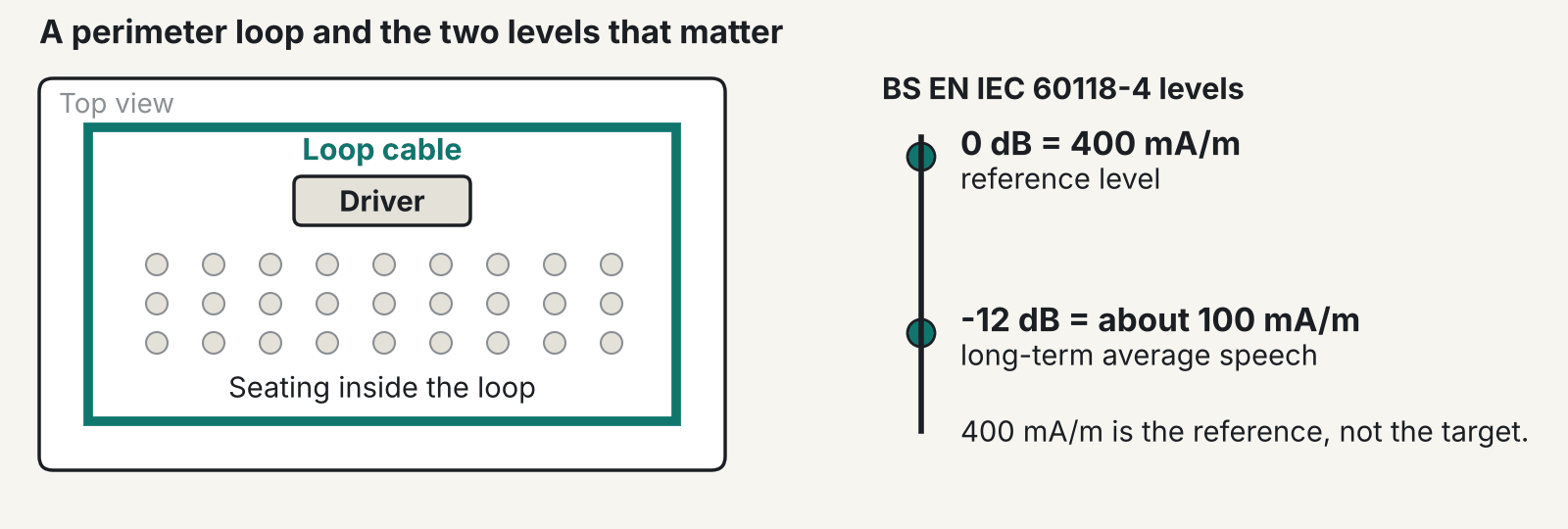
You’ll often see a “400 mA/m target” quoted. That’s a simplification. In the standard, 400 mA/m is the 0 dB reference. The long-term average speech level is about 100 mA/m, which is minus 12 dB against that reference. We haven’t quoted tolerances, background noise limits or measurement heights, because the secondary sources we read disagree. Read the standard or ask the installer to show you the figures they commissioned to.
What a good hearing loop installation includes
A good hearing loop installation starts with a survey, and a cable drum comes later. The installer should measure background magnetic interference with a field strength meter, look for metal in the floor and choose a loop type. A perimeter loop can spill a long way outside the room. A joint design guide from two loop manufacturers says up to four times the loop width. Phased array loops cut that spill, to about 1.2 m from the edge in that guide. It also says steel rebar or pan decking soaks up field at the top of the frequency range, and extra amplifier power won’t fix that.
Next comes the driver, matched to the loop and set up for any metal loss. Then cabling, kept clear of other cables. The same design guide gives 61 cm from parallel voice, data or mains wiring. Buried cable should be marked on the drawings.
Commissioning comes last, and it’s where jobs get skipped. The installer measures with a calibrated meter against BS EN IEC 60118-4, records the results and issues a certificate. Signs go up at each loop-served area so users know to switch to the telecoil setting. In our view, an installer who can’t show you the measured results hasn’t finished the job.
Where loops fail after handover
Most failures after a hearing loop installation are boring. The amplifier’s unplugged, or the source was never routed to it. Microphone gain was set for an empty, quiet room and nobody revisited it when the room filled. Someone fits new dimmers or screens after commissioning, and the interference changes. Then nobody can say what normal sounded like, because the test was never written down.
The fix is routine. Hearing Link guidance says a basic listening test should be done on a regular basis and before events, with a more thorough check normally done annually by a specialist loop supplier. If staff can’t say where the loop is and how to test it, you have a loop in name only. Fold the annual check into your AV maintenance contract so it doesn’t slip. Plan for the day it fails too. The ABTT guide says to tell staff and post notices when a loop is out of action before an event, so users aren’t left guessing at the door.
Questions to put to an installer
Before you sign, put these to the installer:
- Which loop type are you proposing, and why? What will the hearing loop installation cover and what won’t it?
- Will I get the measured results and a certificate at handover, with the standard and its edition named on it?
- Who tests the loop, and how often?
- What signs do you supply, and what should staff do when the loop fails before an event?
- What happens if we change the room later?
Floors matter in any hearing loop installation. Our places of worship page notes that metal in floors complicates loops, and the same applies in many modern meeting spaces. For a real example, the induction hearing loop in our Scottish Fire and Rescue Service Cambuslang auditorium covers the whole auditorium.
See our Meeting Room AV page for the wider audio picture. We design and install from Glasgow, and we’ll tell you straight if a loop isn’t what your room needs.
FAQ
Is a hearing loop a legal requirement?
The Equality Act doesn’t mention hearing loops. It requires reasonable steps to provide an auxiliary aid where a disabled person would otherwise be at a substantial disadvantage, and what is reasonable depends on your premises and your service. For your own position, take legal advice. This post is not legal advice.
How much does hearing loop installation cost?
It depends on room size, loop type, metal in the floor and how many areas you need to cover. We haven’t got a sourced price to quote, so we won’t invent one. Ask for a quote that follows a survey.
How do I know if my hearing loop installation works?
Ask for the commissioning record that shows measured results against the standard. Staff should do a basic listening test regularly and before events, and a specialist should check it annually. If you have no test record, you don’t yet know.
Do hearing aids need a special setting for a loop?
Yes. The hearing aid needs a telecoil, switched on with the T setting or the equivalent programme. Without one, a loop does nothing for the wearer, which is why signs and staff awareness matter.
Are hearing loops being replaced by Bluetooth?
Not that we can see. The Bluetooth SIG describes Auracast as a way to send audio from PA systems, TVs and other sources direct to hearing aids, with supporting products now arriving. We’d treat it as complementary for now and give no dates.
Which standard should a hearing loop be tested against?
BS EN IEC 60118-4:2015+A1:2018 is the current edition we found when we checked in October 2026. It covers field strength, frequency response, measurement methods and commissioning. Loop driver amplifiers are covered by a different standard, IEC 62489-1.
Not sure if your loop works, or if you need one?
Tell us about the room and what you’ve got now, and we’ll give you a straight answer.