
How to write an AV tender brief that gets you comparable bids
Why vague AV tender briefs produce incomparable quotes, what a proper brief needs, and a practical checklist for a tender pack that scores fairly.
A tender brief produces comparable bids when every bidder is pricing the same defined scope against the same drawings, the same evaluation criteria and the same deadline, anything less and you’re comparing three different guesses at what you meant, not three quotes for the same job. Fixing that is mostly a matter of discipline in how the brief is written, not a big technical undertaking.
Anyone who has opened three AV tender responses and found one at half the price of another has usually found a brief problem, not a market problem. The bidders aren’t being dishonest, they’re each pricing a different project, because the brief left room for that to happen.
Why vague briefs produce incomparable bids
A brief that says “AV system for the boardroom, video conferencing capable” gives three competent suppliers three legitimate but different answers. One prices a single display and a soundbar. Another prices dual screens, a ceiling microphone array and ceiling speakers. A third assumes adequate network provision already exists, while a fourth builds in a new data run because nothing told them otherwise. None of them has done anything wrong, each has made a reasonable interpretation of an under-specified requirement, and you’re now comparing four different systems as if they were the same one.
This is the single most common reason AV tenders come back looking chaotic. It isn’t that suppliers pad quotes or lowball to win, it’s that ambiguity in the brief gets resolved silently, bidder by bidder, and you only find out where each landed once the prices are in front of you. By then it’s too late to run a fair comparison without going back and asking everyone to re-quote, which costs time and irritates bidders who priced accurately the first time. The fix isn’t a longer brief. It’s one that closes off the specific places where bidders are currently allowed to guess.
What a genuinely comparable brief needs
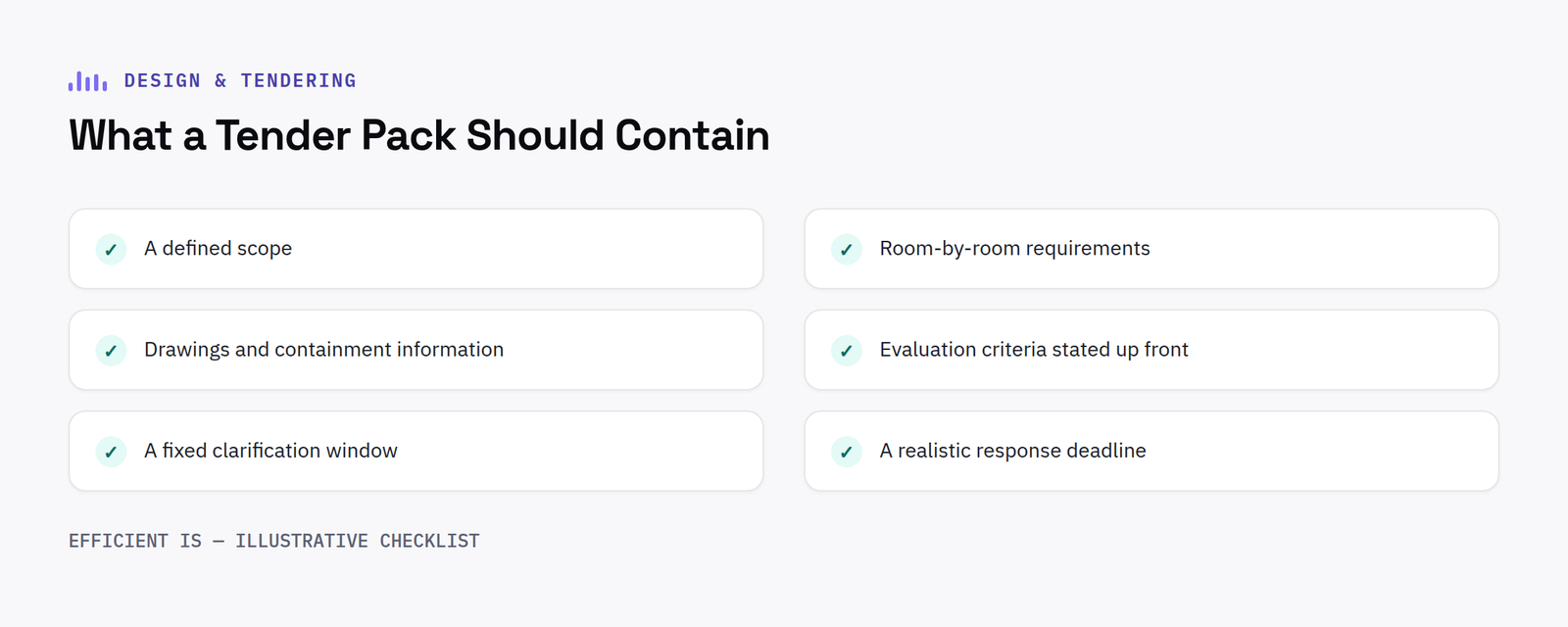
A defined scope. State plainly what is and isn’t included, which rooms, which systems, whether cabling and containment are in scope, whether existing equipment is being reused, and who is responsible for any builders’ work. If a bidder has to ask “does this include the room next door?”, the scope wasn’t defined.
Room-by-room requirements. A single paragraph covering an entire building rarely survives contact with reality. Break the requirement down by room or room type, number of participants, whether it needs video conferencing, which platform (Teams, Zoom, Webex or similar) it must run natively, and whether it’s a huddle space, boardroom or council chamber, each with different acoustic and control demands.
Drawings and containment information. Even a basic floor plan showing room dimensions, existing power and data points, and any known containment routes removes a huge amount of guesswork. Bidders without this either pad their price to cover the unknown or assume the best case and under-price it, neither gives a comparable figure. Our guide to what to expect from CAD and BIM-aligned AV drawings covers what a properly drawn design pack should contain.
Evaluation criteria stated up front. Tell bidders how the award decision will be made before they submit, the weighting between price and quality, what quality covers (experience, method statement, warranty terms, aftercare), and any pass/fail requirements such as accreditations. A bidder who doesn’t know how they’ll be scored can’t target their response at what matters to you, and you lose the ability to defend the outcome if challenged later.
A fixed clarification window. Set a specific period for bidders to submit questions, and circulate every question and answer to all bidders equally, never answer one privately. This keeps the process level and stops the brief being quietly rewritten mid-process for whoever asked first.
A realistic response deadline. A brief with two weeks to respond for a multi-room project with drawings to review will get rushed, corner-cutting responses, or no response at all from bidders who decide it isn’t worth the effort. Match the deadline to the actual complexity of the ask.
Specifying outcomes versus specifying products
One of the more common mistakes in AV briefs is confusing “what the room needs to do” with “which exact product to buy.” Both under- and over-specification cause problems, just in opposite directions.
Naming an exact model number for every item narrows the market to whichever bidders happen to source that product, and can read as a procurement red flag in a public sector process, since it looks like the brief was written around one preferred supplier rather than a genuine requirement. It also locks you into that product’s pricing and availability at the moment you wrote the brief, which may have changed by award.
Under-specifying has the opposite problem. “Suitable display and audio for video conferencing” gives a bidder every incentive to quote the cheapest hardware that technically meets that description, because nothing stops them. The gap between “meets the letter of the brief” and “meets what the room actually needs” is exactly where corner-cutting lives.
The workable middle ground is to specify outcomes with enough technical definition that quality can’t be quietly dropped: not “a display” but “a display of at least 75 inches viewable from the back row at the specified distance”; not “a microphone” but “microphone coverage rated for the room’s dimensions with a defined pickup range.” That gives every bidder the same performance target while leaving them free to propose the product that meets it, which is also where brand-agnostic bidders can compete genuinely on value rather than on who got named in the brief.
What a tender pack should contain
In practice, a complete AV tender pack that supports fair comparison should include: a written scope of works stating what’s included and excluded; room-by-room requirements framed as performance outcomes, not just a hardware list; floor plans or drawings showing dimensions and existing services; a statement of the evaluation criteria and weighting; a fixed timetable covering issue date, clarification window, submission deadline and expected award date; instructions on submission format so every bid can be compared side by side; and any site access or survey arrangements bidders need before pricing accurately. Missing any one of these tends to reappear later as a clarification question, a price disparity, or a bidder declining to respond.
FAQ
How much detail does an AV tender brief actually need?
Enough that a bidder never has to guess at scope, room requirements or how they’ll be scored. That doesn’t mean specifying exact products, it means being precise about outcomes, dimensions and what’s included.
Should a tender brief name specific AV brands or products?
Generally no. Naming exact models narrows the market to whoever can source that product and can look like the brief was written around a preferred supplier, which is a red flag in public sector procurement. Specify performance outcomes and let bidders propose the product that meets them.
How long should bidders get to respond to an AV tender?
Enough time to review drawings, ask clarification questions and price properly, this scales with complexity. A single meeting room might need a couple of weeks; a multi-room building with site visits needed will take longer. Rushing this stage produces rushed, lower-quality responses.
If you’d rather have this built for you, Efficient IS runs the full process, brief capture, CAD/BIM-aligned drawings, tender pack, evaluation support and appointment, through our Design Consultation & Tender Management service, either as independent technical advisor or as a bidder ourselves depending on which route suits your project (see our guide to blind versus open market tendering). We can also wrap in ongoing support and maintenance once a contractor is appointed, and for Scottish public sector bodies we’re an approved supplier on the Scotland Excel framework. To talk through a project, get in touch.
Want help writing a brief that gets comparable bids?
Get in touch and we'll talk through what your tender pack needs.