Blind tender vs open tender for AV projects: which should you use?
Blind tender or open market tender for your AV project? A plain-English comparison, the safeguards that keep either one fair, and how to choose.
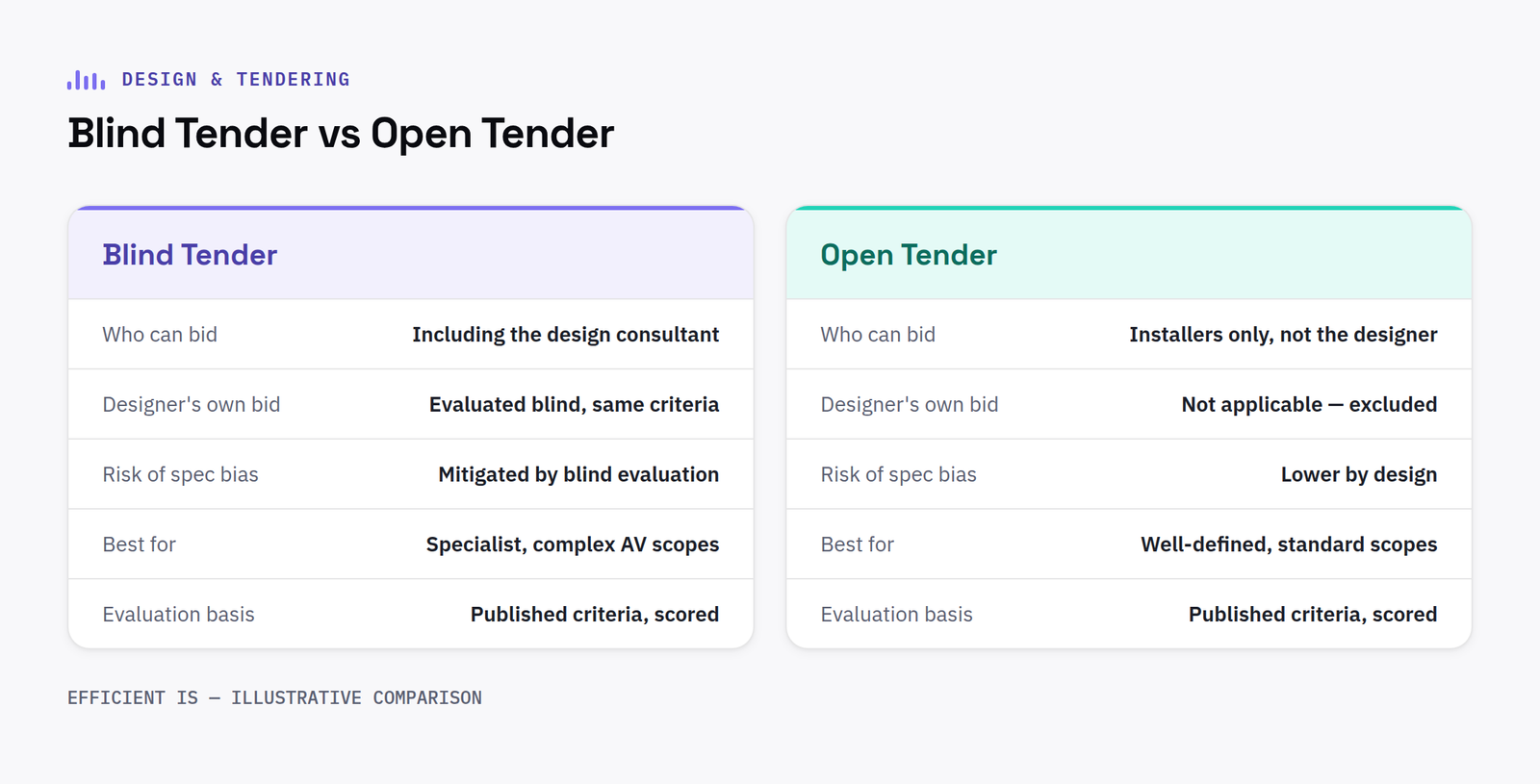
A blind tender is one where the party that designed the specification is also allowed to bid for the installation work, with their bid evaluated blind against the same published criteria as every other bidder and the scoring independently verified. An open market tender is one where the design partner acts purely as technical advisor and does not bid at all. Both can produce a fair, well-run outcome, the right choice depends on how much independence your project needs to be seen to have, not just have.
These two terms come up constantly once a client realises their AV design partner might also want to install the system they’ve just specified. It sounds like a conflict of interest on the surface, and in a badly run process it can be. In a properly run process, it’s a standard and widely used procurement route. The confusion usually isn’t about which one is “better”, it’s about which one fits the project in front of you.
What a blind tender actually means
In a blind tender, the design consultant who wrote the specification and drawings is permitted to submit a bid for the delivery contract alongside other bidders. The word “blind” refers to how that bid is treated once it’s in: it goes into the same evaluation process as everyone else’s, scored against criteria that were published before any bids were opened, and, critically, scored by someone other than the person who wrote the spec. If the design team also scored their own bid, that wouldn’t be a blind tender, it would just be a conflict of interest with extra paperwork.
Done properly, a blind tender is efficient. The consultant who wrote the brief already understands the site, the constraints and the intent behind the specification, so their bid tends to be accurate and their transition into delivery is smooth if they win. Clients who’ve worked with the same AV partner across design and previous projects often prefer this route precisely because it keeps continuity, provided the scoring is genuinely walled off from the design relationship.
What an open market tender means
In an open market tender, the design partner steps out of the bidding entirely. They write the specification, produce the drawings, build the tender pack, and support you through evaluation, but they do not price the installation, and they have no financial interest in who wins. Every bidder competes on equal footing with no one holding an inside position on the brief they helped write.
This route removes the conflict-of-interest question before it can be asked. That’s valuable in its own right, separate from whether the blind version would have been run fairly. Some public sector procurements require it outright, or require it above certain contract value thresholds, because the funding body’s own governance rules don’t allow the ambiguity, regardless of how well-intentioned or well-controlled the alternative might be.
When each route makes sense
A blind tender tends to suit projects where you already trust the design partner’s judgement, want continuity between the people who specified the system and the people delivering it, and can put genuine independent scoring in place. It’s common on corporate fit-outs, refurbishment projects and situations where a single point of accountability from design through to commissioning is worth more to you than maximum market competition.
An open market tender tends to suit projects where independence has to be beyond question, not just actually fair, but demonstrably fair to anyone who later asks how the contract was awarded. That’s most public sector capital projects, anything funded through a route with its own procurement conditions, and any project where a losing bidder challenging the outcome would be genuinely costly. If you’re working through the Scotland Excel framework route, the framework’s own rules will usually tell you which of these applies rather than leaving it to preference.
Neither route is inherently more rigorous than the other. A blind tender with proper safeguards is arguably as defensible as an open market one, it just requires you to actually build those safeguards in, rather than assume good faith will cover it.
What keeps a blind tender genuinely fair
Three things separate a defensible blind tender from a paper exercise. First, the evaluation criteria have to be published and fixed before any bids are opened, not adjusted afterwards to suit whoever comes out ahead. Second, the scoring itself needs to sit with someone independent of the design relationship: a separate evaluation panel, a third-party assessor, or at minimum a documented split between the people who wrote the spec and the people who mark the bids against it. Third, there needs to be a paper trail, a record of who scored what, against which criteria, and why, that would hold up if a losing bidder asked to see how the decision was reached.
None of this is complicated to set up, but it has to be deliberate. Skip any one of the three and a blind tender stops being blind in any meaningful sense, even if nobody involved intended anything improper. We’ve written more on how to get the underlying specification right in our guide to writing an AV tender brief, since a vague brief undermines fair evaluation regardless of which tender route you run.
A practical way to decide: blind tender vs open tender
If your priority is continuity, speed, and you’re confident you can put a properly independent scoring panel in place, a blind tender is a reasonable and common choice, and it doesn’t have to mean fewer bidders or less competition, just one bidder with prior knowledge of the brief. If your priority is that the process needs to be unquestionable to a funding body, an elected member, an auditor or a disappointed bidder, run it open market and keep your design partner purely as technical advisor throughout. When you’re not sure which applies, the honest answer is usually to check your organisation’s own procurement rules or funding conditions first, they often decide it for you before preference even enters the conversation.
FAQ
Can the same company write the AV specification and then win the contract to install it?
Yes, under a blind tender, provided their bid is evaluated against published criteria by someone independent of the design relationship, and the scoring process is documented. Without those safeguards, it’s a conflict of interest rather than a valid blind tender.
Is a blind tender less fair than an open market tender?
Not inherently. A well-run blind tender with independent scoring and a clear paper trail can be just as defensible as an open market process. The difference is that open market removes the question of independence entirely, while blind tender requires you to actively demonstrate it.
Does public sector procurement always require an open market tender?
Not always, but many public sector projects do require it, or require it above certain contract values, depending on the funding route and the procuring body’s own governance rules. It’s worth checking your specific framework or funding conditions before choosing a route.
Efficient IS runs both blind and open market AV tenders for councils, architects, building services consultants, IT MSPs and office refurbishment contractors, and we’re upfront with every client about which route suits their project before any drawings get started. If you’re planning a design brief, want to see what CAD and BIM-aligned AV drawings actually involve, read our post on what to expect from CAD/BIM-aligned AV design, or head straight to our Design Consultation & Tender Management page. To talk through which tender route fits your project, get in touch: it’s the fastest way to reach us.
Not sure which tender route fits your project?
Tell us about it and we'll talk you through what's appropriate.