
How to stop AV becoming the last-minute item in your refurb programme
Why AV so often becomes the last, rushed trade in an office refurbishment programme, and how early procurement and one accountable partner can prevent it.
AV becomes the last-minute item in a refurbishment programme because it’s procured late, treated as a small add-on rather than a coordinated trade, and left dependent on every other trade finishing first. The fix is to procure the AV package early enough that equipment lead times aren’t the bottleneck, agree AV milestones as part of the main programme rather than bolting them on afterwards, and appoint one accountable partner to carry the work from design through to snagging.
Most fit-out contractors and project managers have seen this play out at least once: the programme is holding up fine until second fix, and then AV, screens, room systems, control, signage, turns into the trade everyone is waiting on. It’s rarely because AV work is technically difficult. It’s because of when and how it gets brought into the programme in the first place.
What helps stop AV becoming the last-minute item
The first reason is perception. AV gets treated as “a screen on a wall” rather than a coordinated trade with its own design, procurement and installation sequence. A screen and a soundbar in a meeting room looks simple from the outside, but behind it sits a cable schedule, a control system, network configuration, mounting hardware chosen for a specific wall build-up, and commissioning time to get it working reliably. Treating that as an afterthought is where the trouble usually starts.
The second reason is value, or rather how value gets read. Against the cost of the main fit-out contract, partitions, ceilings, flooring, M&E, the AV package is often a fraction of the overall spend, so it gets procured after the trades that look bigger on paper. But cost and lead time aren’t the same thing. Room systems, video wall processors, control processors and specialist mounting hardware can carry lead times that have nothing to do with how much the package costs, and procuring late means the equipment arrives late regardless of how simple the install itself is.
The third reason is dependency. AV genuinely can’t start second fix until power, data, ceiling grid and joinery are substantially finished: screens need a wall or bracket that’s actually there, control systems need power and network points terminated. That’s a reasonable sequence in principle. The problem is that any slippage upstream, a delayed ceiling, a late joinery item, a snag in first fix, doesn’t get absorbed anywhere else. It lands entirely on AV, scheduled at the end of an already-compressed window with no float left to give.
Put those three together and the pattern is predictable: a trade underestimated on lead time, procured late because it looks like a small package, and scheduled last because it depends on everything else, with no slack built in for when any of that goes wrong. Our companion post on what to specify for AV before first fix covers the technical side of this same problem.
Procure early enough that lead times aren’t the bottleneck
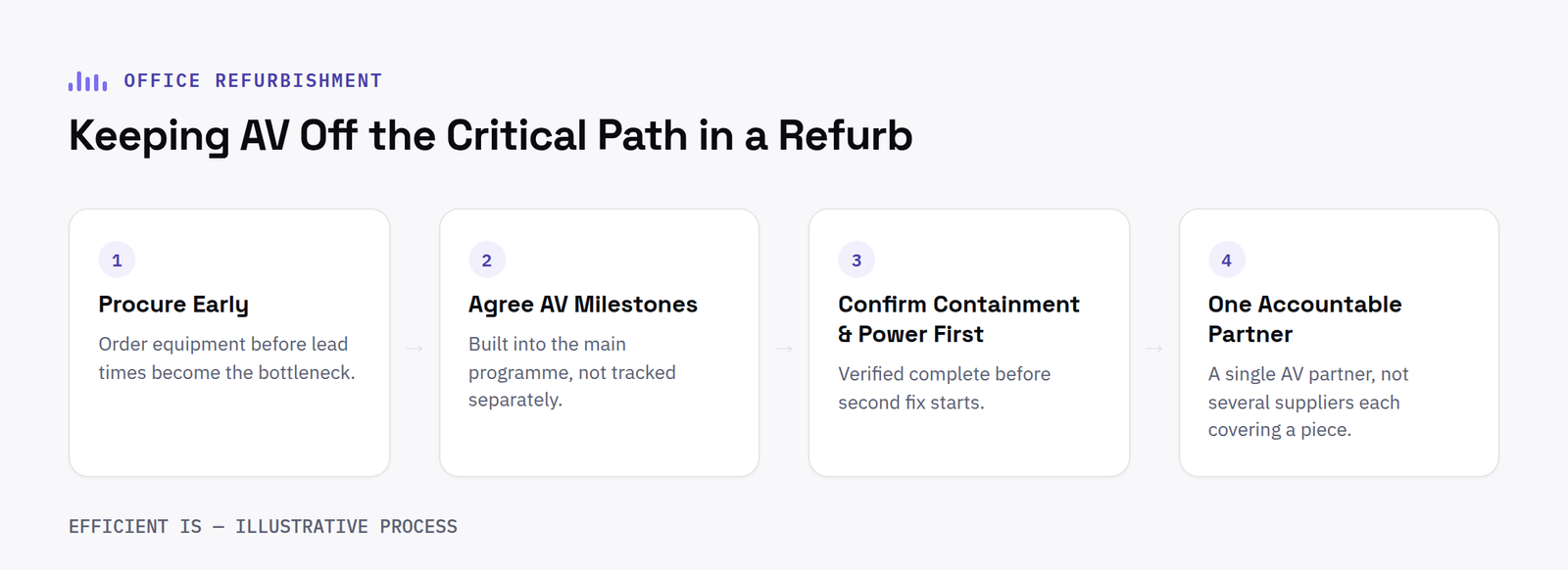
The single biggest lever is procurement timing. If the AV package is tendered and appointed at the same stage as the rest of the fit-out, not after the main contract is already under way, equipment lead times run in parallel with the rest of the programme instead of stacking on top of it at the end. That means specifying AV requirements early enough to get accurate lead times from suppliers, and treating those lead times as a genuine programme constraint rather than something to be absorbed later.
This is easier when AV design and tendering happen as a structured exercise rather than an informal conversation partway through the project. Our design consultation and tender management service is built around exactly this, getting AV requirements defined, costed and appointed early enough that procurement isn’t racing the programme.
Agree AV milestones as part of the main programme
AV needs its own line items on the master programme, tied to the same dependencies everyone else is working to, first fix complete, ceiling grid in, containment tested, second fix window confirmed, rather than a vague allowance at the end marked “AV install.” When AV milestones sit inside the main programme with the same visibility as every other trade, delays get flagged and managed as they happen, not discovered in week one of what was meant to be AV’s window. Our guide to meeting room AV standards for office fit-outs sets out the kind of specification detail that needs to be agreed early enough to actually hit those milestones.
Make sure containment and power are actually finished before second fix
“Should be fine” is the phrase that causes the most AV delay on site. Second fix AV depends on containment and power genuinely being complete and tested, not scheduled to be complete, but actually done and checked. A containment run that’s 90% in, or a power circuit that’s live but not yet tested, is enough to stop an AV second fix team starting cleanly. Confirming this properly before AV is due on site protects the tail end of the programme from a last-minute pile-up.
One accountable AV partner, not several suppliers each covering a piece
A lot of AV programme problems come from splitting the work across multiple suppliers, one for design, another for supply, another for install, sometimes a separate party for control programming or network configuration. Each piece might be handled competently, but nobody owns the join between them, and when something goes wrong at the boundary, a mismatch between what was designed and what was installed, there’s no single point of accountability to resolve it quickly.
A single AV partner carrying the work from design through procurement, installation, commissioning and snagging removes that gap. It means one point of contact who already understands the room, the equipment and the wiring when something needs fixing at handover, rather than a project manager working out which of three suppliers is responsible for a fault. It also means the person who designed the system is accountable for it actually working, not just for handing over a specification. Carrying that through to a formal support and maintenance arrangement after handover extends the same accountability past practical completion, rather than the trail going cold once the contractor demobilises.
FAQ
Why does AV always seem to be the last trade finished on a refurb?
Because it’s usually procured late, it looks like a smaller package than the main fit-out contract, even though equipment lead times don’t scale with cost, and because it depends on power, data, ceiling and joinery finishing first, so any upstream delay pushes straight through to AV with no float left at the end of the programme.
How early should AV be procured in an office fit-out programme?
At the same stage as the rest of the fit-out package, not after the main contract is under way. Procuring early enough to get accurate equipment lead times means AV can run in parallel with the rest of the programme instead of becoming the bottleneck at second fix.
Is it better to use one AV partner or separate suppliers for design, supply and install?
One accountable partner covering design through to commissioning and snagging is generally more reliable. Splitting the work across multiple suppliers means nobody owns the join between design, procurement and installation, which is exactly where problems and delays tend to surface.
If you’re planning or already mid-way through an office refurbishment and want AV built into the programme properly rather than left to catch up at the end, our office refurbishment & fit-out page sets out how we structure that work, or get in touch to talk through your programme and where AV needs to sit within it.
Worried AV will end up last on your programme?
Get in touch and we'll help you build it into the plan properly.