
AV Equipment Price Rises: What the Memory Shortage Means for Your Quotes
AV equipment price rises are uneven. Panels are flat, but the memory inside room PCs, players and servers is rationed into 2028, so the risk sits in how long a quote stays valid.
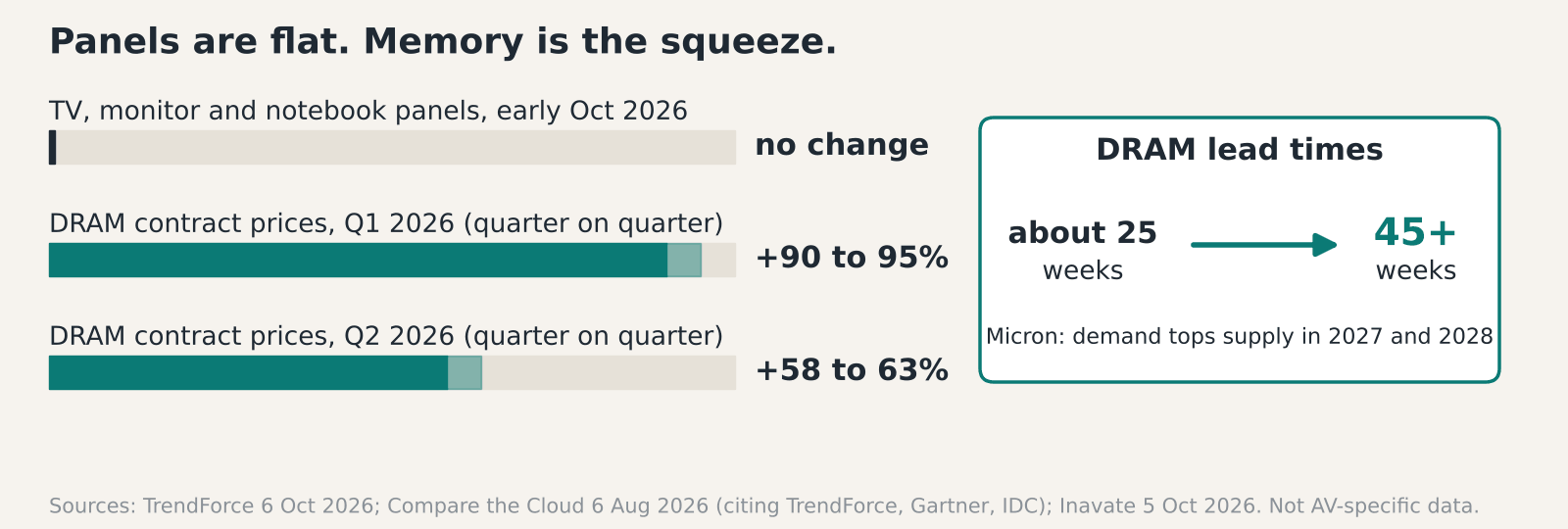
Some AV equipment price rises are real, but they don’t hit everything. TrendForce had panel prices flat in early October 2026, while Micron’s chief executive says memory demand will exceed supply through 2027 and 2028. In our view the exposure sits in the PCs, players and servers behind the screen, and it shows up first as short quote validity.
What changed: as of 8 October 2026, Inavate reported on 5 October that memory shortages will continue into 2028, citing Micron comments from 1 October. TrendForce said on 6 October that panel prices were flat. We checked both on 8 October 2026.
Which AV equipment price rises are real?
The rises are in memory and compute, and in some vendors’ list prices. Panels are steady for now. TrendForce reported early October prices for TV, monitor and notebook panels as flat, with upstream component costs rising and squeezing panel makers’ margins. It didn’t discuss commercial displays or memory specifically.
Memory is another matter. Inavate quotes Micron’s chief executive as saying that “in calendar 2027 as well as 2028, we see demand exceeding supply”, and that customers will pay much higher prices than this year. 24/7 Wall St reports Micron saying more than 75% of its 2027 output is already contracted, with most new capacity arriving from late 2028.
Some AV vendors raised prices earlier this year. Commercial Integrator reported on 7 May 2026 that several AV manufacturers were rolling out increases amid the tariff situation. We could read only the summary, so we can’t give you amounts, dates or the names involved.
How big is the memory squeeze?
Big in PCs and servers. We have no AV-specific numbers. Compare the Cloud reported on 6 August 2026, citing TrendForce, Gartner and IDC, that DRAM contract prices rose 90 to 95% quarter on quarter in the first quarter of 2026 and 58 to 63% in the second. Gartner forecast DRAM up 125% and NAND up 234% across 2026. IDC expected no easing before the end of 2027.
Lead times moved too. The same article has DRAM lead times growing from about 25 weeks to 45 or more. It adds that one server maker cut its quote validity to 14 days. None of that article is about displays or AV.
No source we found links memory costs to commercial displays, signage players or Teams Rooms hardware. We’d expect the pressure to land on anything with a PC inside, but that’s our inference. So ask your supplier which lines in the quote are PC-based, what memory the spec calls for, and what has changed since the last quote. Any AV equipment price rises are likeliest to show up on the PC-based lines first.
Which kit is exposed?
Anything that carries memory and a processor. That means Teams or Zoom room PCs and codecs, signage media players, control-room workstations, video wall controllers, and the servers behind lecture capture and video management. A bare panel on a bracket is far less exposed. Our rough test: if it runs an operating system, ask about memory. Cables and brackets can skip that conversation.
Ageing Windows PCs add to the load, because every Windows 10 machine in an AV rack now needs a decision. If you have both problems, do the PC audit once and price replacements at the same time. Walk the racks, list every PC-based device by room, and note its age and what it runs. That list lets a supplier quote the whole lot together, and it shows you which items can wait.
Fixed-price public sector tenders and frameworks are the awkward case. A supplier who priced months ago and ships much later may be sitting on a loss. One who hates that risk will pad the price or quote a short validity.
What to write into a quote request or tender
AV equipment price rises can land between quote and delivery, so ask every supplier to put three answers in writing: how long the price is valid, what the lead time is on the day of the quote, and what happens if the price moves before delivery. Compare the Cloud suggests locking delivery pricing at the point of order and avoiding reprice-at-shipment clauses. That’s sensible for AV too, and it’s a fair thing to ask for.
Say which parts of the price you expect to be fixed. In our experience a supplier finds it easier to fix labour and panels than compute. Splitting the quote into those lines shows you where the risk sits, and where the supplier has built in a cushion.
Standardise the spec where you can. Ten rooms with the same PC and codec let a supplier buy in one lot and let you hold a spare. Allow named alternatives of equal spec, so one missing part doesn’t stop the job. Our guide to writing an AV tender brief covers how to make bids comparable, and our design, consultation and tendering team can help you draft the wording.
Stage, hold and time your spend
Buying early only helps if somewhere safe holds the kit. Our hardware procurement and staging service can receive, image and store room PCs ahead of the install date, so the price is locked and the room dates can still move. That takes some sting out of AV equipment price rises. Storage and insurance cost money, so weigh that against the price risk.
Many councils, universities and NHS bodies run budgets to 31 March. DRAM lead times of 45 weeks or more don’t fit a January order for March delivery, so year-end spend needs planning now. Ask each supplier for a delivery date in writing and check how the price has moved in each new quote.
Compare the Cloud also mentions the TePAS 2 circular IT lot as a route for public sector buyers. We haven’t checked its terms, so treat it as something to ask your procurement team about. We’d skip bulk-buying a whole estate’s worth on a fear of rising prices. Buy compute for rooms that already have a budget and a design, and leave the panels alone for now.
See our Hardware Procurement and Staging and Design, Consultation and Tendering pages.
FAQ
Will the memory shortage cause AV equipment price rises for displays?
We haven’t seen any evidence. TrendForce had TV, monitor and notebook panel prices flat for early October 2026, and no source we found ties memory costs to commercial displays. The exposure is in the PCs and servers behind them.
How long will the memory shortage last?
Micron’s chief executive said demand will exceed supply in 2027 and 2028, and that 2027 and 2028 will be tighter than 2026. IDC, as reported by Compare the Cloud, saw no easing before the end of 2027. Nobody can give you a date.
How long should an AV quote stay valid?
There’s no standard length. Compare the Cloud reports one server maker cutting quote validity to 14 days, so ask each supplier for the validity in writing. Then ask what happens to the price if you accept inside that window but the kit ships later.
Should we order AV hardware now?
Order what you have a budget and a finished design for. Staging and holding kit can lock in a price while the room dates stay flexible. Blanket buying for rooms you haven’t designed is a bigger gamble than the price rise itself.
Can a public sector tender fix the price?
You can ask bidders to price on a locked-at-order basis and to state their reprice terms. Whether your framework or procurement rules allow that is a question for your procurement team, and it’s best asked before the brief goes out.
Which AV kit is most exposed to AV equipment price rises?
Anything with a PC or server inside, such as room PCs, codecs, signage players, control-room workstations, video wall controllers and capture servers. That’s our reading of the PC and server reports. Ask suppliers to show you which lines have changed.
Planning AV spend for the year ahead?
Send us the room list and your delivery dates, and we’ll tell you where the price and lead time risk sits.