HMCTS now plans to refresh its courtrooms on a rolling 10-year cycle, because ageing audio and video kit fails and hearings suffer. Any council, police force, tribunal or NHS trust with hearing rooms can copy the idea. A courtroom AV upgrade then becomes four jobs: list what you have, cost its whole life, work in batches and settle support first.
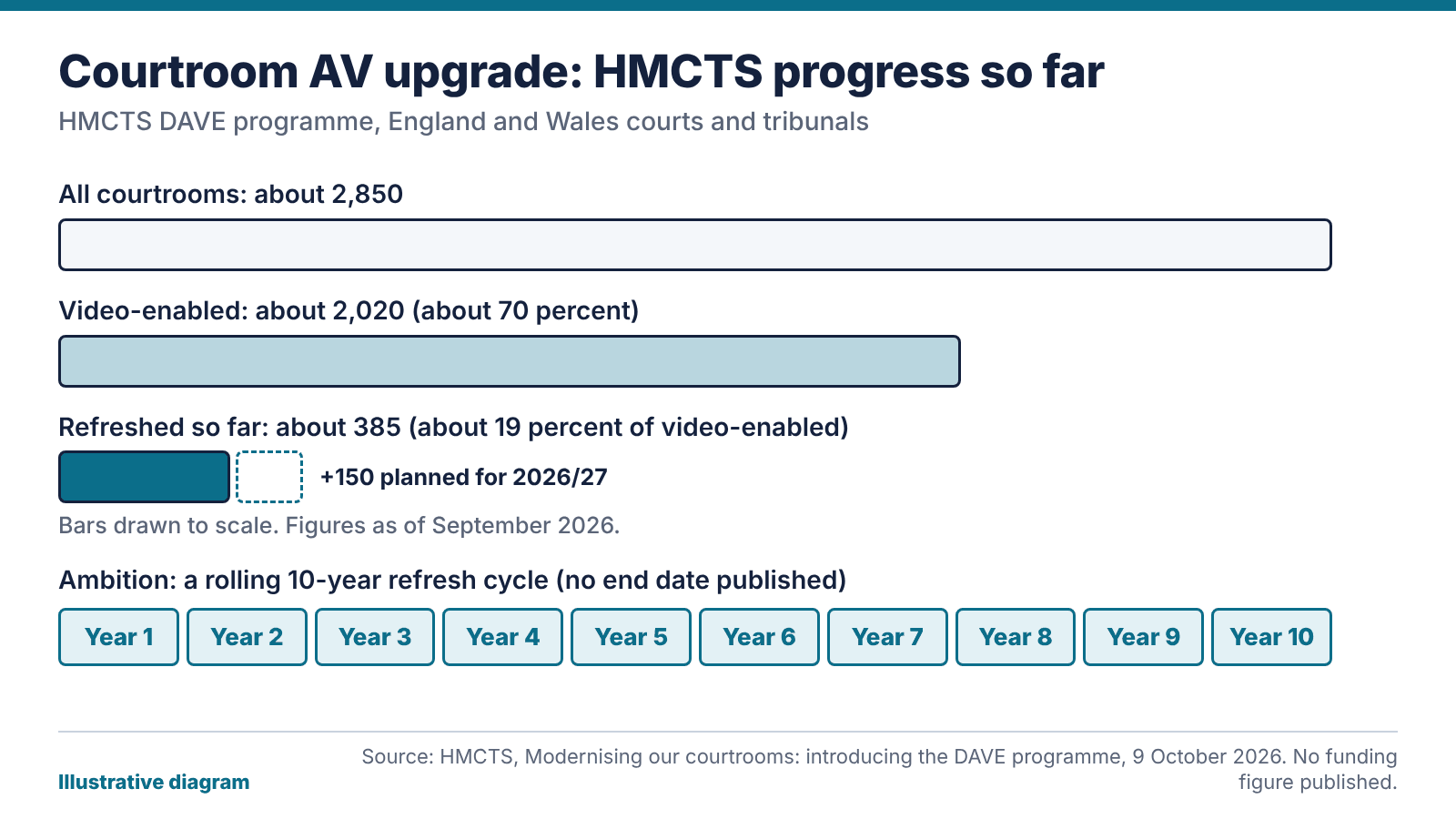
What changed: as of 15 October 2026, HMCTS has said (in a post dated 9 October) that about 385 courtrooms have been refreshed under its DAVE programme, 150 more are planned for 2026/27, and the ambition is a rolling 10-year refresh cycle. The post gives no budget, end date or supplier.
What HMCTS has said about its courtroom AV upgrade
DAVE stands for Digital Audio-Visual Evolution. In its own post on the programme, HMCTS puts the estate at around 2,850 courtrooms, with roughly 2,020 of them video-enabled, which is about 70 percent. About 385 have had new kit so far. That makes DAVE installs about 19 percent of the video-enabled estate.
Another 150 courtrooms are planned for 2026/27, and delivery is spreading into Civil and Family work and the Tribunals. HMCTS also mentions a target of around 80 percent video enablement.
It gives reasons. Much of the existing equipment has been in place for years and is nearing the end of its life, so it’s more likely to fail. When systems fail, HMCTS says, hearings can be disrupted, “leading to delays and increased costs”. Evidence also arrives as video, photographs and audio now, and remote and hybrid hearings have grown.
The kit list is ordinary AV: modern screens, better microphones and speakers, cameras for remote participants and a way to present digital evidence.
Does this courtroom AV upgrade reach Scottish courts?
No. HMCTS runs courts and tribunals in England and Wales, and its post mentions only non-devolved tribunals in Scotland. Scottish courts are devolved and run separately, so nothing in the post says DAVE pays for a single Scottish courtroom.
We’re a Glasgow company, so that was the first thing we checked. If you manage hearing rooms in Scotland, treat DAVE as a public benchmark and look elsewhere for funding. Ask whoever runs your estate which budget line a refresh would come from, because the programme’s scope follows the HMCTS remit and goes no wider.
Outside the justice system the position is the same. A council chamber, a police training room or a tribunal suite has no claim on the programme. What you can take from it is the argument. A large public body has said in print that old AV causes disruption, and its answer is a repeating cycle. You can cite that in a business case.
What lasts ten years in a hearing room
The parts age at different speeds. We’d expect screens and cabling to see out a decade. Cameras and the PCs behind them often won’t, because the software loses support first. The NCSC puts it bluntly: the only fully effective way to deal with an obsolete product is to stop using it, and paid extended support “should not be seen as a long term alternative to full migration”. Both points are in the NCSC guidance on obsolete products.
A rolling cycle spreads the work. Run 40 rooms on a 10-year cycle and that’s four rooms a year. That’s our own arithmetic, but it shows why a steady courtroom AV upgrade programme is easier to fund and staff than replacing all 40 rooms in one panicked summer.
Our view: 10 years is the most you should plan for. Budget to touch the PCs and control software sooner, and carry the cabling and mounts into the next cycle.
Audit the rooms and cost their whole life
You can’t schedule a refresh for kit you haven’t listed. Walk every hearing room, meeting room and training room. Record what’s installed, how old it is, what runs it, who owns it and what the supplier says about support dates. Then ask staff which rooms get cancelled or moved when something breaks. Those are candidates for the first batch, and they may not match the order on the asset register.
For justice work, add the questions that matter on the day. Can the room play the evidence formats you receive? Can a remote witness hear clearly and be seen clearly? Our police and justice sector page explains how we approach secure and restricted estates, and our pages for councils and the NHS cover the same audit for chambers, tribunal suites and clinical review rooms.
Then cost each room from the day it goes in to the day it’s stripped out: equipment, installation, licences, training, support and removal. Fabric that outlasts the cycle, such as containment and power, goes in a long-life budget. Anything with firmware or an operating system goes in a shorter one. One spreadsheet with room, age, owner, support end date and last fault is enough to start.
Phase the courtroom AV upgrade and expect approvals to take months
HMCTS is working through its estate a batch at a time. Do the same. Start with a pilot room, fix what it teaches you, then roll the design out in batches timed around sitting days, term dates or meeting cycles.
On a secure network the install can be the short part. In our justice-sector wireless AV case study, getting a device approved for a secure judicial network took months, and the installation took days. Put approval on the plan with a named owner from day one, or the first batch of your courtroom AV upgrade will slip. Tell the clerks and ushers which room is out of action and when, and what they’ll use in the meantime. A pilot room doubles as the reference: every later room copies its settings and labels.
Standardise as you go. Use the same layout, the same control screen and the same handover in every room, so a clerk or usher who has learned one room can run the rest.
Who answers when a screen won’t wake up?
A hearing that stops because a screen won’t start turns into an adjournment, and nobody asks how new the hardware was. HMCTS ties old kit to disruption and extra cost, and the same logic applies to your support arrangement. Even a well planned courtroom AV upgrade needs someone on call once it’s live.
Decide who attends, how quickly, and what’s held on site as spares. Check whether the contract covers parts, whether the clock starts when you log the fault or when an engineer acknowledges it, and who tests the room after every change. Ask what happens if the first fix doesn’t work. Our guide to AV maintenance contracts goes through those questions, and our support and maintenance team will read a draft contract for you.
Train the people who open the room as well. A one-page card on the wall with how to start a hearing and who to phone when it won’t start will head off some call-outs.
The bottom line: a courtroom AV upgrade runs smoother in batches, with a room register and a support contract in place before the first screen goes up. HMCTS’s 10-year cycle is a benchmark worth quoting, but nothing in its post suggests the funding reaches Scotland.
FAQ
What is the HMCTS DAVE programme?
DAVE is the Digital Audio-Visual Evolution programme, which refreshes audio-visual kit in HMCTS courtrooms. HMCTS reports about 385 courtrooms completed as of September 2026, with 150 planned for 2026/27.
Does a courtroom AV upgrade under DAVE cover Scottish courts?
HMCTS runs courts and tribunals in England and Wales, and its post only mentions non-devolved tribunals in Scotland. Scottish courts are devolved, so nothing in the post says DAVE funds one. Ask the body that runs the court you’re asking about.
How often should courtroom AV be replaced?
Plan on 10 years at most. HMCTS’s stated ambition is a rolling 10-year refresh cycle, and individual parts age faster. Expect to revisit PCs and control software before screens or cabling.
What does a courtroom AV upgrade include?
Modern screens, better microphones and speakers, cameras for remote participants and systems for presenting digital evidence, according to HMCTS. Behind those sit the cabling and network, the control and recording systems and the support arrangement. A good survey covers all of them.
Can councils and NHS trusts use the same approach?
Yes, though the funding is different. Auditing rooms, costing the whole life, working in batches and planning support all carry over to council chambers, tribunal suites and clinical review rooms. Start with a one-sheet register of every room.
Why does software support matter in a courtroom AV upgrade?
A screen can run for years, but the PC or controller behind it may lose security updates long before it breaks. The NCSC advises that the safest course with out-of-support technology is to stop using it, and that paid extended support only buys time.