How to brief an AV consultant without slowing down your programme
Worried an AV consultant will slow your programme? Here's what a properly run AV briefing takes, and how to fold it into meetings you already have.
Bringing in an AV consultant does not have to add a new meeting series to your programme. A well-run AV brief takes one focused session of an hour or two, built around information you likely already have in your room data sheets, and it can usually be folded into a design team meeting you are already holding. The real programme risk is not the brief, it is skipping it, because the fixes for a wrong or missing AV specification almost always land later, when they are far more expensive in time.
Why the fear is usually backwards
It is a reasonable worry. Every consultant added to a project is another set of emails, another person to chase for sign-off, another dependency in a programme that is already tight. On a project with a fixed RIBA Stage 3 deadline, anything that looks like a new workstream feels like a risk rather than a help.
But the sequence usually runs the other way. AV requirements that are guessed at, or left as a generic “AV to be confirmed” note, tend to surface again at tender, when a contractor prices against an incomplete specification and comes back with a stream of clarification queries. Or they surface on site, when a screen the electrical layout was never built to support needs power and data in a different place, or a room designed without acoustic treatment turns out to need it once the audio system goes in. Each of those is a variation, a delay, or a redesign, costing far more programme time than a properly scoped brief would have taken at Stage 2 or 3. A short, well-structured AV conversation early keeps AV off your critical path later, not the other way round.
What a genuinely efficient briefing process looks like
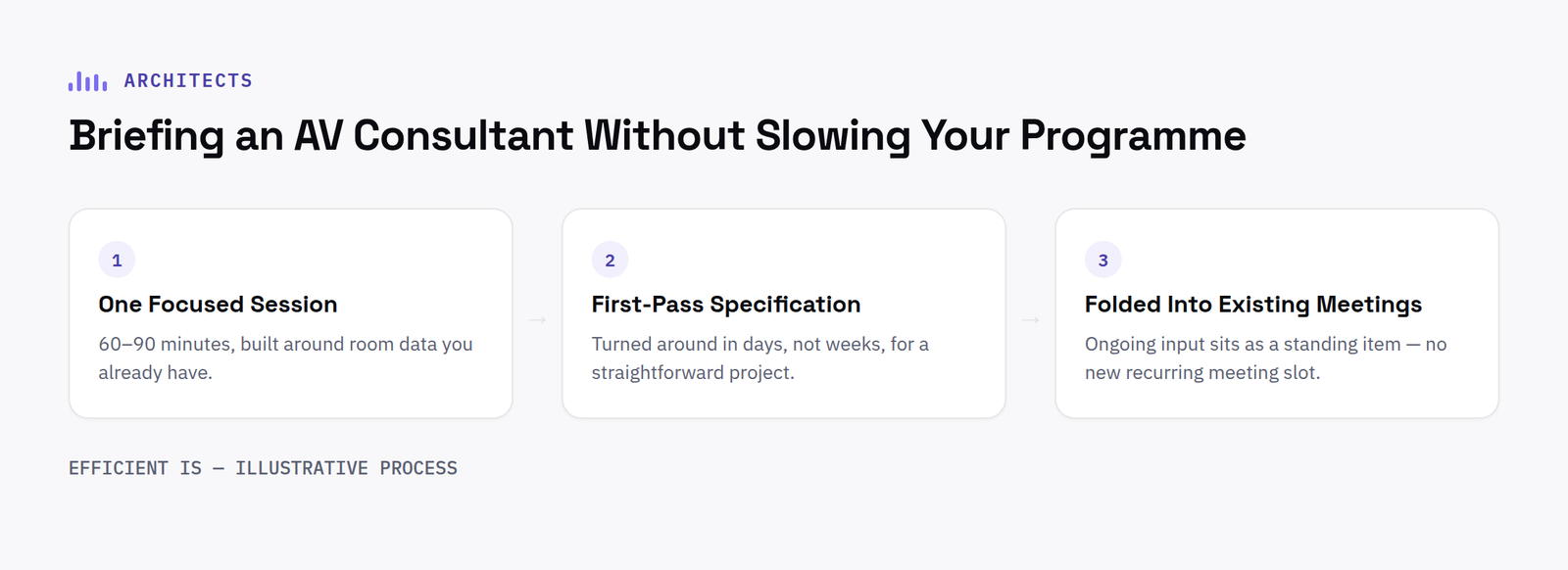
The AV brief does not need to be a drawn-out series of workshops. Done properly, it is one focused session, typically 60 to 90 minutes for most commercial or public sector projects, where the AV consultant works through the room schedule with you, room by room, confirming use case, likely occupancy, and any known technical constraints (structural fixing points, acoustic issues, IT infrastructure already in place). Larger or more complex projects might need two sessions rather than one, but it stays a defined, bounded piece of work, not an open-ended commitment.
What makes this efficient rather than another burden is preparation. The more of the room schedule, occupancy figures, and intended use cases you can hand over before the session, the shorter and more productive it is, the meeting becomes a working session to confirm and clarify, not a fact-finding exercise starting from a blank page. We cover this in more detail, stage by stage, in our guide to specifying AV against the RIBA stages, which sets out what information is genuinely useful at each point in the programme and what can wait.
What the architect needs to bring
The inputs an AV consultant needs are largely things already sitting in your project files:
Room schedules with net areas, so screen sizes and viewing distances can be checked against the room rather than assumed. Occupancy numbers per space, since a meeting room for six needs a very different microphone and camera setup to a boardroom for twenty. Intended use case for each room, video conferencing, presentation only, hybrid teaching, council chamber voting and debate, drop-in touchdown space, because the technology requirement changes significantly between those. And anything already fixed about the building: structural grid, ceiling type, existing containment routes, and any IT network already specified.
None of this needs to be AV-specific documentation. It is the same room data you are already producing for the wider design team. Handing it over in whatever format it already exists in, a spreadsheet, a set of room data sheets, marked-up floor plans, is enough to run a productive session.
What you get back, and by when
From that session, a competent AV consultant should turn around a first-pass specification and layout markup within a defined period agreed at the outset, typically days, not weeks, for a straightforward project. That output should include recommended AV provision per room type, indicative equipment (kept brand-agnostic at this stage so it does not lock you into a single manufacturer before tender), and the coordination information your other consultants need, power and data drop locations, containment routes, structural loading for anything wall- or ceiling-mounted, and acoustic implications where relevant. This is the point where AV starts feeding into your CAD or BIM model as coordinated information rather than sitting as a separate document nobody has cross-referenced. If this needs to become a formal tender package later, our design consultation and tender management work covers exactly that step, turning the agreed specification into tender-ready documentation a contractor can price against without a string of RFIs.
Folding AV into meetings you already have
Beyond the initial briefing session, AV coordination does not need its own recurring meeting slot. Once the brief is agreed, ongoing AV input can sit as a standing item within your existing design team meetings, reviewed alongside M&E, structure, and the rest of the coordination agenda rather than as a separate call. Most changes at that stage are small: a revised occupancy figure, a resized room, a change of use for one space. These are quick to deal with when the AV consultant is already in the room, and far slower as a one-off query fired over email that sits in an inbox for a week.
This is also where a lot of avoidable rework gets caught early, the kind of thing we cover in our piece on the AV specification mistakes architects most commonly run into, most of which come down to a coordination gap that a standing agenda item would have closed.
The realistic time cost
Set against the perception of AV as a heavy additional workstream, the actual time commitment for most projects is: one briefing session of an hour or two, a short turnaround period for the first specification, and then AV as a standing item within meetings the design team is holding anyway. That is a modest, bounded addition to the programme, considerably smaller than the time typically lost to a late AV variation, a failed containment coordination, or a tender that comes back with clarification queries because the specification was never pinned down.
FAQ
How long does an initial AV briefing session actually take?
For most commercial or public sector projects, one session of 60 to 90 minutes covers it, provided room schedules and occupancy figures are available beforehand. Larger or more technically complex projects might need a second session, but it remains a defined, bounded piece of work rather than an ongoing commitment.
What do I need to prepare before the AV consultant’s briefing session?
Room schedules with areas, occupancy numbers per space, and the intended use case for each room (video conferencing, presentation, hybrid teaching, and so on). Anything already fixed about the building, structural grid, ceiling type, existing IT infrastructure, is useful too, but the session can still run productively without every detail confirmed.
Does AV coordination need its own recurring meeting?
No. After the initial brief, AV input can sit as a standing item within your existing design team meetings alongside M&E and structural coordination, rather than requiring a separate meeting series.
If you are planning AV into a project and want a clear sense of what a briefing session would actually involve for your specific programme, our architects sector page sets out how we work as an AV design partner from early design stages through to tender-ready documentation. Or get in touch directly via our contact page and we’ll talk through what a brief would look like for your project.
Ready to brief us on your project?
One focused session is usually all it takes, get in touch to set it up.