
What Is Actually Happening in UK AV in 2026
Last updated: October 2026
UK AV market trends 2026: it is easy to find confident predictions about AV technology, much harder to find evidence that something is genuinely happening, so here are the UK signals this year that are backed by real funding decisions and real published figures, not speculation.
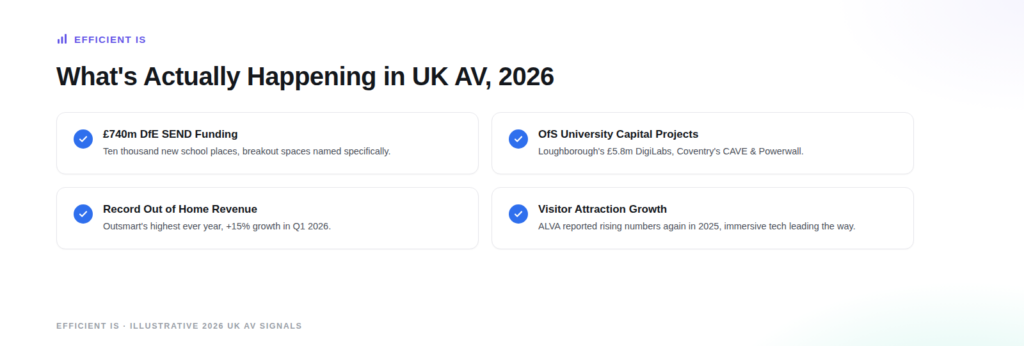
Public sector capital funding for immersive and specialist AV is a real, current trend rather than a one off. The Department for Education has allocated seven hundred and forty million pounds toward ten thousand new SEND school places, explicitly naming breakout spaces and assistive technology as part of that spend. In higher education, the Office for Students has backed real capital projects at Loughborough University, a five point eight million pound DigiLabs facility opened in 2025, and at Coventry University, a CAVE and Powerwall immersive visualisation project tied to its National Transport Design Centre. Two separate funding bodies, two separate sectors, both genuinely putting money behind immersive and specialist AV rather than treating it as experimental spend.
Out of home advertising just had its best year on record
Away from education, UK out of home advertising reported its highest ever annual revenue in 2025, according to Outsmart, the industry’s own trade body, with growth continuing into 2026 at fifteen percent in the first quarter alone. Digital screens account for the clear majority of that revenue. This matters beyond the advertising industry itself: it is a direct signal that businesses considering their own outdoor LED display, whether for advertising or simple building branding, are moving in a market that is genuinely growing rather than one that peaked years ago.
Visitor attractions are leaning further into immersive technology
The Association of Leading Visitor Attractions reported UK visitor numbers at the country’s most popular attractions rose again in 2025. Against that backdrop, major institutions have been adding immersive and digital elements to existing collections rather than treating it as a one off special exhibition: the National Gallery launched new digital experiences for its two hundredth anniversary, and the British Museum introduced immersive digital exhibits under its own branding. Attractions trade press has covered immersive technology as one of the defining themes shaping the sector into 2026, and these are not isolated examples, they are part of a consistent pattern across some of the UK’s most visited institutions.
The research itself is catching up
AVIXA, the global trade association for the AV industry, and Futuresource Consulting, a specialist market research firm, have announced joint research specifically into Pro AV demand across education and corporate markets. That a major industry body and a specialist analyst firm are investing in dedicated research right now, rather than relying on older data, is itself a sign that demand patterns in these two sectors are shifting enough to need fresh measurement.
What this means in practice
None of this is a reason to buy technology for its own sake. It is a reason to take a planned capital project seriously if one is on your table, whether that is a SEND breakout space, a university visualisation suite, or a building mounted display, because the funding and market signals around each of these categories are genuinely stronger this year than a simple sales pitch would suggest on its own.
Talk to us about any of the areas covered in this piece on our Solutions pages, or get a ballpark for your own project on our Get an Estimate page.
FAQ
Is public sector funding for AV and immersive technology actually increasing, or is this one announcement?
It spans more than one announcement and more than one funding body. The Department for Education’s SEND capital funding and the Office for Students’ backing of university projects at Loughborough and Coventry are separate funding streams in separate sectors, both genuinely committing money to immersive and specialist AV this year.
Is digital out of home advertising still growing, or has it peaked?
It is still growing. Outsmart reported the UK out of home sector’s highest ever annual revenue in 2025, with a further fifteen percent revenue growth in the first quarter of 2026 alone, and digital screens make up the clear majority of that spend.
Why does visitor attraction investment in immersive technology matter to other sectors?
Because it shows the same underlying projection and display technology scaling successfully in a genuinely different context, visitor engagement and footfall, rather than being confined to one niche use case. When major institutions keep investing in it rather than treating it as a one off, that is a meaningful signal for anyone evaluating the same category of technology for their own building.
What should this mean for a project I am already planning?
Treat it as useful context for timing, not as pressure to act. If you already have a capital project under consideration in any of these areas, the funding and spending signals this year are genuinely stronger than they have been in some time, which is worth factoring into when you choose to move forward.
Have a project this touches on?
Tell us what you’re trying to fix and we’ll tell you honestly what’s realistic.