The Scotland Excel AV framework, explained in plain terms
Public sector procurement rules exist for good reasons, but running a full tender for a single AV project is often disproportionate to the job. That’s exactly what frameworks like Scotland Excel’s are for.
What a framework actually does
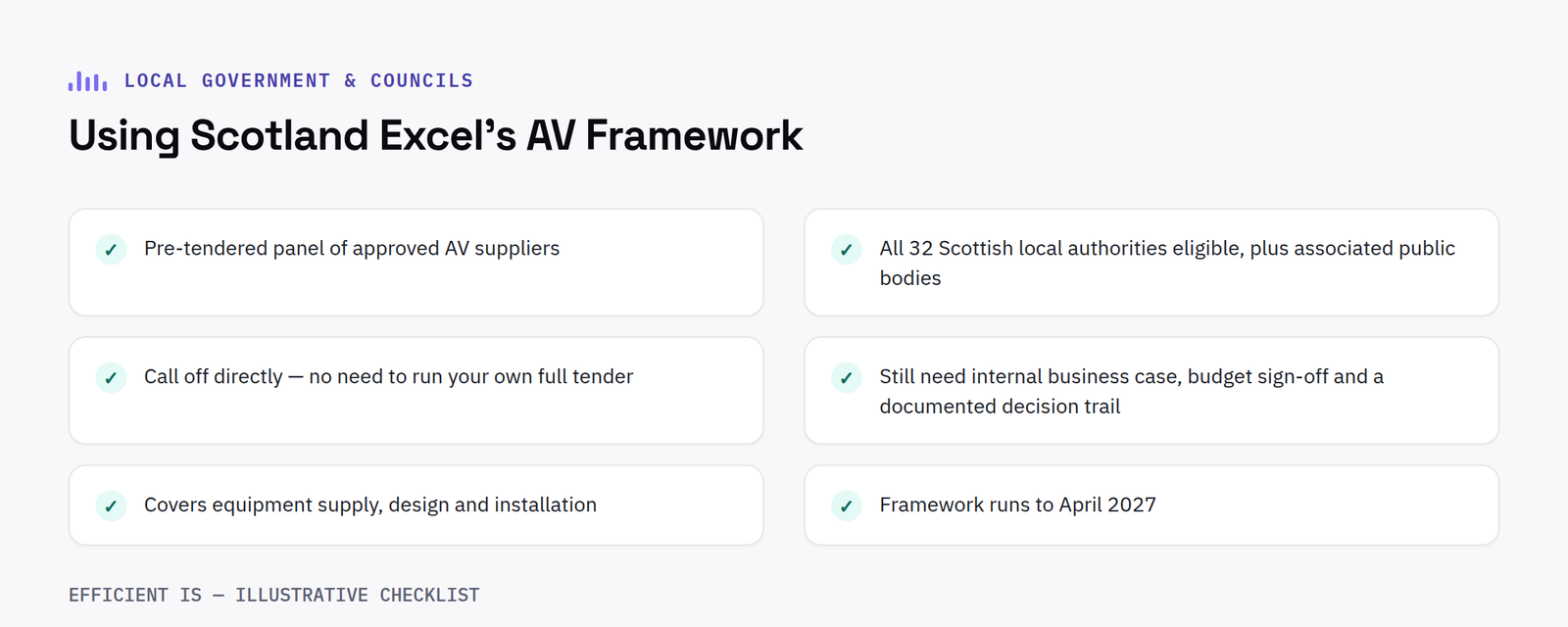
A framework is a pre-tendered panel of approved suppliers that public bodies can call off directly, without running their own full procurement exercise for every individual project. Scotland Excel’s Audio Visual framework covers design, supply and installation, and runs to April 2027, giving continuity for multi-year and phased projects.
Who can actually use it
All 32 Scottish local authorities are eligible, along with a range of associated public bodies, some NHS boards, further and higher education institutions and other organisations that qualify to use Scotland Excel frameworks. If you’re unsure whether your organisation qualifies, that’s worth confirming with Scotland Excel or your framework-approved supplier before scoping a project.
What it doesn’t do
A framework doesn’t remove the need for good internal governance, most public bodies still want a business case, budget sign-off and a documented decision trail for any significant spend. What it removes is the multi-month, resource-heavy process of running an OJEU/Find a Tender exercise from scratch for something a framework already covers.
FAQ
What is the Scotland Excel Audio Visual framework?
A pre-tendered panel of approved AV suppliers that eligible Scottish public bodies can call off directly, covering equipment supply, design and installation, running to April 2027.
How do we start using the framework?
Contact a framework-approved supplier directly with your requirement, they’ll confirm the correct call-off route for your organisation’s procurement team.
How a call off actually works in practice
Using a framework does not mean skipping process entirely, it means following a much shorter one. In practice a call off usually starts with a short written requirement, room sizes, use cases and any specific compliance needs, sent to one or more framework approved suppliers. Suppliers then return a proposal and quotation against that requirement, evaluated internally by the public body against whatever criteria the framework specifies, most commonly a mix of price and quality. Once a supplier is selected, a purchase order is raised directly against the framework agreement rather than a new standalone contract, which is what removes most of the time a full tender would otherwise take.
How suppliers are evaluated to get on the framework in the first place
Framework suppliers are not simply invited on. They go through their own competitive tender to be appointed to the panel in the first place, assessed against technical capability, financial standing, quality of past delivery and price. That upfront vetting is part of what makes call off procurement faster for the public body afterwards, the competitive testing has already happened once at framework level, so it does not need repeating for every individual project drawn down against it.
It is also worth checking a framework’s remaining term before committing to a multi-year rollout plan. Scotland Excel’s Audio Visual framework runs to April 2027, comfortably long enough for most single projects but worth factoring in if a phased rollout is expected to run across several budget years, since a call off generally needs to be raised while the framework itself is still live, not after it has expired and a successor framework is still being established.
Have a project in mind?
Tell us what you’re trying to fix and we’ll tell you honestly what’s realistic.