
AV in Retail and Shopping Centres: Beyond a Single Screen
A single price board solves a shop’s problem, but a shopping centre is solving a different one entirely, guiding thousands of people a day around a space they have never been in before, while generating advertising revenue from the same screens.
The gap between a shop’s digital signage needs and a shopping centre’s is really a gap in scale and purpose, not technology. We have already covered what works for a single independent shop, salon or clinic in our companion piece on digital signage for independent businesses. A shopping centre faces a genuinely different set of problems: visitors who do not know the layout, dozens of individual retailers who all want visibility, and an owner who often wants the screen network to generate its own advertising income rather than purely being a cost.
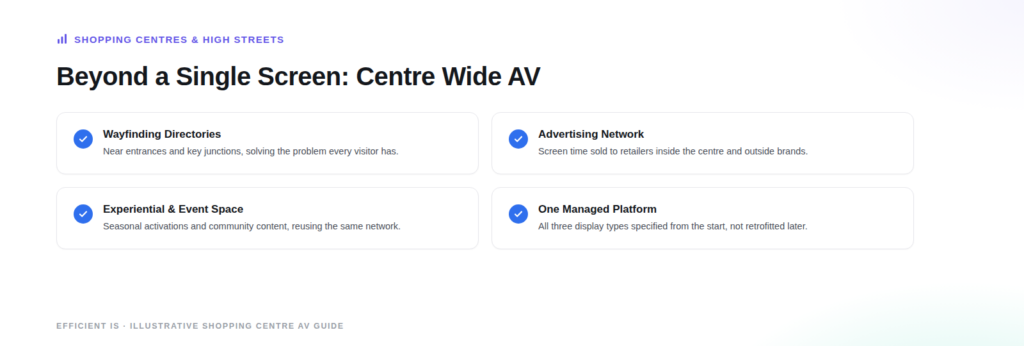
Wayfinding comes first
The single most common reason a shopping centre invests in digital signage is wayfinding: directory screens near entrances and at key junctions that show visitors where they actually are and how to reach a specific shop, toilet or exit. This sounds simple but genuinely reduces visitor frustration in large or oddly laid out centres, and it is usually the first screen category installed, before anything more ambitious, because it solves a problem every single visitor has regardless of which shops they are there to visit.
Centre wide advertising networks
Once a wayfinding network exists, many centres extend it into a genuine advertising asset, selling screen time to retailers inside the centre and to outside brands, turning what started as a visitor service into a revenue line. The UK out of home advertising sector, tracked by the industry body Outsmart, reported its highest ever annual revenue in 2025 with digital screens accounting for the clear majority of that spend, and shopping centre screen networks are a meaningful part of that wider digital out of home category rather than a separate thing entirely.
Experiential and event space
The third category is less common but genuinely effective where it is used well: a larger format screen or a dedicated space used for seasonal events, brand activations or community content, giving the centre something to offer beyond retail alone. This tends to come later, once the core wayfinding and advertising infrastructure already exists, since it usually reuses the same network and content management system rather than needing an entirely separate setup.
What this means for procurement
A centre wide network needs to be managed centrally even though individual retailers may want some control over their own content, which makes the content management platform choice as important as the screens themselves. It also needs to be planned for multiple display types from the start, directory screens, advertising panels and any experiential installation, since retrofitting a second, incompatible system later is far more expensive than specifying for all three uses up front.
See our Retail and Restaurant Screens page, or our Digital Signage page for the content management side of a multi screen network.
FAQ
What is the first thing a shopping centre should invest in, if budget is limited?
Wayfinding. Directory screens near entrances and at key junctions solve the problem every single visitor has, finding their way around an unfamiliar space, and they are usually the first category installed before anything more ambitious like an advertising network.
Can a shopping centre’s digital signage network actually make money, rather than just being a cost?
Yes, and many UK centres already do this by selling screen time to both retailers inside the centre and outside brands. The wider UK out of home advertising sector reported its highest ever annual revenue in 2025 according to Outsmart, with digital screens making up the clear majority of that spend.
Is this different from what an individual shop needs?
It is a difference of scale and purpose rather than technology. An individual shop is usually solving one specific job, like an often changing price list or a window display. A shopping centre is managing wayfinding for thousands of unfamiliar visitors a day, often across dozens of individual retailers, which needs centralised content management from day one.
Should wayfinding, advertising and any event screens be separate systems?
No, this is worth planning for up front rather than retrofitting later. Specifying one centrally managed content platform that can handle all three display types from the start is significantly cheaper than adding a second, incompatible system once the first one already exists.
Managing a retail space or shopping centre?
Tell us what you’re trying to fix and we’ll tell you honestly what’s realistic.