A control room video wall lives or dies on reliability, not resolution
Control room video walls run continuously, for years, in front of operators making time-critical decisions. That changes almost every design assumption compared to a reception or boardroom wall.
Duty cycle is the design brief
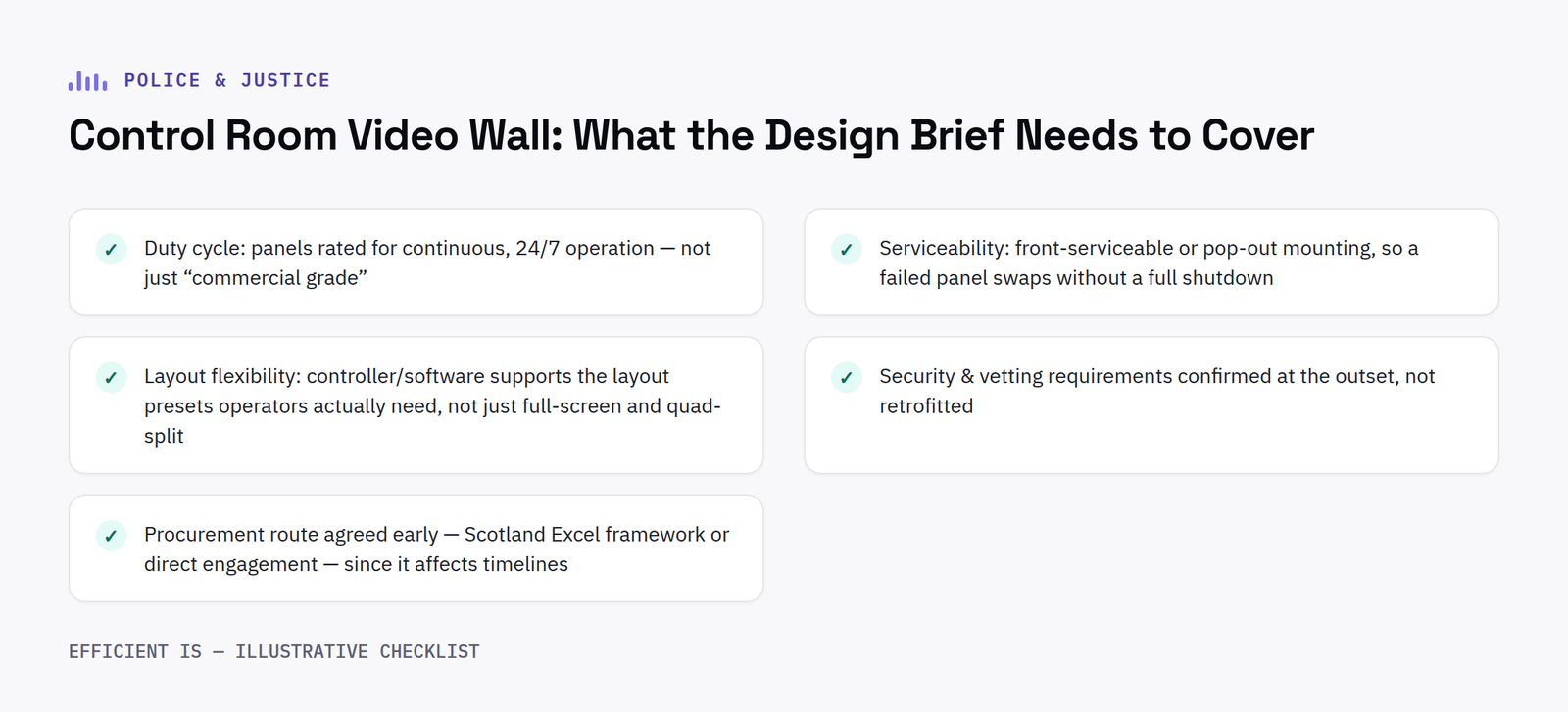
Most video wall panels are rated for a defined number of hours of daily use, plenty for a boardroom, potentially marginal for a control room that runs genuinely 24/7. Specifying panels rated for continuous operation, not just “commercial grade” in general terms, is the single most important decision in a control room video wall project.
Serviceability without downtime
A panel failure in a live control room isn’t a maintenance ticket, it’s an operational gap. Front-serviceable or pop-out mounting, so a failed panel can be swapped without dismantling the whole wall or powering anything else down, is worth specifying explicitly rather than assuming.
Layout flexibility for changing incidents
The content on a control room wall needs to reconfigure fast, a single incident might need one camera feed full-screen one moment and a sixteen-way grid the next. This is a controller and software question as much as a hardware one: check the video wall controller supports the layout presets your operators actually need, not just full-screen and a basic quad-split.
Procurement route
Public sector security and vetting requirements apply throughout a police or justice AV project, and should be confirmed at the outset rather than retrofitted. Procurement is typically available either through the Scotland Excel framework for Scottish forces and justice bodies, or direct engagement, both routes should be considered before design work starts, since the route can affect timelines.
FAQ
How reliable do control room video walls need to be?
Specified for continuous, 24/7 operational use as the primary design requirement, not general “commercial grade” panels rated for standard business hours.
Can a single panel be replaced without shutting down the whole video wall?
Yes, if front-serviceable or pop-out mounting is specified at the design stage, this should be an explicit requirement, not an assumption.
Specifying redundancy properly
A control room cannot simply go dark because a single power supply or signal path failed. Redundant power feeds into the wall, and ideally a backed up UPS supply, are worth specifying from the outset rather than treated as an optional extra. On the signal side, a redundant video wall controller or at minimum a documented failover process, so operators are never left without any picture at all while a fault is diagnosed, matters as much as the physical panels themselves.
Commissioning and testing before go live
A control room video wall should be burnt in and tested under realistic conditions before operators rely on it for live incidents, not simply switched on and handed over. That means running the full expected duty cycle for a sustained period, testing every camera feed and layout preset the operators will actually use, and confirming panel to panel colour and brightness matching across the whole wall. Faults found during a proper commissioning period are far cheaper to fix than the same fault discovered mid incident once the room has gone live.
Cabling and connectivity behind the wall deserve the same attention as the panels themselves. Running spare, clearly labelled cable paths at installation time, rather than exactly the number needed on day one, makes it far easier to add a camera feed or an extra input later without pulling the wall apart to do it. Labelling matters as much as capacity. An unlabelled cable run behind a live control room wall is a problem for whoever has to trace it during a future fault.
Have a project in mind?
Tell us what you’re trying to fix and we’ll tell you honestly what’s realistic.