
Networks built for today’s headcount always cost more to fix than to design properly the first time
Almost every network redesign we get called in for started as a perfectly reasonable network for a much smaller company.
The pattern that keeps repeating
A business installs a network sized correctly for 15 people. Eighteen months later there are 45 people, three departments that shouldn’t see each other’s traffic, a guest network bolted on as an afterthought, and a single point of failure nobody remembers configuring. None of this was a mistake at the time, it’s just what happens when a network isn’t designed with growth and segmentation in mind from the start.
Segmentation is cheap now, expensive later
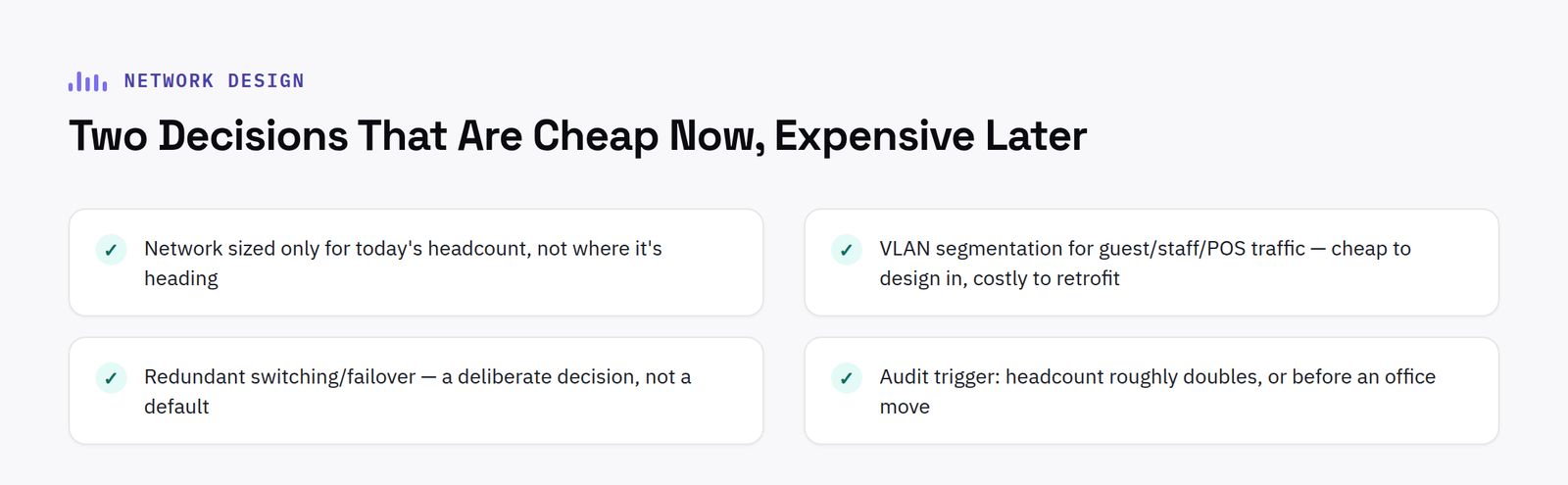
VLAN segmentation, separating guest WiFi, staff traffic and any operational or point-of-sale systems onto logically separate networks, costs very little to design in from the outset and a great deal more to retrofit into a live, working network without disruption. It’s also the single biggest practical security improvement most small businesses can make: a compromised guest device on a properly segmented network can’t see anything it shouldn’t.
Redundancy: worth asking the question even if the answer is no
Not every business needs failover internet connections or redundant switching, for many, a few hours of downtime is a genuine inconvenience, not a crisis. But that should be a deliberate decision made once, at design stage, not an assumption nobody actually tested. Ask explicitly: what happens, in pounds and reputation, if this network is down for a working day?
FAQ
When should a growing business redesign its network?
Before the pain point, ideally, a network audit is worth doing whenever headcount roughly doubles from what the network was originally sized for, or before any office move or expansion.
Is VLAN segmentation worth it for a small business?
Yes, in most cases, it’s one of the cheapest, highest-impact security improvements available, and far easier to design in from the start than retrofit later.
How to right-size a network without over-specifying it
Sizing a network for growth does not mean buying enterprise grade equipment for a fifteen-person office on the assumption it might one day be needed. The practical approach is to design the architecture, segmentation, addressing scheme, cable capacity, for where the business realistically expects to be in two to three years, while choosing switching and access point hardware sized for current headcount with clear, low cost upgrade paths built in. This avoids both extremes: a network that needs a disruptive redesign after eighteen months, and a business paying for capacity it will not use for years.
A simple way to test this at design stage is to ask what happens if headcount doubles. If the answer involves ripping out cabling or redesigning the addressing scheme from scratch, the original design was not really built for growth, whatever it was sized for on day one. If the answer is adding more access points and switch ports within an already planned structure, the design has done its job.
Bringing this conversation forward to the design stage, rather than raising it for the first time once a network is already showing strain, is usually the single biggest factor in whether the eventual upgrade is a smooth, planned piece of work or a disruptive emergency project squeezed in around a business that is already struggling to keep up with its own growth.
Have a project in mind?
Tell us what you’re trying to fix and we’ll tell you honestly what’s realistic.