What ITIL-Aligned IT Support Actually Means for Your Business
“ITIL-aligned” gets used a lot in IT support marketing. Here’s what it actually means in practice, not just as a phrase on a page.
ITIL, briefly
ITIL (IT Infrastructure Library) is a widely-used framework for how IT services should be structured, delivered and measured: covering things like incident management, problem management, and service level management. It’s not a certification your support provider either has or doesn’t; it’s a set of practices a provider can be more or less rigorous about actually following.
What ITIL-aligned IT support looks like day to day
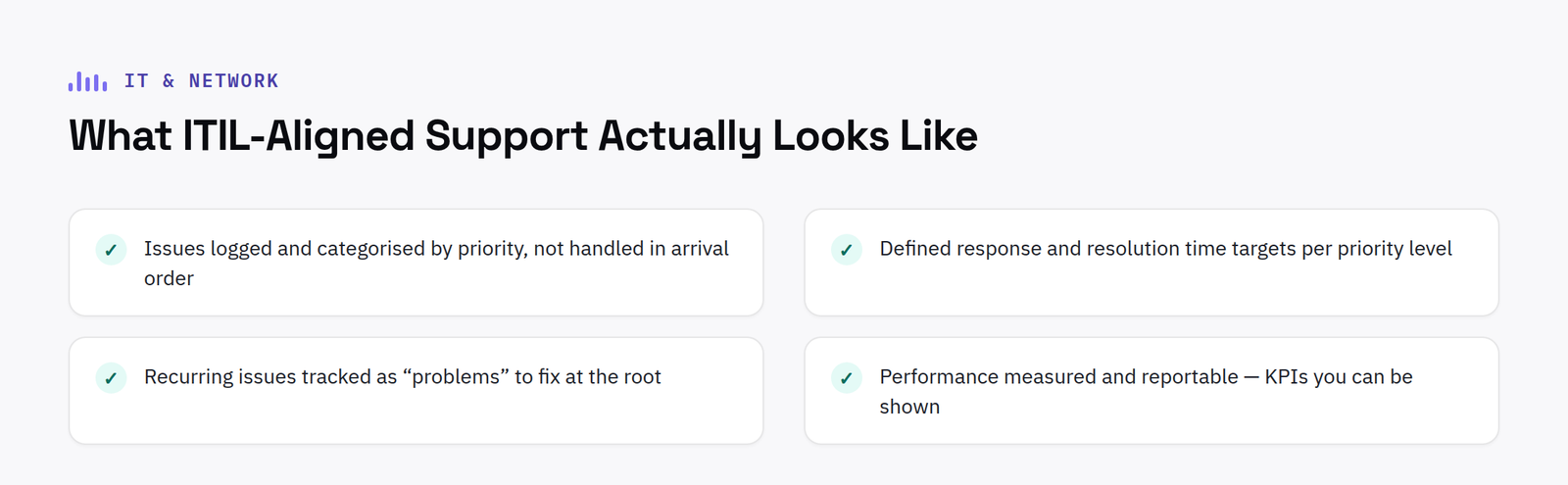
In practical terms, ITIL-aligned support means: issues are logged and categorised by priority, not just handled in whatever order they arrive; there are defined response and resolution time targets for each priority level; recurring issues get tracked as “problems” to be fixed at the root, not just repeatedly resolved as one-off tickets; and performance against all of that is actually measured and reportable, KPIs you can be shown, not just told about.
Why this matters more than it sounds like it should
The practical difference between “we’ll sort it” and an ITIL-aligned service is what happens when something genuinely urgent comes in during a busy week. A framework with defined priorities means an urgent issue gets urgent treatment regardless of what else is in the queue, informal support, however well-intentioned, doesn’t have that structural guarantee.
What to ask a provider claiming to be ITIL-aligned
What are your response time targets by priority level, how are they measured, and can you show reporting against them? A provider genuinely running this way will have a straightforward answer; one using the phrase loosely usually won’t.
What changes once ITIL alignment actually sticks
The real test of ITIL alignment is not the framework itself but what happens six months after it is introduced. A provider that has genuinely adopted structured priorities should be able to show a trend, not just a snapshot: response times holding steady or improving as ticket volume grows, the same handful of recurring issues not reappearing month after month once they have been logged as problems and fixed at the root, and reporting that gets more useful over time rather than staying a static dashboard nobody revisits. None of that happens automatically just because a provider mentions the word ITIL somewhere on their website.
It is also worth understanding what ITIL alignment does not promise. It is not a guarantee that nothing will ever go wrong, and it is not a substitute for enough engineers to actually cover the ticket volume a business generates. What it does promise is that when something does go wrong, there is a defined process for how it gets handled, escalated and closed, rather than whichever engineer happens to pick up the phone deciding on the spot how urgent it is. For a growing business moving from informal support to a proper managed service, that structural change, more than any specific tool or dashboard, is usually the biggest practical difference they notice.
A useful way to test this before signing a contract is to ask for a real example, not a hypothetical one: a recent incident, what priority it was assigned, how long it took to resolve, and whether it was logged as a one off fix or flagged as a problem for root cause investigation. A provider running a genuinely ITIL-aligned service should be able to walk through a real case in a few minutes. One that cannot usually has the structure on paper but not in daily practice.
Want to see it running at scale?
See how we structure priorities and KPIs, including a live example for a national client.