In-House IT vs Managed IT Support: How SMEs Should Decide
There’s a point in most growing businesses where “someone in the office who’s good with computers” stops being a sustainable IT strategy. The question is usually less “should we get support” and more “in-house, or managed.”
What in-house gets you
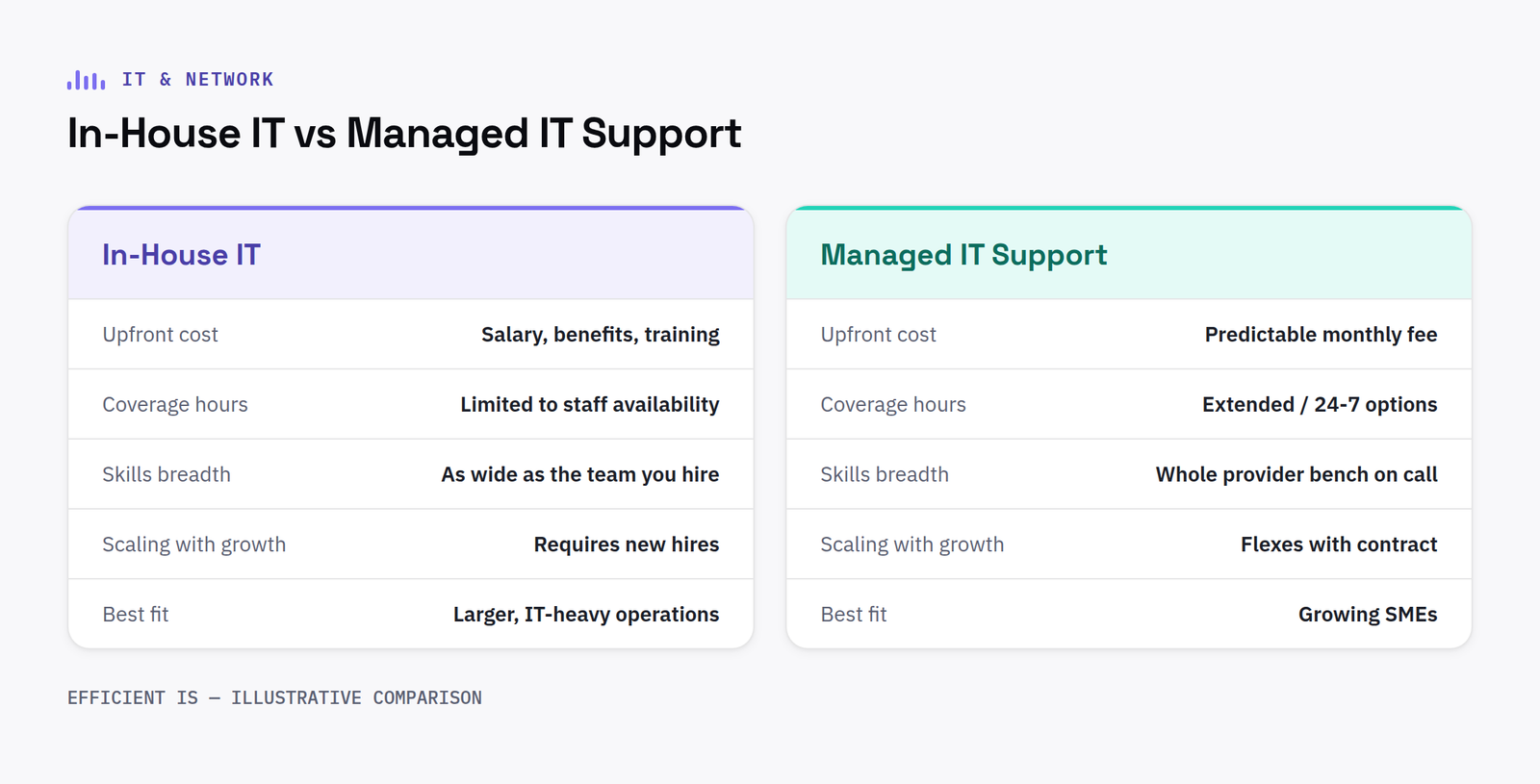
Someone who knows your systems intimately, is physically present, and is fully dedicated to your business. It also means you’re carrying one person’s (or one small team’s) availability, holiday cover, and skill gaps as single points of failure: and hiring for a broad enough skill set to cover networking, device management, security and day-to-day helpdesk is a genuinely hard hire at SME budgets.
What managed support gets you
A team rather than a person, so illness, holiday and skill gaps don’t become your problem, plus SLA-backed response times you can actually hold a provider to, rather than informal expectations. The trade-off is less day-to-day physical presence, though a good managed provider builds relationship and responsiveness that closes most of that gap.
The real decision point isn’t in-house IT vs managed IT as a binary
Plenty of organisations run a hybrid, a smaller in-house presence for anything genuinely site-specific, backed by a managed helpdesk for volume, escalation and out-of-hours cover. What matters is having SLA-backed response times and clear escalation paths either way, not just “call someone when it breaks.”
What to actually check before choosing a managed provider
Ask what “1st line” and “2nd line” actually mean in their service, what the response time commitments are by priority, and whether that’s measured against real KPIs or just described as a general aim.
What a hybrid model actually looks like in practice
The hybrid approach mentioned above is worth spelling out with an example, since it tends to be more practical than either extreme for a business somewhere between 20 and 150 staff. A common pattern is one in-house IT person handling anything physically hands on, new starter setup, meeting room troubleshooting, liaising with the office on day to day requests, backed by a managed provider covering the helpdesk queue, security monitoring, patching, backups and out of hours cover. Neither side is carrying the whole load alone, and neither gap, the in-house person’s holiday or the managed provider’s lack of daily physical presence, becomes a genuine single point of failure.
The trade-off worth being honest about is cost structure rather than capability. Pure in-house is usually cheaper on paper for a small headcount, until the business needs to cover holiday, sickness or a skills gap that the one person on staff simply does not have. Pure managed is more predictable month to month, but can feel less personal for a business used to having someone they know walk over and fix something in person. A hybrid model costs more than either extreme individually, but for many growing businesses it removes the single biggest risk in either pure approach: one person, or one relationship, being the entire IT function.
Whichever model a business chooses, the practical test is the same: ask what actually happens the day the one person who understands the network is unreachable. If the honest answer is that the business would struggle, that is usually the clearest sign a change is worth making, regardless of which direction it points in.
Timing matters too. The decision is easiest to make well before a genuine gap appears, not in the middle of a crisis after a key person has already handed in their notice. Reviewing the setup annually, alongside a normal IT budget conversation, means the business is choosing deliberately rather than reacting to whoever happens to leave next.
Weighing up in-house vs managed?
See how we structure priorities and KPIs, including a live example running at national scale.