The Microsoft 365 Migration Checklist UK Businesses Actually Need
A good Microsoft 365 migration finds its problems before cutover, not after
The migrations that go badly aren’t the ones with difficult technical challenges. They’re the ones where nobody looked closely enough at what was actually being moved until it was too late to fix quietly.
Document what you’re actually moving, honestly
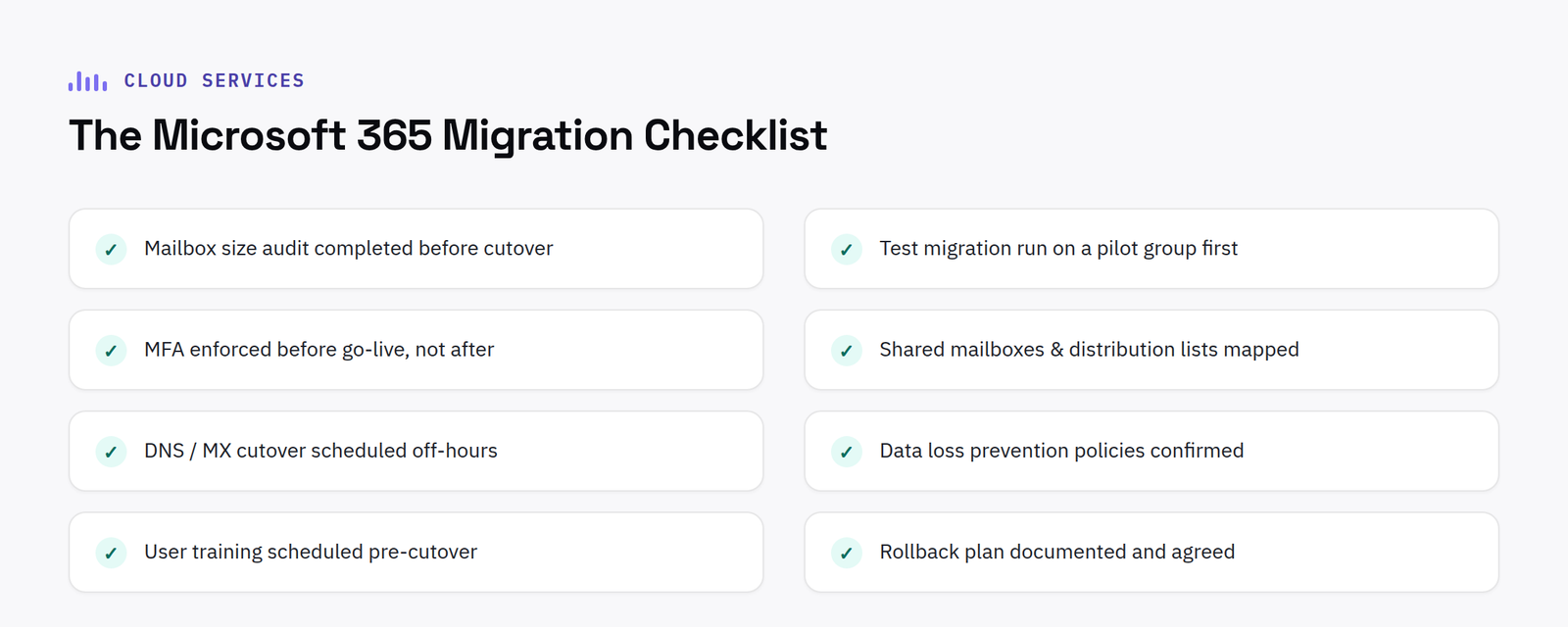
Before any technical migration work starts, document current email retention policies, any litigation hold requirements, data loss prevention rules, and industry-specific obligations, FCA rules for financial services, NHS Data Security and Protection Toolkit requirements for healthcare, and so on. These need to be replicated, and ideally improved, in Microsoft 365, not rediscovered afterwards.
Expect, and welcome, awkward findings
A pre-migration data review regularly turns up things nobody flagged: shared mailbox access still including staff who left years ago, quality documents mixed in with superseded versions, donor or client data exported and saved locally with no defined retention period. Finding these before migration is useful progress, not a delay, it’s far cheaper to fix identity gaps and unclear data ownership before the move than to explain afterwards why email works but file access and permissions don’t.
Get the licensing decision right early
For most UK SMBs, Microsoft 365 Business Premium is worth the jump over Business Standard specifically for the built-in security features, Defender for Office 365, Intune device management, and Conditional Access. Under UK GDPR’s requirement to implement “appropriate technical measures” to protect personal data, these aren’t luxuries, and buying licensing before starting technical migration work avoids a mid-project scramble.
FAQ
Do we need Microsoft 365 Business Premium, or is Standard enough?
For most UK SMBs subject to UK GDPR, Business Premium’s built-in security features (Defender for Office 365, Intune, Conditional Access) are worth the modest additional cost given the compliance obligation to implement appropriate technical measures.
What’s the biggest risk in a Microsoft 365 migration?
Undiscovered compliance and data-ownership gaps, stale shared mailbox access, unclear retention policies, mixed-up document versions, surfacing after cutover instead of before it.
What a realistic migration timeline actually looks like
For a typical SME migration, from initial data review through to final cutover, four to eight weeks is a realistic range, depending on mailbox count, data volume and how many compliance requirements need documenting first. Rushing this timeline to hit an arbitrary deadline is usually where problems creep in: skipping the pre-migration data review to save a week often means discovering a compliance gap or access issue after cutover instead of before it, which is a far more disruptive way to find out.
A phased cutover, migrating a small pilot group first, checking mail flow, permissions and third-party integrations work as expected, then rolling out to the rest of the business in stages, catches most issues while they only affect a handful of people rather than the whole organisation at once. This is worth building into the project plan from the outset rather than treating it as an optional extra step if time allows.
Communicating the change to staff ahead of cutover matters more than it might seem: a short note explaining what will change, when, and who to contact if something looks wrong, meaningfully reduces the number of support tickets raised in the first few days after go-live.
Keeping the old system accessible in a read-only state for a short period after cutover, rather than switching it off immediately, gives a practical safety net if something is discovered missing during the first few weeks of normal use, without adding meaningful cost or complexity to the project.
Have a project in mind?
Tell us what you’re trying to fix and we’ll tell you honestly what’s realistic.