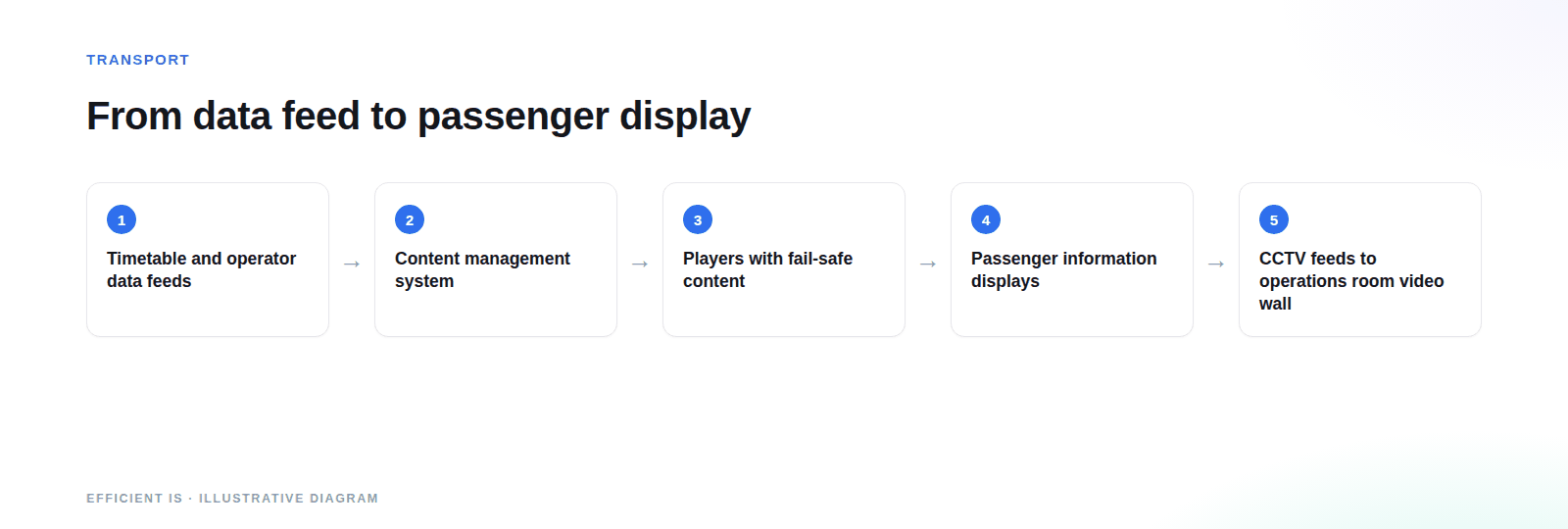
Transport AV means passenger information displays, digital signage, control room video walls, public address interfacing and CCTV integration, for stations, bus stations, airports, ports and depots. Efficient IS designs, installs and supports it across the UK. Everything’s specified to run day and night, take a knock and be serviced out of hours.
Departure boards, platform and stand information, wayfinding and service disruption messages, run from one content platform so a change is made once and appears everywhere.
Terminal information, wayfinding and operational displays. Restricted areas mean vetting and access rules, which we plan with you at the start.
Video walls that put cameras, schedules and incident views in front of the whole team. Our control room and video wall work is built for continuous use.
Shift boards, safety messages, vehicle status and internal comms in places where nobody wants to carry a laptop around.
A hub is public, busy, dirty, open all night and often hard to close for work. That changes the specification.
Public screens get kicked, knocked, cleaned with the wrong spray and exposed to draughts, sun through station roofs and temperature swings. We use commercial-grade displays in protective enclosures, with brightness and ingress ratings chosen for each spot.
Consumer panels aren’t built for years of continuous running. We specify equipment rated for the duty cycle, and design out single points of failure, so one failed power supply or input doesn’t blank a departure board.
Work often has to happen between the last service and the first. We stage and test systems off-site, plan installs and swaps as short lift-and-connect jobs, and agree access, permits and rollback plans before the night starts.
A broken information screen at 6am is a passenger problem, not an IT ticket. Support and maintenance with agreed response times and remote monitoring means we find the fault before it’s reported.
Public address and voice alarm are safety-critical, so the voice alarm side stays with the fire alarm specialist who designs and certifies it. We interface with it: which announcements take priority, which zones are affected and how screens change when an alarm sounds. Where PA is part of the project, we can specify and supply it.
Cameras belong on the same network, and their feeds can go up on the control room wall. That’s the point of integrating CCTV, with retention and access set to your policy, and the cabling done once to a good standard.
Martyn’s Law (the Terrorism (Protection of Premises) Act 2025) is not a blanket rule for every transport site. The government’s statutory guidance excludes transport premises that are already subject to existing legislative requirements to consider and mitigate threats, naming applicable airports, national rail and underground premises, international rail premises and port facilities.
That leaves other premises to check against the capacity thresholds (200 and 800, counting staff). The guidance lists bus and coach stations among the in-scope uses. The main duties haven’t commenced, with an implementation period of at least 24 months from Royal Assent on 3 April 2025. Our Martyn’s Law readiness page covers the communication side.
What moves a quote most.
Protective housings, higher brightness and better ingress ratings cost more, and mean fewer replacements.
Scale brings savings in design and support, but many small sites cost more to commission than a single large one.
Real-time information needs a feed from your operator or authority. Setting it up and testing failure cases takes time.
Redundant players, power and network paths cost more, and for a 24/7 operation they’re usually worth it.
Night-only access, permits and escorts add hours to every task.
Response times, spares holding and remote monitoring all shape the price of a care plan.
Prefer to talk it through? Call 0845 095 3600 or email av@efficient-is.co.uk. We’ll give you a straight answer, not a sales script.
Survey, a review of how the hub operates day and night, requirements gathering, and a plan that works with your maintenance windows.
Procured through our manufacturer and distributor relationships, or your framework of choice.
Delivered by our engineers in Scotland, or a vetted local partner, anywhere in the UK, with kit staged and tested beforehand so night-time work is quick.
Documentation, training for control room and station staff, and ongoing care plans with agreed response times.
Most need passenger information displays, wayfinding and disruption messaging from one content platform, and often a video wall or monitors in the operations room. Larger sites add public address interfacing, CCTV integration and outdoor displays for forecourts.
They can, if they’re specified for it. We choose commercial displays rated for continuous operation, allow for cooling and power, and add redundancy where an outage would affect passengers. We also offer remote monitoring so faults are spotted quickly.
We do, and most of the work happens before the night itself. We stage and test equipment in our warehouse first, so the job on site is a short install or swap, and we agree access, permits and a fallback beforehand. It’s the approach we took with our Dundee outdoor kiosk, built off-site and live within a day.
We interface with them and can specify and supply PA where it’s part of the AV project. Voice alarm is a fire safety system, and we work alongside the specialist who designs, certifies and maintains it. We don’t alter it.
Yes. Cameras and the wall share the network, so feeds can be shown at a sensible size on the wall, with access controlled and retention set to your policy. See our CCTV page for how we design these systems.
Partly. The statutory guidance excludes transport premises already covered by other security requirements, such as applicable airports, national rail and underground, international rail and port facilities, but bus and coach stations are listed as an in-scope use, so they depend on how many people can be expected at once. Check against the guidance and take advice.
We offer care plans with agreed response times, planned maintenance visits and remote monitoring, covering systems we installed and, in most cases, ones we didn’t, after a survey.
Tell us the site, how it operates and when you can close it for work, and we’ll tell you what’s realistic.








Find our work useful? Add us as a preferred source on Google.