If you’ve got many rooms, long cable runs or layouts that keep changing, AV over IP is worth a look: video and audio travel over standard Ethernet instead of dedicated cables and a matrix switcher. Efficient IS, a Glasgow AV and network integrator, designs both the AV and the network it runs on.
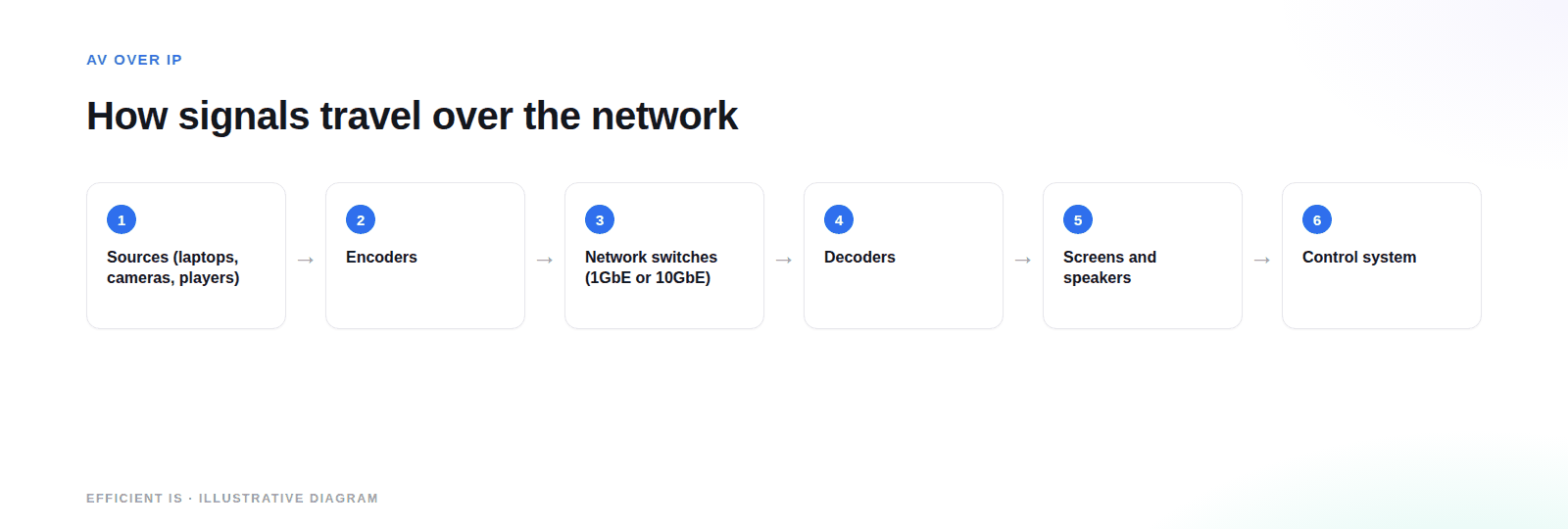
A traditional matrix switcher takes every source and screen on its own cable back to a central box. If you want a new screen, you run a new cable. AV over IP replaces that with an encoder at each source, a decoder at each screen and ordinary network switches in between.
The routing becomes software: any source to any screen, changed on a control panel. Nobody pulls a lead. Adding a room means plugging into a switch port. That’s the whole idea.
Offices, universities and venues where sources need to reach many rooms, sometimes in different buildings. The same fabric can serve meeting rooms and the video walls beside them.
Rooms that combine and split, with sources and screens that change per event. Software routing means the layout can change without anyone touching a cable, a pattern that fits event and venue AV.
Control rooms, council chambers and learning spaces where many cameras, displays and recorders need flexible routing across a building bigger than one equipment rack can reach.
It comes down to how much picture quality and how little delay you need, set against what your network can carry. There are three broad approaches, and a good design picks per application, not per site.
Runs on the gigabit network most buildings already have. The video is compressed to fit, which adds a small delay and some loss of fidelity. For presentations, signage and general distribution it’s usually fine, and it’s the cheapest per endpoint. It can be noticeable for live camera feeds or anything where lip sync matters.
Needs 10 Gigabit switching, which is dearer, but the picture is effectively identical to the source with next to no delay. The SDVoE Alliance, a consortium of AV technology providers, promotes this approach, carrying video over standard Ethernet with little or no compression. It’s the choice for control rooms, simulation and live production, where the picture is the product.
Audio is a lighter load and has its own mature ecosystem. Dante moves audio, video and control over standard IP networking, and AES67 is the AES standard for audio-over-IP interoperability. Check each product’s support for it, because two audio networks won’t necessarily talk to each other.
Networked AV isn’t ordinary office traffic. Video streams are large and continuous, and many systems use multicast so one source can feed many screens without being sent many times. That needs switches that handle multicast correctly: IGMP snooping with a querier, so traffic goes only where it’s wanted, and enough bandwidth that no uplink saturates.
Quality of service rules, switch buffers and the cabling itself (Cat6A or fibre for 10GbE) all matter. Audio systems add precise clocking on top, so follow each vendor’s switch guidance, because office defaults often won’t do. Settings such as Energy Efficient Ethernet are a known cause of dropouts on some audio networks.
Put AV on its own VLAN, with management interfaces reachable only from where they need to be, no default passwords and a firmware plan. Treat the encoders and decoders as network devices, because they are, and because Cyber Essentials expects exactly that.
Resilience is the other half. A single switch failure can take a whole floor of AV with it, so the rooms that can’t go down get redundant links and a spare, and the AV is monitored like any other network service.
Often. We’d sooner say so than sell you a network you don’t need.
Four sources and four screens in one equipment room is a small matrix job. It’s simpler, has no network dependency, and is usually cheaper than eight IP endpoints and the switch to match.
If the application can’t accept any delay and your network can’t carry 10GbE, a direct matrix or a dedicated, separate AV network is the safer route.
It puts the AV on the network, which means the network team owns part of it. If your IT team can’t or won’t take that on, the system will suffer, and a self-contained matrix may serve you better.
These projects fail in the gap between the AV contractor and the network team. The AV side specifies endpoints that need multicast and the network side hasn’t been told, so the first video call stutters. We design both halves together, so the switch specification, the VLAN plan and the endpoints are one document.
That’s the reason to talk to us. Our network design team specifies the switching and multicast handling, our engineers handle network installation and the structured cabling under it, and the same team commissions the AV on top. For a bigger estate we’d start with consultancy and design, so the architecture is agreed before a single endpoint is bought.
Endpoints are the visible cost. Most of the swing is elsewhere.
Each source and screen needs an encoder or decoder, and 10GbE units cost more than 1GbE ones.
Existing switches either carry it or need replacing with multicast-capable, higher-capacity models.
Existing Cat6 may not carry 10GbE over the run you need, and between buildings you’ll want fibre.
Routing panels, scenes and integration with room systems are programming time, and it’s worth paying for.
Redundant switches and links add cost, and keep the important rooms on air when a switch fails.
VLAN design, load testing and handover to your IT team take time. Skipping them is the usual cause of problems.
Prefer to talk it through? Call 0845 095 3600 or email av@efficient-is.co.uk, we’ll give you a straight answer, not a sales script.
Rooms, sources, picture quality needs, and an honest look at your existing network.
Matrix or IP per area, 1GbE or 10GbE, switching, VLANs, control and resilience, agreed with your IT team.
Cabling, switching and endpoints installed and tested under load. Delivered by our engineers in Scotland, or a vetted local partner, anywhere in the UK.
Documentation, training for AV and IT staff, and optional support and maintenance.
Video and audio travel over a standard network instead of through dedicated cables to a central switcher. Encoders turn each source into network traffic, decoders turn it back into picture and sound at each screen, and software decides what goes where.
Not always. It scales better and routes more flexibly across many rooms or buildings. For a single room or a small fixed install, a matrix is simpler and often cheaper, and we’ll say so.
Only if you need near-lossless or uncompressed pictures with almost no delay. For general distribution, presentations and signage, compressed 1GbE systems are often perfectly good. Uncompressed 4K is far more than a gigabit link can carry.
It can, but give it its own VLAN, with multicast set up correctly and bandwidth reserved. On a busy network we’d usually separate the AV switching entirely, particularly for 10GbE.
As secure as you make it. Put it on its own VLAN, change default passwords, restrict the management interfaces and keep firmware current. It’s a network device estate and should be managed like one.
SDVoE is an alliance approach to carrying video over Ethernet, typically 10GbE with little or no compression. Dante is a networked audio, video and control platform, widely used for audio. AES67 is a standard for audio-over-IP interoperability. They solve different problems, and a project may use more than one.
Tell us the rooms, the sources and your network.





Find our work useful? Add us as a preferred source on Google.