Blind Tender vs Open Tender for AV Projects: Which Should You Use?

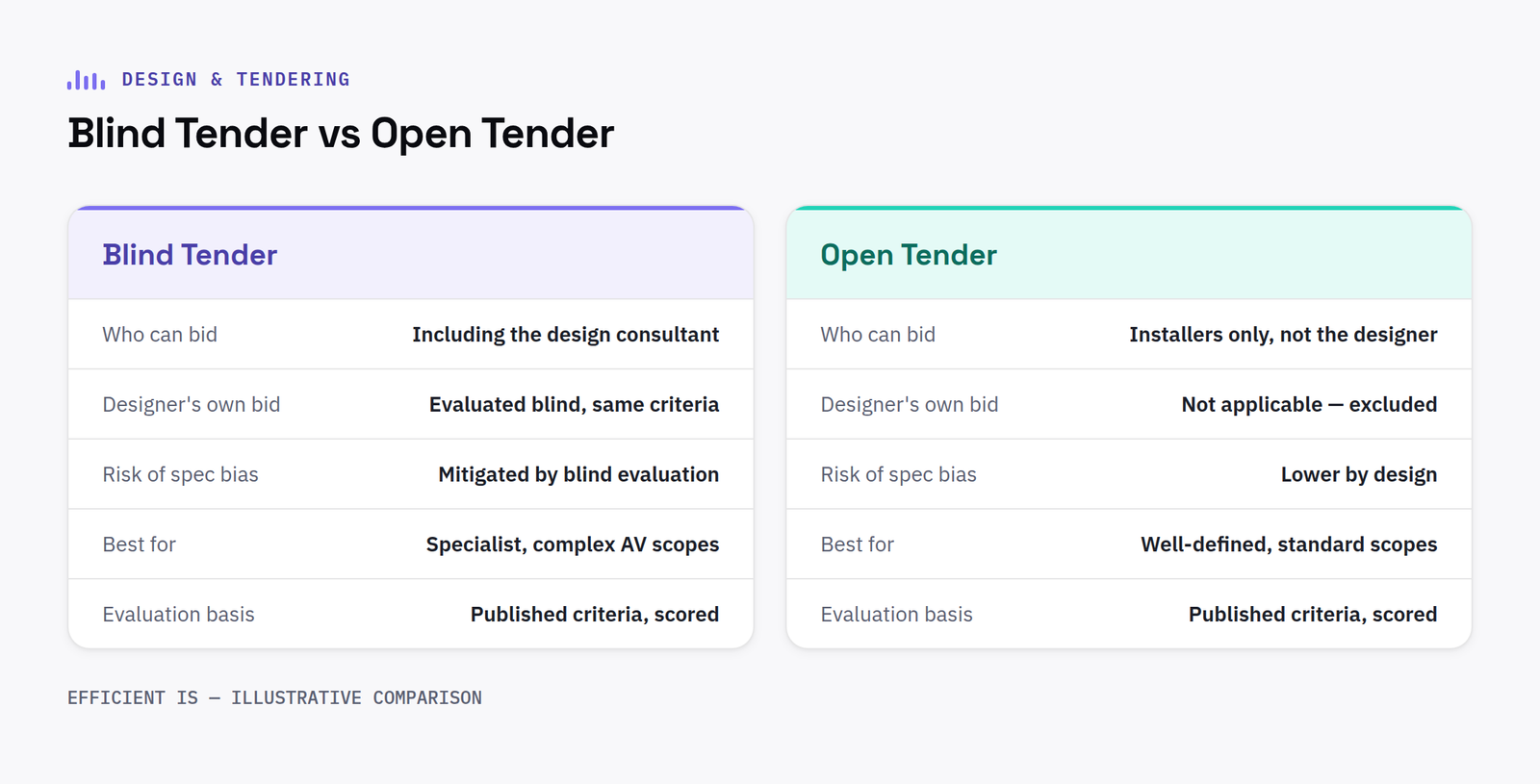
A blind tender is one where the party that designed the specification is also allowed to bid for the installation work, with their bid evaluated blind against the same published criteria as every other bidder and the scoring independently verified. An open market tender is one where the design partner acts purely as technical advisor and does not bid at all. Both can produce a fair, well-run outcome β€” the right choice depends on how much independence your project needs to be seen to have, not just have.

These two terms come up constantly once a client realises their AV design partner might also want to install the system they’ve just specified. It sounds like a conflict of interest on the surface, and in a badly run process it can be. In a properly run process, it’s a standard and widely used procurement route. The confusion usually isn’t about which one is “better” β€” it’s about which one fits the project in front of you.

What a blind tender actually means

In a blind tender, the design consultant who wrote the specification and drawings is permitted to submit a bid for the delivery contract alongside other bidders. The word “blind” refers to how that bid is treated once it’s in: it goes into the same evaluation process as everyone else’s, scored against criteria that were published before any bids were opened, and β€” critically β€” scored by someone other than the person who wrote the spec. If the design team also scored their own bid, that wouldn’t be a blind tender, it would just be a conflict of interest with extra paperwork.

Done properly, a blind tender is efficient. The consultant who wrote the brief already understands the site, the constraints and the intent behind the specification, so their bid tends to be accurate and their transition into delivery is smooth if they win. Clients who’ve worked with the same AV partner across design and previous projects often prefer this route precisely because it keeps continuity, provided the scoring is genuinely walled off from the design relationship.

What an open market tender means

In an open market tender, the design partner steps out of the bidding entirely. They write the specification, produce the drawings, build the tender pack, and support you through evaluation β€” but they do not price the installation, and they have no financial interest in who wins. Every bidder competes on equal footing with no one holding an inside position on the brief they helped write.

This route removes the conflict-of-interest question before it can be asked. That’s valuable in its own right, separate from whether the blind version would have been run fairly. Some public sector procurements require it outright, or require it above certain contract value thresholds, because the funding body’s own governance rules don’t allow the ambiguity β€” regardless of how well-intentioned or well-controlled the alternative might be.

When each route makes sense

A blind tender tends to suit projects where you already trust the design partner’s judgement, want continuity between the people who specified the system and the people delivering it, and can put genuine independent scoring in place. It’s common on corporate fit-outs, refurbishment projects and situations where a single point of accountability from design through to commissioning is worth more to you than maximum market competition.

An open market tender tends to suit projects where independence has to be beyond question β€” not just actually fair, but demonstrably fair to anyone who later asks how the contract was awarded. That’s most public sector capital projects, anything funded through a route with its own procurement conditions, and any project where a losing bidder challenging the outcome would be genuinely costly. If you’re working through the /partners/scotland-excel-framework/ route, the framework’s own rules will usually tell you which of these applies rather than leaving it to preference.

Neither route is inherently more rigorous than the other. A blind tender with proper safeguards is arguably as defensible as an open market one β€” it just requires you to actually build those safeguards in, rather than assume good faith will cover it.

What keeps a blind tender genuinely fair

Three things separate a defensible blind tender from a paper exercise. First, the evaluation criteria have to be published and fixed before any bids are opened β€” not adjusted afterwards to suit whoever comes out ahead. Second, the scoring itself needs to sit with someone independent of the design relationship: a separate evaluation panel, a third-party assessor, or at minimum a documented split between the people who wrote the spec and the people who mark the bids against it. Third, there needs to be a paper trail β€” a record of who scored what, against which criteria, and why β€” that would hold up if a losing bidder asked to see how the decision was reached.

None of this is complicated to set up, but it has to be deliberate. Skip any one of the three and a blind tender stops being blind in any meaningful sense, even if nobody involved intended anything improper. We’ve written more on how to get the underlying specification right in /how-to-write-an-av-tender-brief/, since a vague brief undermines fair evaluation regardless of which tender route you run.

A practical way to decide

If your priority is continuity, speed, and you’re confident you can put a properly independent scoring panel in place, a blind tender is a reasonable and common choice β€” and it doesn’t have to mean fewer bidders or less competition, just one bidder with prior knowledge of the brief. If your priority is that the process needs to be unquestionable to a funding body, an elected member, an auditor or a disappointed bidder, run it open market and keep your design partner purely as technical advisor throughout. When you’re not sure which applies, the honest answer is usually to check your organisation’s own procurement rules or funding conditions first β€” they often decide it for you before preference even enters the conversation.

FAQ

Can the same company write the AV specification and then win the contract to install it?

Yes, under a blind tender β€” provided their bid is evaluated against published criteria by someone independent of the design relationship, and the scoring process is documented. Without those safeguards, it’s a conflict of interest rather than a valid blind tender.

Is a blind tender less fair than an open market tender?

Not inherently. A well-run blind tender with independent scoring and a clear paper trail can be just as defensible as an open market process. The difference is that open market removes the question of independence entirely, while blind tender requires you to actively demonstrate it.

Does public sector procurement always require an open market tender?

Not always, but many public sector projects do require it, or require it above certain contract values, depending on the funding route and the procuring body’s own governance rules. It’s worth checking your specific framework or funding conditions before choosing a route.

Efficient IS runs both blind and open market AV tenders for councils, architects, building services consultants, IT MSPs and office refurbishment contractors, and we’re upfront with every client about which route suits their project before any drawings get started. If you’re planning a design brief, want to see what CAD and BIM-aligned AV drawings actually involve, read /cad-bim-av-design-what-to-expect/, or head straight to our /solutions/design-consultation-tendering/ page. To talk through which tender route fits your project, /contact/?enquiry=Design+Consultation+%26+Tendering is the fastest way to reach us.

CAD & BIM for AV: What to Expect From Your Design Partner

Good AV design drawings do three jobs at once: they tell the contractor exactly what to install and where, they let the wider design team check for clashes before anything is built, and they carry through into a tender pack that contractors can price accurately. If an AV partner can only offer a written spec or a rough sketch, they are not giving you enough to coordinate against or to build from. This post sets out what CAD and BIM output for AV should actually contain, and what to ask before you appoint someone to produce it.

What CAD output for AV should actually include

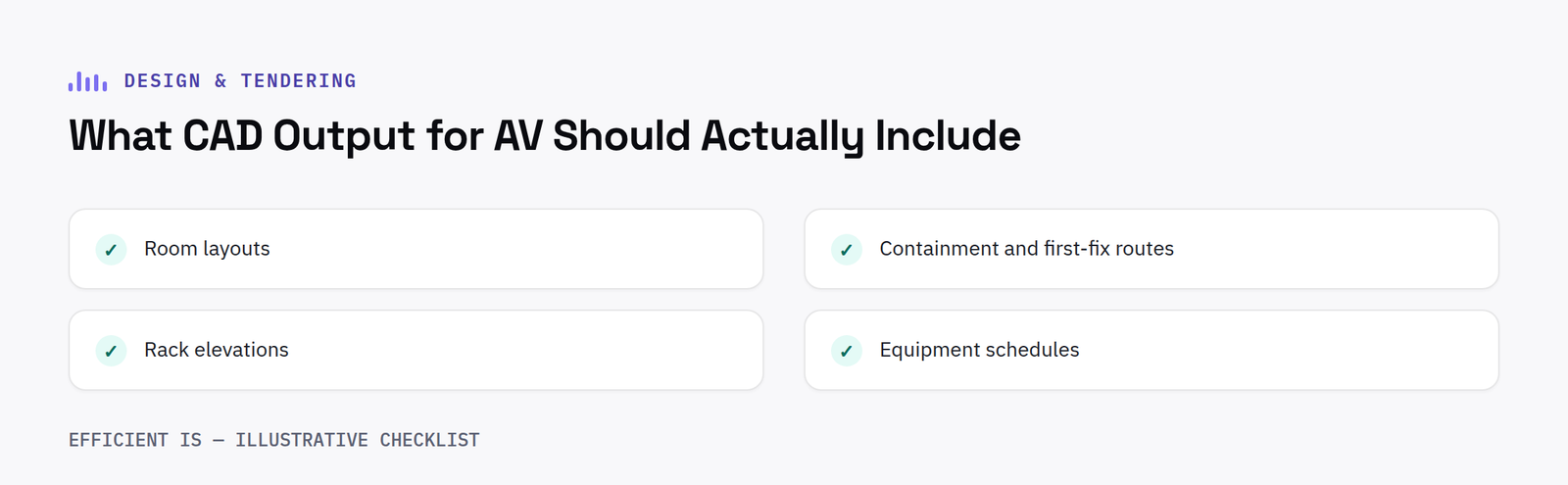
“AV drawings” gets used loosely. In practice, a competent AV design partner should be producing a defined set of documents, not a single diagram with some boxes on it. At minimum, that set should cover:

Room layouts. Plan views showing screen or display positions, camera and microphone placement, speaker locations, control panels, and any lectern or table-based connectivity points, drawn to scale against the actual room dimensions rather than a generic template.

Containment and first-fix routes. Cable routes from source to destination β€” first fix positions for conduit, tray, floor boxes and back boxes β€” issued early enough that the electrical and building services contractors can coordinate their own containment runs around them, not after walls are closed up.

Rack elevations. A drawn-to-scale layout of what sits in the AV rack or credenza, in what order, with rack unit heights, ventilation and cable management accounted for, so the space required is known before the joinery or comms room is finalised.

Equipment schedules. A room-by-room or line-item list of every piece of hardware, tied to the drawings by reference number, that a contractor can price against and an installer can check off during commissioning.

If any of these are missing, the drawings are not ready for tender or for construction β€” they are a concept, not a deliverable.

What “BIM-aligned” actually means for AV

BIM-aligned does not mean the AV designer owns the model. It means AV design elements β€” screens, cameras, rack enclosures, containment β€” are modelled or coordinated within the shared project model rather than added afterwards as an afterthought. In practice that means working in native CAD or BIM software that can exchange files with the architect’s and M&E consultant’s platforms, using consistent levels, grids and reference points, and being available to sit inside the same clash detection process as every other building services discipline.

Clash detection matters here in a very concrete way. AV containment competes for the same ceiling void, riser and wall cavity space as electrical, mechanical and data containment. Rack enclosures need floor space, ventilation clearance and power that has to be planned alongside everything else going into a comms room. If AV isn’t part of that coordination pass, clashes get found on site instead of on screen β€” which is a far more expensive place to find them.

Why drawings produced in isolation cause problems later

The most common failure mode is straightforward: an AV supplier is brought in after the architectural and M&E design is largely fixed, and produces AV drawings with no reference to what else is happening in that space. The results tend to follow a predictable pattern:

Containment routes clash with electrical or mechanical runs already fixed in the design, forcing rework or compromises that weaken the AV installation. Rooms get sized without anyone accounting for screen depth, rack footprint or the clearance needed around a video wall, so equipment that looked fine on paper doesn’t actually fit. Power and data provision gets specified generically rather than matched to what the AV equipment actually needs, leaving contractors to work out on site what should have been settled at design stage. None of this is because anyone did a bad job in isolation β€” it happens because AV was treated as an add-on rather than as a coordinated discipline from the start.

This is the core argument for bringing AV design in early rather than late β€” a point covered in more detail in our guide to specifying AV at the right RIBA stages, and in how we work as an AV design partner on our architects sector page.

What to ask a prospective AV design partner

Before appointing anyone to produce AV design drawings for a project with an architect, M&E consultant or main contractor involved, it’s worth confirming three things directly:

Do they produce native CAD or BIM output? Ask what software they design in and what file formats they can hand over. A PDF export of a drawing is not the same as a native file your design team can actually coordinate against.

Do they coordinate directly with the design team? Find out whether they will exchange files and revisions with your architect and M&E consultant as the design develops, or whether they expect to be handed a finished layout and work around it.

Will they attend design team meetings? An AV designer who turns up to coordination meetings can flag containment and space issues while they’re still cheap to fix. One who only communicates by email tends to surface problems later, when they’re expensive.

If the answer to any of these is vague, that’s a reasonable signal the drawings you’ll get won’t be ready to tender or build from without extra work on your side.

FAQ

What’s the difference between an AV layout drawing and a full AV design pack?

A layout drawing shows where equipment sits in a room. A full design pack adds containment and first-fix routes, rack elevations and an equipment schedule tied to the drawings β€” the set of documents a contractor actually needs to price and build from.

Does the AV designer need to use the same software as our architect?

Not necessarily the same software, but it needs to be able to exchange files in formats your architect and M&E consultant can bring into the shared model, so AV elements can be checked for clashes alongside everything else.

At what stage should AV drawings be produced?

As early as possible, ideally alongside the architectural and M&E design rather than after it’s fixed. Late AV drawings tend to be working around decisions that have already closed off options β€” see our guide to writing an AV tender brief for how to set a project up properly from the outset.

Efficient IS produces CAD and BIM-aligned AV drawings as part of our Design Consultation & Tender Management service, working alongside architects, M&E consultants and contractors from brief through to tender pack. If you’re planning a project and want to talk through what your AV drawings should include, get in touch.

How to Write an AV Tender Brief That Gets You Comparable Bids

A tender brief produces comparable bids when every bidder is pricing the same defined scope against the same drawings, the same evaluation criteria and the same deadline β€” anything less and you’re comparing three different guesses at what you meant, not three quotes for the same job. Fixing that is mostly a matter of discipline in how the brief is written, not a big technical undertaking.

Anyone who has opened three AV tender responses and found one at half the price of another has usually found a brief problem, not a market problem. The bidders aren’t being dishonest β€” they’re each pricing a different project, because the brief left room for that to happen.

Why vague briefs produce incomparable bids

A brief that says “AV system for the boardroom, video conferencing capable” gives three competent suppliers three legitimate but different answers. One prices a single display and a soundbar. Another prices dual screens, a ceiling microphone array and ceiling speakers. A third assumes adequate network provision already exists, while a fourth builds in a new data run because nothing told them otherwise. None of them has done anything wrong β€” each has made a reasonable interpretation of an under-specified requirement, and you’re now comparing four different systems as if they were the same one.

This is the single most common reason AV tenders come back looking chaotic. It isn’t that suppliers pad quotes or lowball to win β€” it’s that ambiguity in the brief gets resolved silently, bidder by bidder, and you only find out where each landed once the prices are in front of you. By then it’s too late to run a fair comparison without going back and asking everyone to re-quote, which costs time and irritates bidders who priced accurately the first time. The fix isn’t a longer brief. It’s one that closes off the specific places where bidders are currently allowed to guess.

What a genuinely comparable brief needs

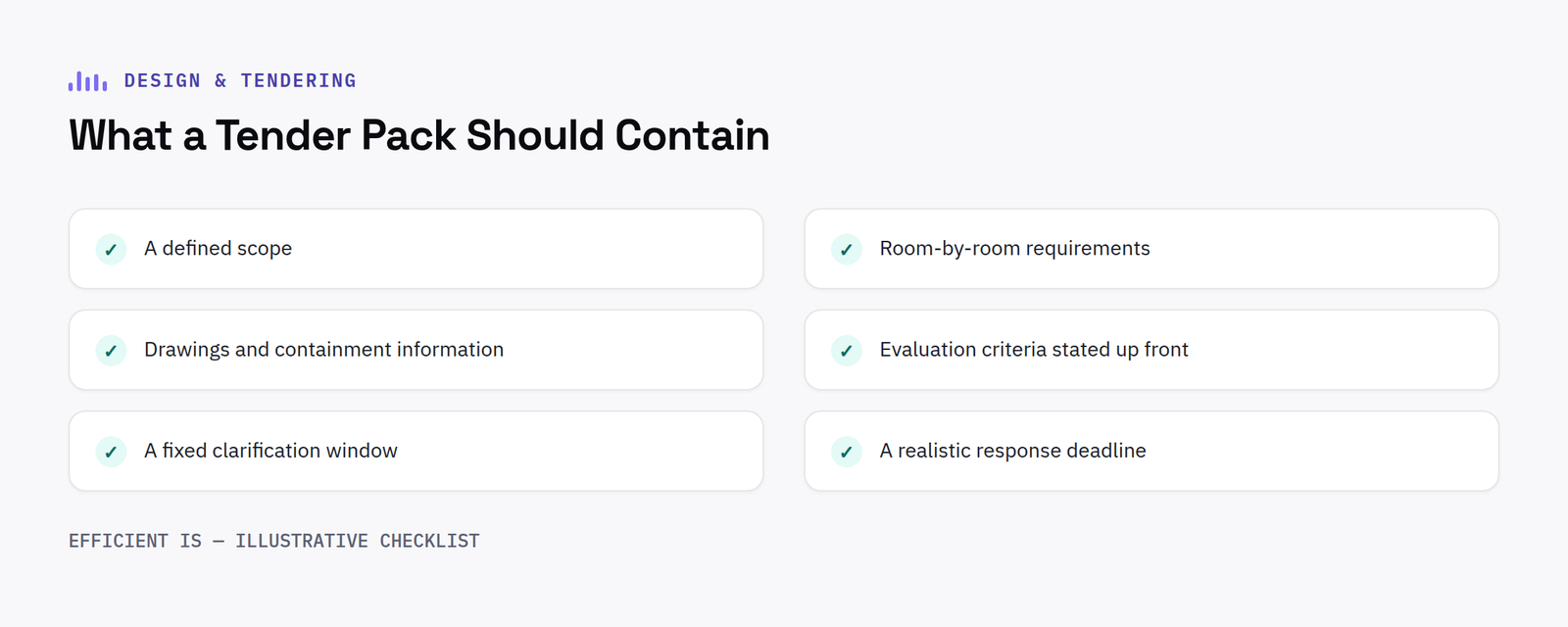
A defined scope. State plainly what is and isn’t included β€” which rooms, which systems, whether cabling and containment are in scope, whether existing equipment is being reused, and who is responsible for any builders’ work. If a bidder has to ask “does this include the room next door?”, the scope wasn’t defined.

Room-by-room requirements. A single paragraph covering an entire building rarely survives contact with reality. Break the requirement down by room or room type β€” number of participants, whether it needs video conferencing, which platform (Teams, Zoom, Webex or similar) it must run natively, and whether it’s a huddle space, boardroom or council chamber, each with different acoustic and control demands.

Drawings and containment information. Even a basic floor plan showing room dimensions, existing power and data points, and any known containment routes removes a huge amount of guesswork. Bidders without this either pad their price to cover the unknown or assume the best case and under-price it β€” neither gives a comparable figure. Our guide to what to expect from CAD and BIM-aligned AV drawings covers what a properly drawn design pack should contain.

Evaluation criteria stated up front. Tell bidders how the award decision will be made before they submit β€” the weighting between price and quality, what quality covers (experience, method statement, warranty terms, aftercare), and any pass/fail requirements such as accreditations. A bidder who doesn’t know how they’ll be scored can’t target their response at what matters to you, and you lose the ability to defend the outcome if challenged later.

A fixed clarification window. Set a specific period for bidders to submit questions, and circulate every question and answer to all bidders equally β€” never answer one privately. This keeps the process level and stops the brief being quietly rewritten mid-process for whoever asked first.

A realistic response deadline. A brief with two weeks to respond for a multi-room project with drawings to review will get rushed, corner-cutting responses, or no response at all from bidders who decide it isn’t worth the effort. Match the deadline to the actual complexity of the ask.

Specifying outcomes versus specifying products

One of the more common mistakes in AV briefs is confusing “what the room needs to do” with “which exact product to buy.” Both under- and over-specification cause problems, just in opposite directions.

Naming an exact model number for every item narrows the market to whichever bidders happen to source that product, and can read as a procurement red flag in a public sector process, since it looks like the brief was written around one preferred supplier rather than a genuine requirement. It also locks you into that product’s pricing and availability at the moment you wrote the brief, which may have changed by award.

Under-specifying has the opposite problem. “Suitable display and audio for video conferencing” gives a bidder every incentive to quote the cheapest hardware that technically meets that description, because nothing stops them. The gap between “meets the letter of the brief” and “meets what the room actually needs” is exactly where corner-cutting lives.

The workable middle ground is to specify outcomes with enough technical definition that quality can’t be quietly dropped: not “a display” but “a display of at least 75 inches viewable from the back row at the specified distance”; not “a microphone” but “microphone coverage rated for the room’s dimensions with a defined pickup range.” That gives every bidder the same performance target while leaving them free to propose the product that meets it β€” which is also where brand-agnostic bidders can compete genuinely on value rather than on who got named in the brief.

What a tender pack should contain

In practice, a complete AV tender pack that supports fair comparison should include: a written scope of works stating what’s included and excluded; room-by-room requirements framed as performance outcomes, not just a hardware list; floor plans or drawings showing dimensions and existing services; a statement of the evaluation criteria and weighting; a fixed timetable covering issue date, clarification window, submission deadline and expected award date; instructions on submission format so every bid can be compared side by side; and any site access or survey arrangements bidders need before pricing accurately. Missing any one of these tends to reappear later as a clarification question, a price disparity, or a bidder declining to respond.

FAQ

How much detail does an AV tender brief actually need?

Enough that a bidder never has to guess at scope, room requirements or how they’ll be scored. That doesn’t mean specifying exact products β€” it means being precise about outcomes, dimensions and what’s included.

Should a tender brief name specific AV brands or products?

Generally no. Naming exact models narrows the market to whoever can source that product and can look like the brief was written around a preferred supplier, which is a red flag in public sector procurement. Specify performance outcomes and let bidders propose the product that meets them.

How long should bidders get to respond to an AV tender?

Enough time to review drawings, ask clarification questions and price properly β€” this scales with complexity. A single meeting room might need a couple of weeks; a multi-room building with site visits needed will take longer. Rushing this stage produces rushed, lower-quality responses.

If you’d rather have this built for you, Efficient IS runs the full process β€” brief capture, CAD/BIM-aligned drawings, tender pack, evaluation support and appointment β€” through our Design Consultation & Tender Management service, either as independent technical advisor or as a bidder ourselves depending on which route suits your project (see our guide to blind versus open market tendering). We can also wrap in ongoing support and maintenance once a contractor is appointed, and for Scottish public sector bodies we’re an approved supplier on the Scotland Excel framework. To talk through a project, get in touch.

How Scottish Councils Can Procure AV Without Running a Full Tender

The Scotland Excel AV framework, explained in plain terms

Public sector procurement rules exist for good reasons, but running a full tender for a single AV project is often disproportionate to the job. That’s exactly what frameworks like Scotland Excel’s are for.

What a framework actually does

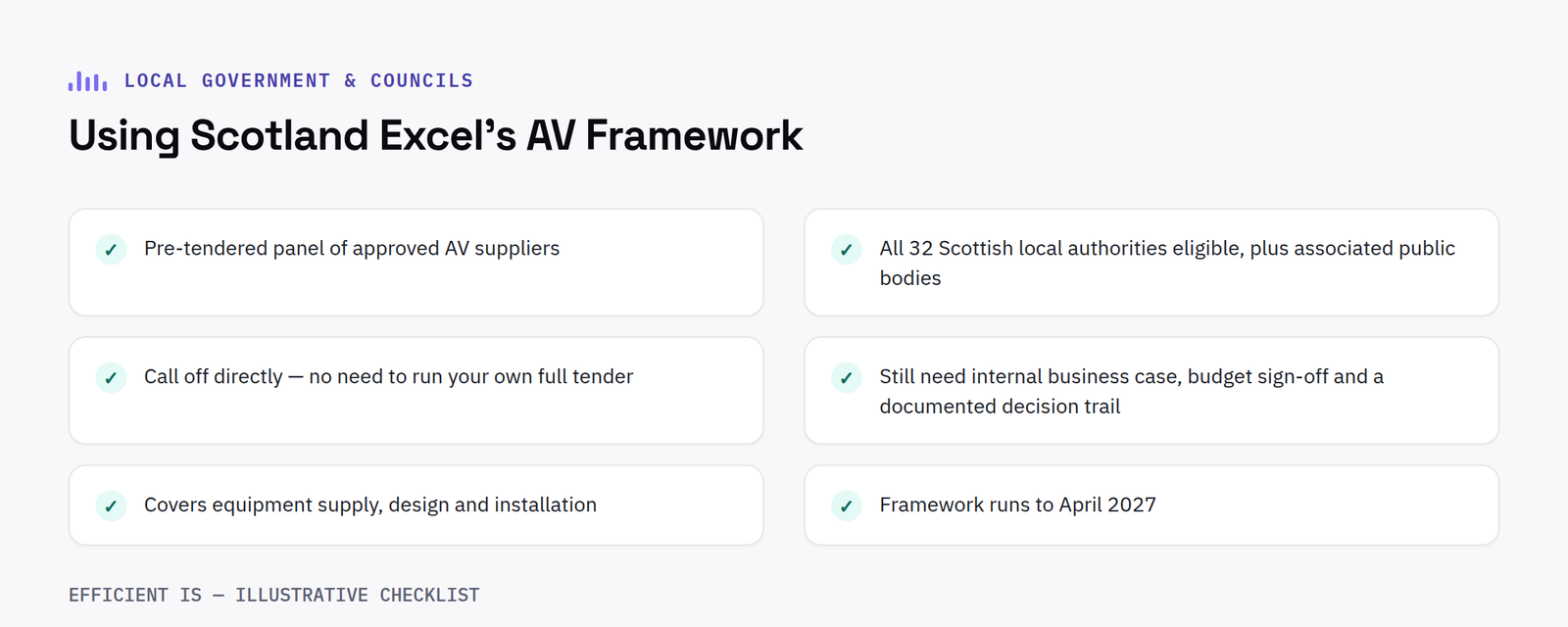
A framework is a pre-tendered panel of approved suppliers that public bodies can call off directly, without running their own full procurement exercise for every individual project. Scotland Excel’s Audio Visual framework covers design, supply and installation, and runs to April 2027, giving continuity for multi-year and phased projects.

Who can actually use it

All 32 Scottish local authorities are eligible, along with a range of associated public bodies β€” some NHS boards, further and higher education institutions and other organisations that qualify to use Scotland Excel frameworks. If you’re unsure whether your organisation qualifies, that’s worth confirming with Scotland Excel or your framework-approved supplier before scoping a project.

What it doesn’t do

A framework doesn’t remove the need for good internal governance β€” most public bodies still want a business case, budget sign-off and a documented decision trail for any significant spend. What it removes is the multi-month, resource-heavy process of running an OJEU/Find a Tender exercise from scratch for something a framework already covers.

The bottom line: If your organisation is eligible to use Scotland Excel, a framework call-off is almost always faster than a full tender for AV design, supply and installation β€” worth checking eligibility before defaulting to a full procurement exercise.
Questions worth asking

FAQ

What is the Scotland Excel Audio Visual framework?

A pre-tendered panel of approved AV suppliers that eligible Scottish public bodies can call off directly, covering equipment supply, design and installation, running to April 2027.

How do we start using the framework?

Contact a framework-approved supplier directly with your requirement β€” they’ll confirm the correct call-off route for your organisation’s procurement team.

Have a project in mind?

Tell us what you’re trying to fix and we’ll tell you honestly what’s realistic.

πŸ“ž 0845 095 3600  ·  βœ‰ av@efficient-is.co.uk

Book a discovery call

Find our work useful? Add us as a preferred source on Google.