What is Martyn’s Law? The plain-English version.
Martyn’s Law is the common name for the Terrorism (Protection of Premises) Act 2025, new legislation that will require certain public premises and events to be better prepared for a terrorist attack. Here’s what it actually says, without the legal drafting.
Where the name comes from
The Act is named after Martyn Hett, one of 22 people killed in the 2017 Manchester Arena bombing. His mother, Figen Murray OBE, spent more than five years campaigning for a law requiring venues to plan and train for a terrorist attack the way they already do for fire. That campaign became the Terrorism (Protection of Premises) Act 2025, which received Royal Assent on 3 April 2025.
It applies across the whole UK, England, Wales, Scotland and Northern Ireland.
What it actually requires
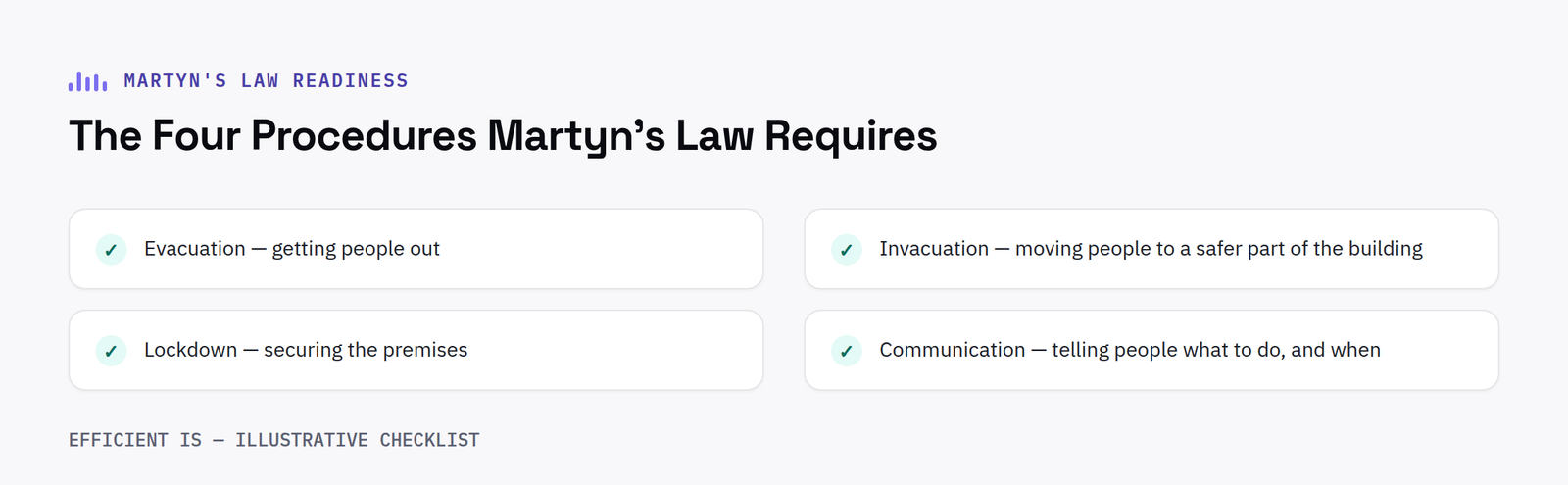
At its core, Martyn’s Law requires the person responsible for a qualifying premises or event to have working procedures for four things: evacuation (getting people out), invacuation (moving people to a safer part of the building rather than outside), lockdown (securing the premises), and communication (actually telling people what to do, and when).
Larger premises face additional requirements, physical and technical measures, a named senior individual responsible for compliance, and a formal compliance document held on file for the regulator. We cover exactly where that line sits in our follow-up post on who’s affected.
Who regulates it
The Security Industry Authority (SIA)already the regulator for the private security industry: is the regulator for Martyn’s Law. It will have powers to issue compliance notices, restriction notices and financial penalties once the Act is in force.
It isn’t enforceable yet
This is worth being precise about: the Act received Royal Assent in April 2025, but the substantive duties are not yet enforceable. There’s a statutory implementation period of at least 24 months, statutory guidance was published in April 2026, and the government has said the requirements are expected to come into force in Spring 2027. We go through the exact timeline in our timeline post.
The government has also been explicit that no third party can sell you “compliance”, the duty sits with your premises’ responsible person, and stays there. What a specialist like us can genuinely help with is the technology side: making sure your screens, speakers and network can actually deliver the communication half of the duty.
FAQ
Is Martyn’s Law in force yet?
No. It received Royal Assent on 3 April 2025, but the substantive duties aren’t enforceable yet. The government expects the requirements to come into force in Spring 2027, following a statutory implementation period of at least 24 months.
Who enforces Martyn’s Law?
The Security Industry Authority (SIA) is the regulator, with powers to issue compliance notices, restriction notices and financial penalties once the Act is in force.
Does Martyn’s Law apply in Scotland?
Yes, the Act’s territorial extent covers England, Wales, Scotland and Northern Ireland.
How this differs from existing fire safety obligations
Martyn’s Law sits alongside existing fire safety and health and safety obligations rather than replacing them. A premises already compliant with fire safety legislation still needs to separately address the four duty areas Martyn’s Law introduces, since they cover a different category of threat and require different procedures, even though some planning and staff training can reasonably be combined across both.
Have a project in mind?
Tell us what you’re trying to fix and we’ll tell you honestly what’s realistic.